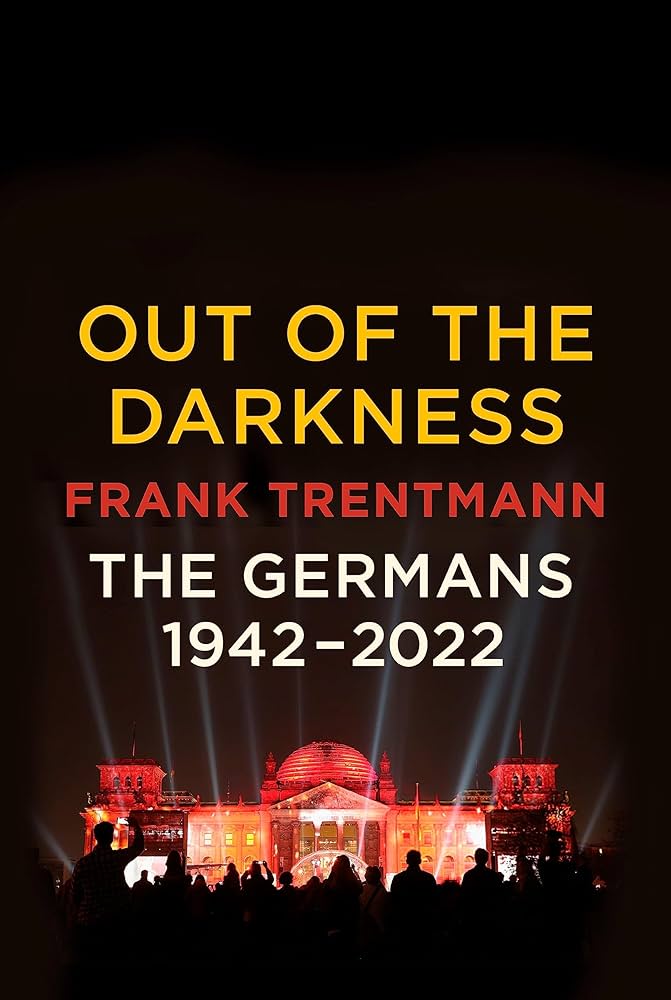
Trentmann, Frank. Out of the Darkness: The Germans, 1942-2022. New York: Alfred A. Knopf, 2023.
Completely unintentionally, my reading for 2024 happened to feature a number of books concerned with the physical and moral reconstruction of Germany in the second half of the twentieth century. Beginning, appropriately, with Harald Jähner’s account of the immediate aftermath of the Second World War, I found myself intrigued by the prospect of exploring the wider context and consequences of many of the themes Jähner explored so well in his more restricted focus. Enter Frank Trentmann’s Out of the Darkness. Upon seeing its stated scope, I was excited; starting during the war and ending in the present (as it stood at the time of publication, at least) seemed to indicate both broad and deep discussion of just how the German people transformed from brutal fascism to, in many ways, the moral leaders of 21st-century Europe.
Starting out, Trentmann fulfilled my initial hopes and more. Out of the Darkness is less a general history of Germany and more a history of the evolving moral and ethical worldviews of Germans over nearly a century. As such, by far the most fascinating material comes from the era in which, under the Nazis, the German people engaged in the genocidal, nationalist imperialism that sparked the Second World War. Not without some level of understanding, if not sympathy, Trentmann explores the worldview of a people who by and large had embraced the chauvinistic, egotistical navel-gazing of their fascist leaders. Far from the Holocaust and other atrocities being the responsibility of a small political elite, Out of the Darkness conclusively demonstrates how all Germans were on some level complicit in the dehumanization of their enemies and the prioritization of their own comfort and aggrandizement, from the massacre of civilians to the denial of Jewish humanity despite many individuals’ personal disapproval of just how far Hitler and his cronies pursued their “Final Solution.”
From this moral rock bottom, Trentmann conducts readers through the reconstruction and redemption of not only the German state(s) but the German moral compass following the Second World War, showing how conceptions of democracy, militarism, naturalism, consumerism, education, elder care, and other social issues developed and differed between West Germany, East Germany, and ultimately the reunited modern Federal Republic. These range from fascinating to simply curious details, and as Out of the Darkness proceeds through its narrative it undergoes its own evolution from engrossing to just an eclectic selection of interesting topics. The problem is that morality is such a pervasive subject that any work focusing on it should by rights explore every single element of life. Understandably, Trentmann makes decisions about what to discuss and what not to, but unfortunately does not enlighten the reader as to why he picked the topics he did. Disappointingly, certain key moments in the moral evolutions he does discuss are also elided or skipped over entirely; in particular, the turn from sweeping Nazism and participation in the Holocaust under the rug to a soul-searching mea culpa in the 1960s and ‘70s, led largely by the children of the war generation and compatriots of our own counterculture and “hippy” movements, is only tangentially referenced for that fact that it happened and never explored in the detail I had hoped it would be.
This is not to say that what Trentmann does cover isn’t worth reading; far from it! The initial sections concerning the Nazi regime and the aftermath of the Second World War remain what I would consider essential reading for anyone studying the twentieth century or modern world. My search for a comprehensive history of Germany’s evolution from the depths of fascist depravity to its current form, however, continues.