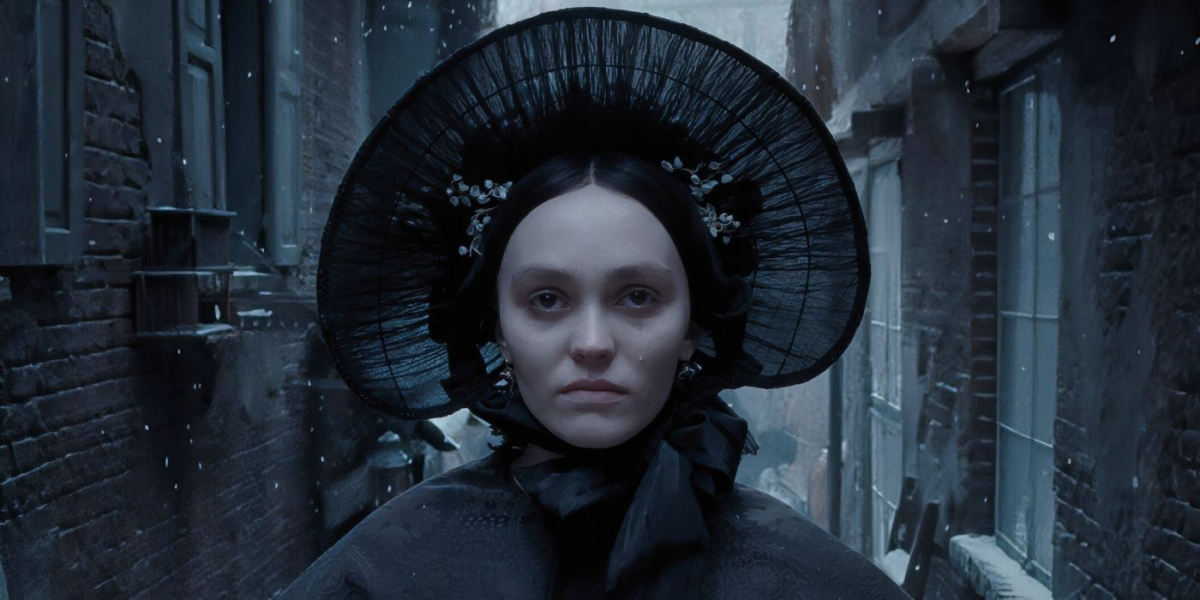
Robert Eggers’ 2024 film Nosferatu is a remake that honours the 1922 original and its legacy by staying true to its roots while making creative changes which serve to supplement the original film. As with his other films such as The Witch, The Lighthouse, and The Northman, Robert Eggers strives for historical accuracy in every aspect of this gothic horror production, including an adherence to the visual style of the German Expressionism in which the original film was made. This German Expressionist influence compliments Nosferatu’s choice of setting, which is in the year 1838 – this is a decade which does not appear onscreen often in terms of costume design, as it has a distinct aesthetic which sometimes appears odd by modern beauty and fashion standards. However, the 1830s were also firmly in the midst of the Romanticism movement in the arts, which lasted until the mid-1840s.
For the uninitiated, Romanticism placed great emphasis on the aesthetics of strong emotion, and many famous works of art, music, and literature originate from this period of history (i.e. Mary Shelley’s Frankenstein, “Liberty Leading the People” painting by Eugène Delacroix, “Nocturne in E-flat major, Op. 9, No. 2” by Frédéric Chopin). German Expressionist film, on the other hand, originated during the Weimar Republic in the 1920s and is where many classic horror movie tropes and themes, and indeed horror movies themselves, originate. German Expressionist film was born from the pushback of independent film makers who disliked the major trends of popular German film, which they considered lacking in terms of any emotional, psychological, or political depth. In response, those involved with this movement decided to place character psychology and political commentary at the centre of their productions. It is during this decade that the original Nosferatu by F.W. Murnau was made. The combination of German Expressionist interest in visual representation of character psychology through costume, set design, lighting, and makeup, paired with a story set in the era of Romanticism makes the original Nosferatu a unique and especially powerful work which stands as a cornerstone of the horror film genre to this day, and additionally is effectively the very first vampire movie. German Expressionist films were silent, as the technology did not yet exist for adding sound, and were all shot on soundstages as opposed to on location. This choice was made in order to allow for full control over the way the environments looked, with props and sets designed with abstracted proportions, perspective, and scale in order to serve as representations of the characters’ psychological and emotional state throughout the runtime of the film. Similarly, this same desire for full creative control was used in dramatic, high contrast lighting, with makeup and costumes which were also designed with character emotion and psychology in mind, as mentioned above.
Given all of this context then, Robert Eggers’ 2024 remake (while not as heavily abstract in its visuals as Murnau’s) is shot with a style reminiscent of the original film. Eggers uses high contrast, dramatic lighting and often makes unconventional framing choices with his shots and muted colour palette in order to create visual tension on screen. However, where is the line between historical accuracy to the 1830’s and creative liberty in this film? As mentioned above, the 1830s are not typically a decade one sees on film due to some of its less conventional fashions, but Eggers manages to retain the overall look and feel of this decade while making some changes which better represent the characters and stories. Eggers also makes the interesting choice to dress the characters in clothing which shares the same colour palette as their environments, resulting in a film that feels very muted and monotone, and that is evocative of a black and white film while still being in full colour.
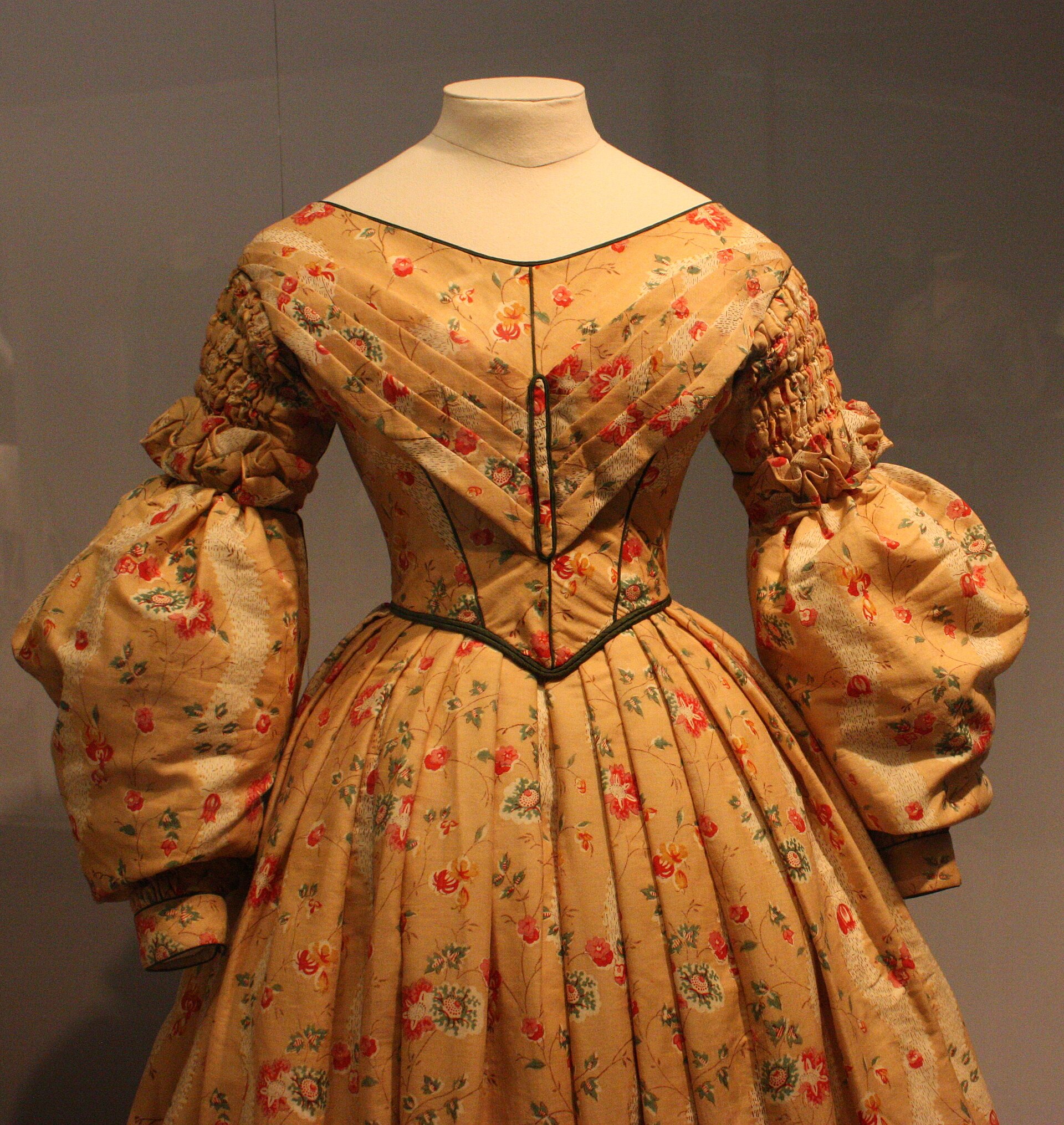
For further context, women’s 1830s fashion consisted of floor length dresses made in delicate floral prints over soft, light backgrounds. This era saw the introduction of new green dyes which were often used in patterns of grasses and ferns, with emphasis placed on florals, botanicals, and stripes which retained their popularity as well. Women’s clothing had very large sleeves that moved down the shoulder toward the elbow to fill out the space, with necklines that were wide, rounded, cut to sit off-the-shoulder, and included low narrow waists and very full conical shaped skirts. This overall silhouette was bulky both above and below the waist, and was intended to make the waist itself appear much smaller. Formal dresses were made using heavy, stiff fabrics like brocades and velvets, while cotton persisted as the main textile for day-wear.
True to 1830s fashion, Nosferatu’s protagonist Ellen wears gowns which closely resemble the silhouette appropriate to the decade, however there are details which differ from the source material. Examples of this are the large sleeves of her dress which are missing the padded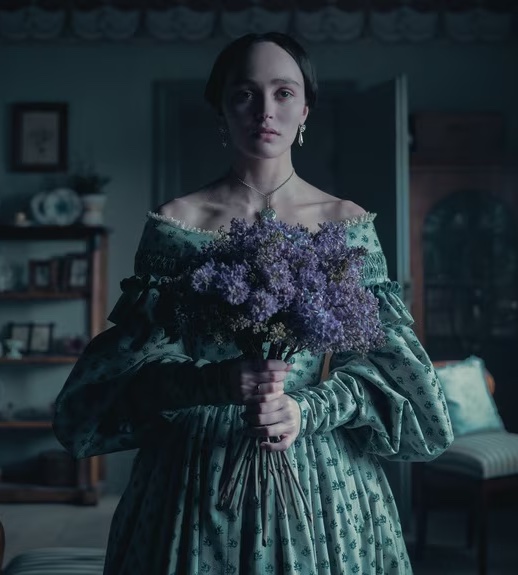 structure which would have allowed them to stay rounded and full (as seen in the image at right). Ellen’s skirt in the right image also appears to be missing under-structure such as a crinoline or petticoat, which would have allowed it to sit with the aforementioned conical shape that is common in the era. It is possible that these details may have been deliberate choices that were intended to speak to Ellen’s personality or emotional or mental state of mind, but this is speculation, especially as later in the film Ellen’s dresses do include an elliptical cage crinoline, and she wears large bonnets (which are consistent with the 1830s) and period accurate hair and makeup as well – details which are most commonly omitted from historical film and television productions. Regardless, throughout the film Ellen’s clothing becomes gradually darker in colour palette as well, which further speaks to the notion of clothing acting as a visual representation of character psychology, culminating in the all-black mourning gown she wears at the end. Interestingly, Ellen’s final costume of the film is an all-white wedding dress, possibly representing the end of her character’s arc and Ellen being at peace with her final heroic decision, especially as the tradition of white wedding dresses did not appear until Queen Victoria introduced the idea in 1840, two years after the film takes place. This is just one example of how the costumes within Nosferatu manage to serve as vehicles of visual storytelling for its characters, while still retaining an overall look and feel which is evocative of the 1830s. These creative decisions make Eggers’ 2024 remake a great tribute that honours Murnau’s original film, its legacy, and its German Expressionist roots.