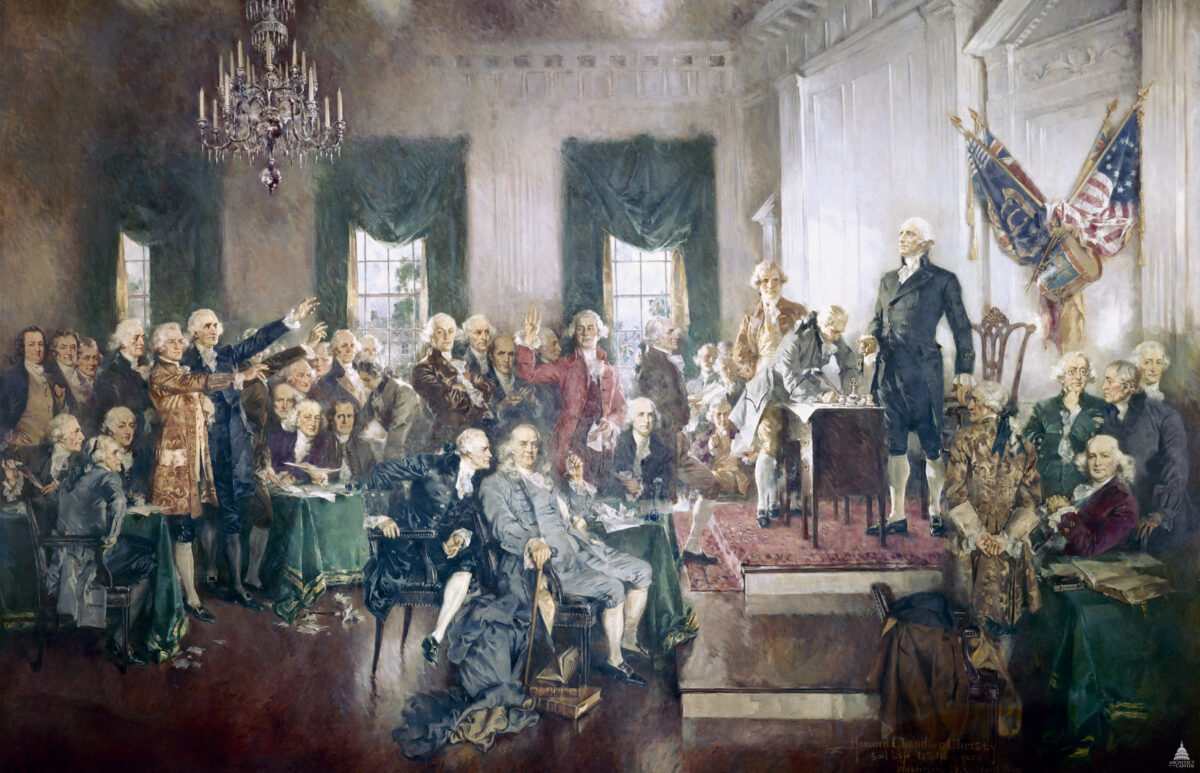
The classic song, “Won’t Get Fooled Again,” by the English Rock Band The Who includes these lyrics:
I’ll tip my hat to the new Constitution
Take a bow for the new revolution
Smile and grin at the change all around
Pick up my guitar and play
Just like yesterday
Then I’ll get on my knees and pray
We don’t get fooled again
Don’t get fooled again, no, no
Yeah
Meet the new boss
Same as the old boss
Their central meaning is that the revolution the song’s singers fought for did not actually result in anticipated change and now their new boss, under the new Constitution, is the same as the old boss, indicating they’ve been fooled and have resolved not to be duped again.
This song, while written in an entirely different place and context, often inspires me to think about the American Revolution and the real historiographical debates historians have about the extent to which the American Revolution did, in fact, change American society, culture, and politics. This question is more prescient than ever as the nation enters its 250th anniversary in 2026 (wherein memory may outweigh cold, hard history with its ever important and thorny facts).
This debate also begs the question of what actually defines a revolution. Historians like to use that term to define a myriad of disparate events, from the Neolithic Revolution to the Russian Revolution to the Scientific Revolution. Each of these have their own import, and the term benefits from some specificity beyond just “change.” Jack Goldstone, a political scientist at George Mason University, provided what I think is the best definition of a revolution in his appropriately named work, Revolutions, an entry in the Oxford University series A Very Short Introduction. Goldstone explains that a revolution is the violent and/or peaceful overthrow of an existing government through the mass mobilization of civic society in the name of social justice to create new political institutions. I like this definition because it specifies the type of revolution (a political one, fundamentally) and the various components historians can examine to determine if an event qualifies as such. Using this definition, for instance, a Jacobite Rebellion in Early Modern England would not qualify as a revolution since its aims were not to upend absolute monarchy whereas the Taiping Civil War in Qing China does qualify since those revolutionaries wanted to replace the existing Manchu-Confucian system of governance in China with their own syncretic Christian-Confucian one.
One reason I also like this definition is that it does not close debate about a revolution’s results, but rather opens new inquiries and questions. What qualifies as “social justice” in a revolutionary movement? How should historians assess if those criteria were enacted, implemented, or prioritized in the revolution’s aftermath? To what extent were the new political institutions different in their operation from the ones that came before? Did the people who fought the revolution, like the singers in The Who’s song, conclude the revolution was a failure? If so, why? If not, why not? The questions are endless.
The American Revolution lends itself to such debates and conversations. This very question, in fact, is what I ask my students to debate at the end of our first unit. Though historians never deal in absolutes and must bow to facts (it is impossible to argue the American Revolution did not lead to new political institutions), the American Revolution lends itself to such debate because of the complexities involved in it. Is it accurate to argue that colonial society experienced a mass mobilization that shifted from resistance to rebellion if nearly a third of all colonists resisted the Patriot cause and remained Loyalists, interpreting independence as a bridge too far? How should one account for the fact that the Revolution’s rhetoric of liberty, natural rights, and government by the consent of the governed clearly excluded the enslaved people within America’s colonial society? Or, does the reality that half of the new states in the fledgling U.S. abolished slavery (in some capacity, however conditional it was) in the aftermath of the Revolution on explicit ideological and ethical grounds indicate that those ideals really did have purchase and application broadly within a new, emerging American culture?
For my part, I think the most accurate conclusion is that the American Revolution was, indeed, revolutionary since each preexisting British colony abolished their royal charters and fashioned new constitutions to govern their states as republics. These new republics also enshrined a myriad of rights within their own Bills of Rights as a means to prevent future tyranny and enfranchised more of their new citizens than their colonial predecessors ever did. Moreover, it is readily apparent that the ideals of the revolution—consent from the governed, liberty from tyranny, equality before the law, the right to property, and natural rights to equality and life—inculcated American culture. Indentured servitude and apprenticeship disappeared in favor of free labor contracts, unburdening young men from years of stationary, largely uncompensated labor. Women began agitating for greater opportunity on the grounds that they were inherently equal. Enslaved people and free Black people petitioned state governments for freedom, enfranchisement, or other civil rights using arguments that echoed colonists’ petitions and complaints to Parliament in the 1760s or lifted wholesale the words of the Declaration of Independence. Even America’s new governing elites, such as Thomas Jefferson and George Washington, recognized the necessity and value of religious freedom and pushed their states and the nation to embrace religious pluralism and tolerance for evangelical Protestants and even Jewish people. These realities do not erase the glaring limitations of the revolution (Abigail Adams’ plea that her husband and Patriot lawmakers “Remember the Ladies!” was met with a droll joke in John’s reply), but indicates that a cultural and intellectual change met the emergence of new institutions. America was a different society from its colonial roots.
That said, there’s a fair critique of my analysis (one I hope my fellow contributors to Concerning History might take up over the next few months) which decidedly examines the transitory nature of some of the changes I mentioned above within the retrenchment that occurred to erase some social or cultural autonomy women, free Black people, farmers, or religious minorities had gained. Historians such as Rosemarie Zagarri have catalogued a backlash to revolutionary fervor that came to fruition with the triumph of Jeffersonian Republicanism in the early 1800s. Moreover, the explosion of the cotton industry, and the tragic expansion of slavery that came with it, paused the hoped-for-yet-little-pursued dream of the Founders that slavery would just disappear in time as the weight of a democratizing society and economic diversification transformed America. The question for debate, then, is whether the factors I mentioned made enough change in the name of social justice within a new national system of governance or that the unfinished revolution I find was rather one that had to be rekindled wholly by subsequent generations to reconstitute the United States with a new birth of freedom.