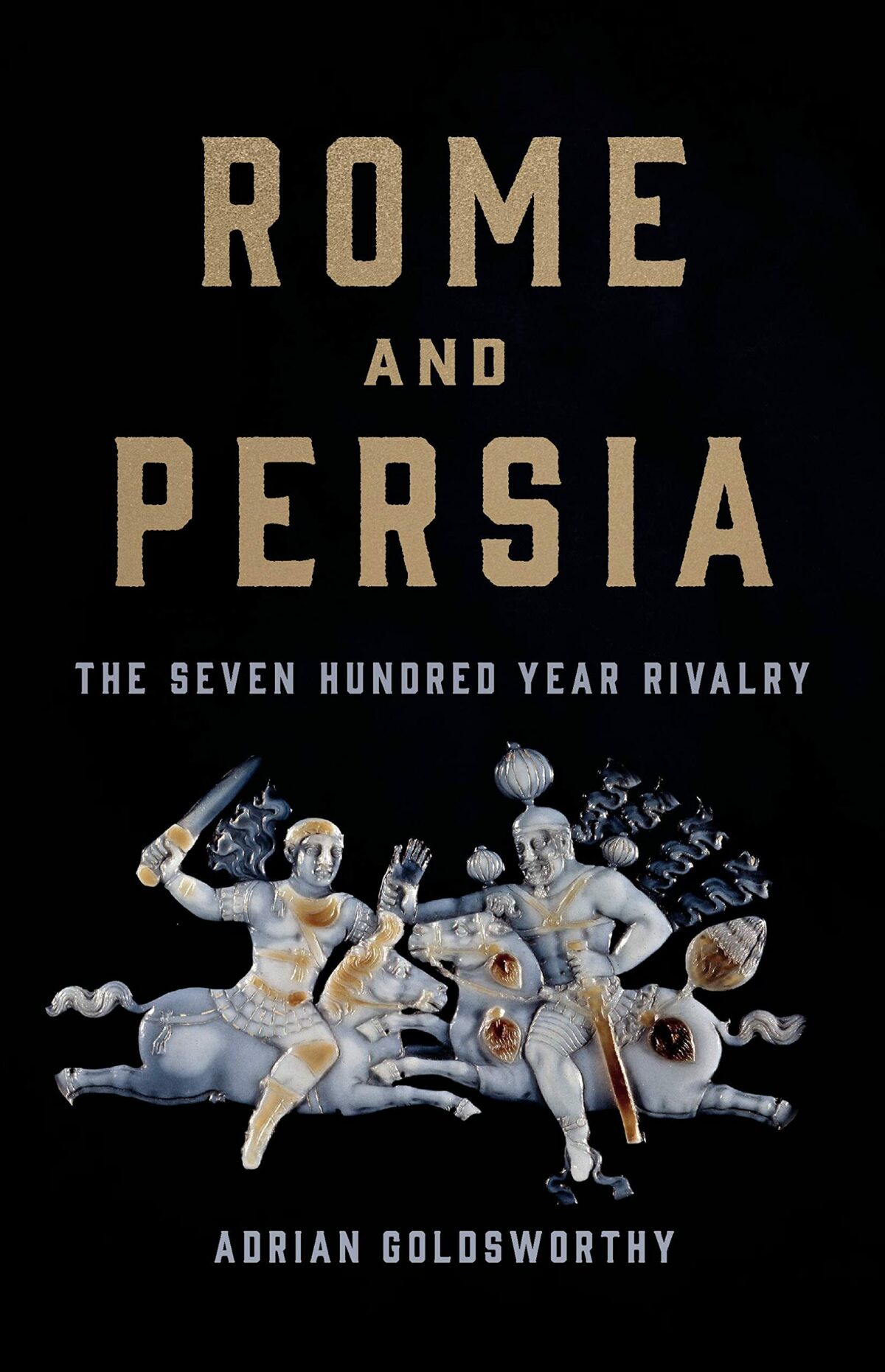
Goldsworthy, Adrian. Rome and Persia: The Seven Hundred Year Rivalry. New York: Basic Books, 2023.
Whether due to Europe’s more intimate relationship with the western half of the Roman Empire, our fascination with its fall, or some sense of more compelling motifs that lead to its portrayal in so much modern media like the original Gladiator, Rome’s conflicts with its “barbarian” neighbors along misty forest frontiers forms the overwhelming majority of our modern memory of that ancient empire’s foreign policy. The more works I read on Late Antiquity in general and Eastern Rome specifically, however, it has become glaringly apparent that these traditional topics are only half the story, and arguably the less important half. The richest provinces of the Empire always lay in the more developed and urbanized east, and only by considering the threat of Sassanian Persia from the third century AD can many subsequent developments in Roman politics and military deployment begin to make sense. When I discovered a monograph that focused exclusively on the centuries-long conflict that defined Rome’s eastern frontier, then, it was immediately added to my list.
Adrian Goldsworthy’s Rome and Persia charts the entire course of these two ancient superpowers’ rivalry from its very beginnings in late Republican Rome to its end seven centuries when the united Arab tribes under the banner of Islam destroyed Sassanid Persia and reduced the Eastern Roman Empire to a rump state. The work itself is rather unique; I can’t remember ever reading any Roman history able to track such a (relatively) narrow, defined political and military subject across such a broad period of time. The benefits are readily apparent. History is nothing if not the study of causality and change over time, and Goldsworthy masterfully uses his scope to demonstrate how Rome and Persia influenced each others’ development constructively and destructively, ultimately defining themselves by and against their opposite’s example in many ways. Rome and Persia is clear that from an overall imperial perspective, this was never an even contest—Roman resources, of every variety, dwarfed those of its eastern neighbor. Yet the nature of transport and communication in the ancient world meant that only a fraction of Rome’s might could be brought to bear in the Near East at any given time, even in the best of circumstances, and in many ways Goldsworthy’s narrative is really driven by an evolving but ever-present parity. Initially, that parity took the form of a sort of mutual incomprehension between Rome and the Persian Arsacid dynasty (more commonly known as the Parthians). The Parthian Arsacids’ steppe heritage led them to compose their armies nearly entirely of cavalry, whether lightly armed and mobile horse archers or heavily armored shock cavalry. A well-led and disciplined Parthian force was therefore extremely hard to pin down and defeat by Roman heavy infantry, yet conversely a well-led and disciplined Roman force was impervious to any Parthian assault, not to mention able to reduce enemy fortifications through an expertise in siegecraft that the Arsacids generally lacked. The first three centuries of the rivalry therefore settled into more of a wary, watchful peace periodically broken by periods of short-lived conflict. The Arsacids gained a handful of high-profile victories when poor Roman commanders led their armies to massacre, but they otherwise posed no real threat to Roman territory while Roman armies could essentially penetrate deep into the Parthian heartland at will.
A new paradigm appeared in the third century AD, not due to the overthrow of the Arsacids by the ethnically Persian Sassanid dynasty—Goldsworthy is clear, and persuasive, that the Arsacids should not be considered a distinct, less powerful state but simply a previous dynastic installment in a single empire that shows more continuity than break—but Rome’s descent into a century of civil war and resultant weakness at just the moment when the upstart Sassanid founders were looking to demonstrate their power and right to rule. While the original frontiers would be mostly restored by the beginning of the fourth century AD, Persian and Roman armies had largely converged in terms of composition, tactics, and siege ability. The decline and fall of the Western Roman Empire and increasing pressure on East Rome’s European frontiers further leveled the playing field, and the final two centuries of Rome and Persia’s rivalry would be defined by a mirror-image parity. When one power experienced civil strife, bad leadership, or other weakness, the other took advantage and vice versa, subtly shifting the frontier and influence over minor client states back and forth while, according to Goldsworthy, never changing the status quo in any meaningful way and even allowing for long periods of peace based on mutual respect as long as both played by the rules and accepted the basic fact of each others’ existence, never trying to gain too great an advantage. While other historians like Peter Heather argue that Rome was the first to break this unspoken agreement and provoked a Persian response, Goldsworthy blames the Sassanids; all agree, however, that the final war between the rivals was altogether different, as Persia nearly destroyed Rome before overstretching and nearly facing ruin itself. Thus exhausted, Rome and Persia would both prove easy prey for the forces that would emerge from Arabia less than a decade hence.
If Goldsworthy had just stopped there, I would have had scarcely any complaints. But in an unfortunate near-last second reversal, he feels the need to contend that, despite the hundreds of years spent throwing material and human resources at each other for essentially no gain, the long conflict between Rome and Persia really had nothing to do with their simultaneous collapse in the seventh century. It may be true that the costs of waging war and maintaining a permanently-hostile frontier do not seem to have placed any undue strain on either power’s treasury, but every pound of gold and human life with no return must be considered as wasted, unable to be spent building greater future strength. What’s more, Goldsworthy has the temerity to even downplay the significance of that final conflict that so weakened both states immediately before the rise of Islam and Arab unification, saying that “usually it is wiser to ask why a side won rather than why its opponents lost.” On the contrary, both questions are equally valid in the abstract, and each particular situation results in a different balance of importance between the two. To say that a war that lasted for twenty-six years and saw the devastation and conquest of nearly the entirety of both empires at one time or another did not play a major, if not deciding, role in their fall to an external invader only four years later is utter nonsense.
I thus unfortunately cannot offer a full throated recommendation of Rome and Persia, but as my main point of contention occurs almost entirely within the book’s conclusion, I remain mostly positive towards the bulk of Goldsworthy’s narrative. I would love to see more segmented histories in this style of other Roman frontiers or provinces, largely divorcing them from the history of the Empire as a whole in order to better illuminate that nuances of their particular development. If you can look past the odd conclusion, this one at least is a worthy addition to any ancient historian’s collection.