by Bryan & Heather
No one in 2025 has any right to complain about a lack of media set during the Second World War. Whether through documentaries or period dramas or even the occasional (black) comedy, the tragedies and triumphs of this conflict provide endless material for creatives. While much of that vast flood is of mediocre quality, there are still enough gems for us to keep trying new ones (at least to us) that intrigue us. One such came across Heather’s Netflix recommendations not long ago, and its promise of a human story of hope amidst oppression and deprivation told through multiple points of view was both interesting and felt more relevant than we’d like.
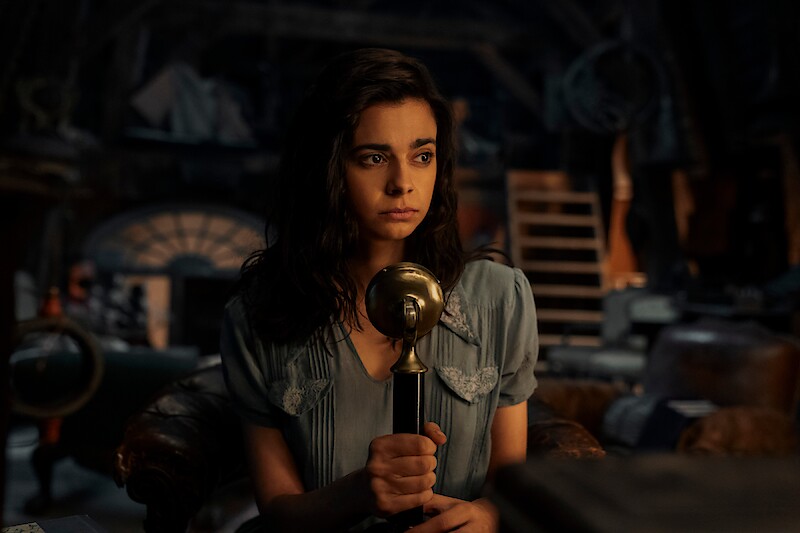
Netflix’s four-part miniseries All the Light We Cannot See, based on the 2014 novel of the same name by Anthony Doerr, takes place in the occupied French port of Saint-Malo in the days leading up to its liberation by American forces in August of 1944. As the town’s residents and occupying German forces endure near-constant bombardment by Allied aircraft and, eventually, artillery, a young blind girl named Marie broadcasts unauthorized messages of hope, comfort, and longing for her missing family over the radio in her uncle’s attic. Softhearted German radio operator Werner, tasked with hunting down illegal transmissions listens in, is more interested in finding and protecting the mysterious young woman who broadcasts on the same shortwave frequency over which he and his sister would listen to a kindly old professor speak of science and the wonders of the world when they were young. All the while, a sinister SS officer hunts down a blind girl and the invaluable, cursed gem he believes she hides, even as the entire town denies her existence.
As with many modern period pieces, All the Light We Cannot See is concerned more with the human story of its characters than with the specific details of the history which it involves, but that does not mean it’s historically vapid. The costuming is quite good, and the experience of an occupied city under siege and night bombing rings quite true (even if, for narrative reasons, characters seldom actually use bomb shelters). It is slowly revealed that Marie’s messages are not simply supportive; they are delivered under the instructions of her uncle Etienne (Hugh Laurie), a member of the local Resistance, and contain coded information instructing the Allies on the locations of their targets. Through Etienne, the show also explores both the participation of the war generations of the First World War in the Second (a reality of the period that should receive more explicit narrative exposure than it does in these dramas) and the psychological impact of war on soldiers—Etienne is so affected by his own trauma that only the combination of Marie’s youthful earnestness and the dire existential need to fight the Germans get him to leave his house for the first time in decades. The show even playfully subverts gender expectations, revealing that the local Resistance cell is in fact led primarily by the town’s elderly women, their coordination hidden under the cover of afternoon social gatherings.
What criticisms we did have stemmed more from narrative convenience and dialogue than historical accuracy. Not having read the source material, we cannot say whether anything was lost in adaptation, but as the story progresses, the characters take on a Victor Hugo-level of happy coincidence. Etienne of course turns out to be the Professor that so enchanted young Marie and Werner, every character happens to be right where they need to be with little prior explanation, and rescues always occur in the nick of time-–more than once as a result of a perfectly-falling pile of masonry or other explosive effect. Many of the lines also feel obviously florid and literary, such that we were reasonably certain it was based on a book before checking to make sure. The one convention that did somewhat raise our historical eyebrows was the choice to not even try for French accents or shift from French into English; while all the Germans in the show had German accents, all French characters spoke British-accented English without exception. Not a major flaw, certainly, but one that did slightly break what was otherwise admirable immersion in the world of war-torn Brittany.
By the time we finished the final episode, we agreed that the best description of All the Light We Cannot See was that it was competent. It offers nothing particularly groundbreaking in terms of story or its historical content, and at times can be a bit too artsy or convenient for its own good, but overall we had no major complaints. One can find far worse out there, and for those who enjoy (or perhaps appreciate is the better word) seeing the Second World War brought to fictional life, it’s well worth a watch.