Ridley Scott’s 2000 film Gladiator has received more than a few mentions here on Concerning History throughout the years. It is certainly high on the list of films most likely to be found on historians’ lists of guilty pleasure movies, for while its storytelling never fails to inspire and the broad scope of its events can somewhat fit into the historical record, the details and presentation of the lives of Maximus Decimus Meridius and the Emperor Commodus are not all that accurate, after all. Unsurprisingly, given the movie’s success, a sequel was discussed as early as 2001, but the death of Russel Crowe’s main character left a nigh-insurmountable obstacle, such that the only real idea to get close to production apparently involved the gods sending Maximus back from the afterlife to fight through all the wars of human history up to the present (yikes). This being the age of nostalgia IP content, however, it wasn’t that much of a surprise when we did finally get a sequel, from Ridley Scott himself no less, almost a quarter century after the original. I was dubious enough about this new film’s quality that I didn’t feel the need to rush out and see it in theaters, but knew that once it hit streaming I’d get around to it. That time has, at last, arrived.
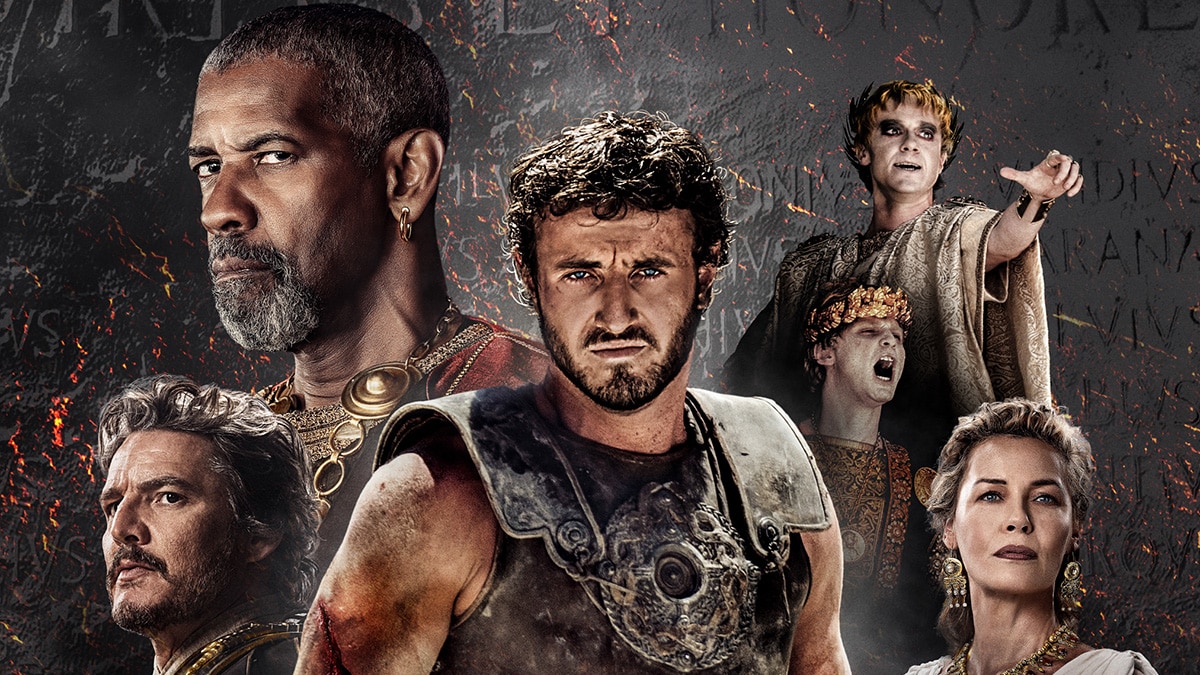
Gladiator II opens “sixteen years after the death of Marcus Aurelius,” according to its opening text. Though its predecessor had ended with Maximus’ dying exhortation for Rome to be returned to the people (and the Republic restored, presumably), according to Marcus Aurelius’s wishes, what would have been this ahistorical, fantastical outcome apparently did not happen. Rome is now ruled by the “twin” emperors Geta and Caracalla, and continues to expand around the Mediterranean. A young man named Hanno (Paul Mescal) and his wife Arishat prepare to defend their city in Numidia from an approaching Roman fleet, but in the ensuing battle Arishat is killed, the city taken, and Hanno and other survivors are taken to Rome as slaves. Hanno becomes a gladiator, and is soon revealed to be Lucius Verus, son of Marcus Aurelius’s daughter Lucilla (Connie Niellson) and, as it turns out, Maximus Decimus Meridius. Lucilla’s husband Acacius (Pedra Pascal) turns out to be the general behind the conquest of Numidia, and while Lucius at first seeks revenge, he later relents and attempts to defend his mother and restore Aurelius’s Dream of Rome after the gladiator handler Macrinus (Denzell Washington) exposes her plot against the emperors and attempts to bring down Rome himself. While he fails at the former, he largely succeeds at the later, killing Macrinus in sight of both the Praetorian Guard and Acacius’ legion before then uniting both to restore and safeguard the Republic.
The problems, however, start from the film’s very beginning. It is supposedly set sixteen years after the death of Marcus Aurelius. As Aurelius died in AD 180, this would mean the film opens in AD 196—but the text actually says AD 200, which seems a needless error as the year has nothing to do with the overall plot. Compounding this issue, Geta and Caracalla would not reign for another decade; their father Septimius Severus would have been ruling in either 196 or 200. Geta and Caracalla were also not twins, and the older Caracalla ruled jointly with his father before then ruling jointly with his younger brother after Severus’s death in 211. Caracalla would have been the senior emperor, then, not the junior as in the film, and while he did indeed have Geta murdered soon afterwards, he did not himself die for another six years, in which time he instituted one of the most significant changes in Roman history, the “Caracallan Threshold,” wherein all inhabitants of the Empire were declared to possess Roman citizenship. Caracalla’s murderer and short-lived successor, Macrinus, is indeed historical, even to the point of being of Berber descent and the first emperor who did not come from the Senatorial class, but he was most certainly not a former slave, and he was also the first emperor to never set foot in Rome during his reign. To top it all off, Lucius is treated as if being the last descendent of the “royal blood” of Marcus Aurelius would have meant something in Roman politics, especially after the last emperor of that dynasty was a generation dead. Here, Washington’s Macrinus has the right of it: only the loyalty of the legions and the power that brought governed who could become emperor of Rome.
Outside the details of Roman dynastic politics, Gladiator II is still a historical mess. The framing of Acacius’s conquest of Numidia heavily implies that the region is a new addition to Rome, yet Numidia had been absorbed into the Empire in the 40s BC and had been heavily Romanized in the following two centuries. And of course, the Numidian leader is here named Jugurtha, which was indeed the name of its most famous king who fought the Romans—from 109 to 104 BC. Even little details are wide of the mark. Geta hinting that Caracalla has syphilis is over a millennium too early (the first reported cases of syphilis in European history were in 1494, and the disease likely originated in the Americas and came over to the Old World through the nascent Columbian Exchange), and the care and transport necessary to fill a flooded Coliseum with sharks for a naumacchia (mock naval battle) is unlikely to the point of impossibility.
That is not to say that Gladiator II is totally devoid of any historical joy; naumacchia were indeed conducted in the Colosseum, and the naval tactic of sweeping an opponent’s oars that Lucius employs was a real and devastating one, not least for the storm of deadly splinters that resulted and that the film portrays with chilling, bloody accuracy. It is also nice to see Geta and Caracalla on screen at all, as I don’t believe they’ve ever been depicted in film. For third-century Rome to even be the subject of a period piece is remarkable, yet here I do feel like I’m reaching, and the movie itself really isn’t good enough to warrant it. Aside from just ignoring the ending of the original (and never actually explaining what happened to thwart Maximus’ dying order), Gladiator II just feels empty of all the pathos and compelling storytelling of its predecessor—in other words, of all that might help one overlook such bad history. It tries to play all the greatest hits, sometimes to the point of incomprehension (“Strength and Honor” was the motto of Maximus’s legion, not his personal creed), but without any real heart or stakes, and just winds up in the same ahistorical (yet tellingly not yet fulfilled) place. While it’s nice eye candy of the ancient world, I almost think a time-traveling Roman general would have been better.