by Bryan & Heather
The Gilded Age seems to be an increasingly popular setting for period pieces in the last couple years, spearheaded by, well, HBO’s The Gilded Age. We weren’t surprised by the announcement of a new Netflix miniseries set in the 1880s, then. Upon learning the specific story, though, Bryan’s ears perked up. Centered on the assassination of a mostly-forgotten president and his equally forgotten assassin, this show sounded eerily similar to Candice Millard’s book on James Garfield entitled Destiny of the Republic, which had made waves in the popular history community about a decade ago. It could certainly have been a coincidence, but Bryan hoped this new show would be a dramatic adaptation of Millard’s nonfiction account—and so it would prove, to our delight.
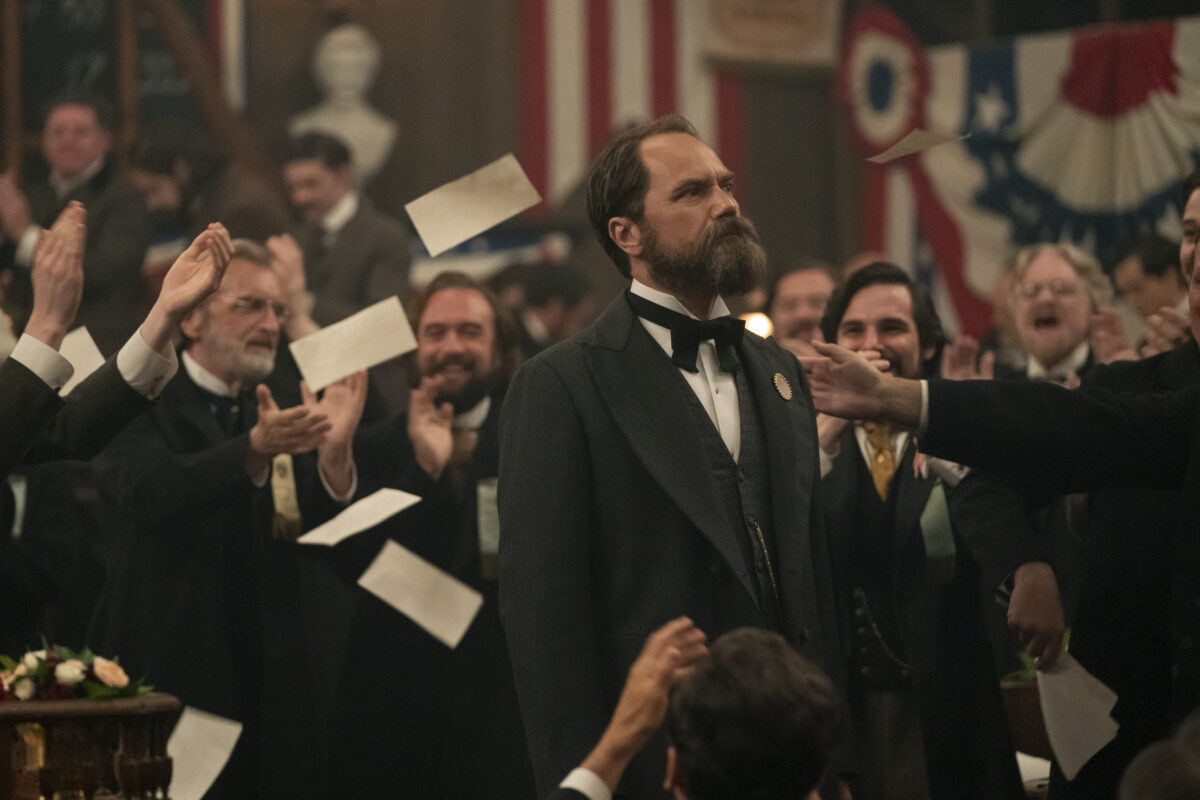
Death by Lightning is at its heart a story about three people. James A. Garfield (Michael Shannon), veteran of the Civil War and one-time US Congressman, opens the show on his Ohio farm, living close to an idyllic life of honest labor with the rest of his family. When called upon to nominate Senator John Sherman for president at the 1880 Republican National Convention in Chicago, however, Garfield’s impassioned speech against the corruption of the patronage spoils system and dirty deal making of his own party results in his own nomination. Initially unwilling to accept, Garfield eventually decides to take this opportunity to actually build a government composed of the best people for the job rather than simply creating a money making scheme for his cronies. The party cannot lose the support of that corrupt New York machine, though, and so his running mate becomes Chester A. Arthur (Nick Offerman), a former lawyer and current thug. While Arthur is initially a thorn in Garfield’s side, the President’s integrity ultimately leads Arthur down a different path. All the while, against the backdrop of these high politics lurks the figure of Charles Guiteau (Matthew MacFadyen), a manic, perennially down-on-his-luck delusional narcissist who steals from any who show him kindness and thinks he can weasel his way into the good graces of the Garfield campaign and thus gain a job through the spoils system, not realizing that he is both thoroughly unqualified and contrary to the animus of his chosen candidate. When he finally realizes the administration has no intention of ever offering him a position, he unleashes self-righteous fury by shooting Garfield not yet three months into the President’s term. The bullet miraculously misses all vital organs and does not prove fatal—but the actions of Garfield’s doctor, arrogantly dismissive of the new “germ theory” being discussed in Europe at the time, probes the wound with unsanitized instruments, including his own fingers, and sparks a raging infection that eventually claims Garfield’s life.
Readers of the Destiny of the Republic might notice a striking difference between the show and the book in the above description. Millard’s work is primarily focused on events after Garfield is shot on the platform of the Baltimore and Potomac Railroad Station, detailing the competing schools of medical knowledge, fruitless efforts to locate the bullet, and even the invention of new devices to assist the ailing President by some of the leading minds of the age, including Thomas Edison. The political backdrop of Garfield’s presidential campaign and policies once in office form an important backdrop to these events, but rarely more than a backdrop. Death by Lightning, on the other hand, inverts that balance. The vast majority of the miniseries actually focuses on Garfield’s road to the White House and clashes with the New York political machine. Guiteau’s story is laced throughout, but the shooting, convalescence, and death are confined to less than half of the final episode. It was jarring to Bryan at first, as he expected a different kind of show, but it does make some amount of sense. Much of what Millard covers would not necessarily make for good drama on screen, while the battle for the soul of the Republican Party is just the sort of backbiting intrigue that modern period pieces thrive on.
Stepping beyond adaptation, Death by Lightning turned out to be one of the more delightful historically-set shows we’ve watched in a long while. All the performances are fantastic, and familiar faces lurk everywhere even beyond the three major players. Material culture and setting are mostly accurate, though every once and a while a hairstyle or body type might not be strictly up to late 19th century beauty standards. We also applauded the decision to go for accurate facial hair for all the men (as opposed to the laughably beardless Edwin Stanton in 2024’s Manhunt), and some of them are truly spectacular. Only two inaccuracies really jumped out at us: the portrayal of the Oneida, New York “free love” commune (of which Guiteau was briefly a member) was too anachronistically sexual and sensational, and Thomas Edison was inexplicably replaced by Alexander Graham Bell in the efforts to assist the ailing Garfield. We did note that some of the dialogue felt too modern at times, as well, but on the whole we gave that a pass, both for accessibility and because it resulted in some of the more sharp, witty, and downright funny scenes we’ve watched in recent memory.
Despite its (largely superficial) differences with Millard’s original source material, we cannot recommend Death by Lightning enough. It can get a bit maudlin and meta at times, really steering into it’s “forgotten men” premise (it’s not just you, Garfield, America has largely forgotten all the Gilded Age presidents), but at others it really shines as what a period piece about seemingly-boring material can be. It can even serve as a prequel of sorts to The Gilded Age, ending only a few months before the first season of the latter show begins. For anyone interested in 19th-century America, the history of American politics, or just good television, Death by Lightning is a must-watch.