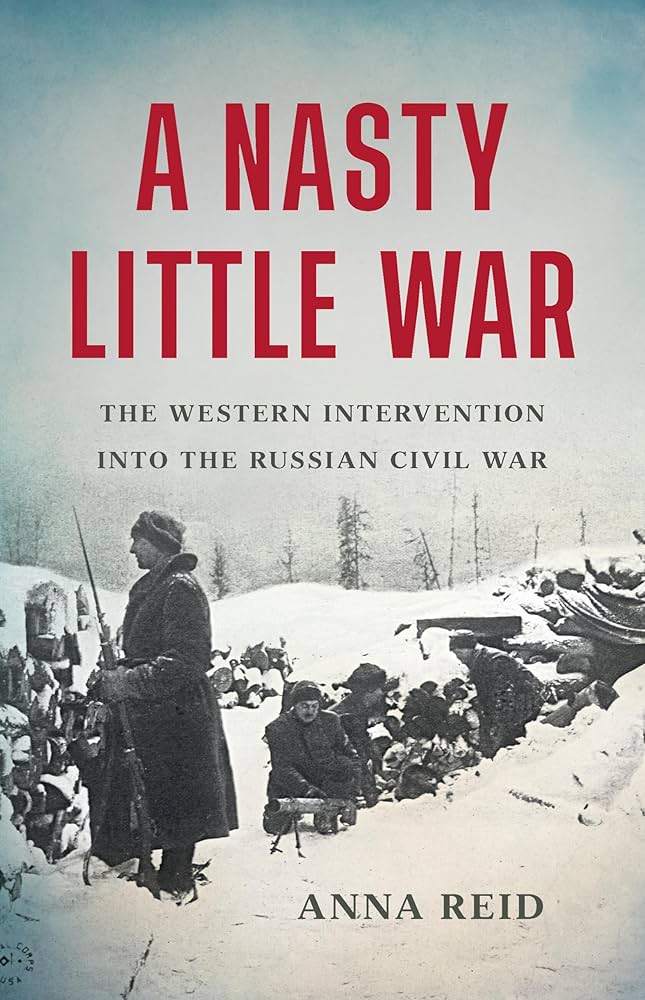
Reid, Anna. A Nasty Little War: The Western Intervention into the Russian Civil War. New York: Basic Books, 2023.
It’s hard to think of any event that exceeds the Russian Revolution for both impact on the course of the 20th century and sheer contingent possibility. From the overthrow of the tsar in 1917 to the final consolidation of Communist rule in 1922 (not to mention the accession of Stalin two years later), outcomes as various as a socialist democratic republic, a conservative oligarchy, a reactionary dictatorship, or a different flavor of Communist state were all somewhat possible, as was the dissolution of the former Russian Empire into various nation states on the model of what would eventually happen with the fall of the Soviet Union. All these ends hung in the balance for five years as Russia tore itself apart in a quagmire and humanitarian tragedy of epic proportions. Last year I had the pleasure of reading Laura Engelstein’s magnificent political history of these events, but one key element of my interest was only obliquely mentioned in those pages: the role of the Allied powers and their attempted intervention. I had first learned of those efforts and what would become essentially a late sideshow of the First World War in undergrad, and I’ve wanted to learn more for a long while. Was there ever actually a chance of the capitalist West influencing Russia away from Communism? Or was this all a futile misadventure that should never have happened in the first place?
From its opening pages, Anna Reid’s A Nasty Little War makes clear that the answer is emphatically the latter. What would ultimately become a sprawling effort involving five world powers (Britain, France, Japan, the United States, and Germany) spread across the Baltic, Scandinavia, Arctic Russia, and the Ukraine and general northern Black Sea coast actually began as a limited effort to secure war materiel from falling into enemy hands. Despite the Russian provisional government’s promises to continue prosecuting the First World War, the country’s descent into chaos immediately worried the Allies. Massive dumps of supplies and equipment remained in Russian hands, and if the state pursued a separate peace with Germany (as would ultimately happen later that year), all of it might be seized by the Central powers and turned against its former owners. Reid meticulously documents how the initial dispatch of British troops to the ports of Murmansk in the north and Vladivostok in the east immediately after the Treaty of Brest-Litovsk slowly but surely fell victim to mission creep as Britain and her allies attempted to safeguard their own nationals, deny strategic resources (Azerbaijani oil fields, most notably) to the enemy, and pursue their own territorial aggrandizement.
As the Allies found themselves increasingly drawn into the Russian mire, it was remarkable how familiar this intervention seemed to my twenty-first century eyes. What had originally been a measured expedition to accomplish very specific objectives morphed into something unrecognizable as politicians at home couldn’t help but dream of influencing geopolitics and securing a stable, powerful international ally—yet at the same time ignoring intelligence reports that such an effort would require manpower and materiel on an exponentially greater scale than those politicians wanted to commit. Meanwhile, commanders on the ground proved unable or unwilling to accurately assess the competence of local leaders and their men, leading to massive corruption, misallocation of supplies, vital tasks being taken over by Allied troops, and even complicity in war crimes against civilian populations. When the war weariness of both the public at home and soldiers at the front compelled the winding down of responsibilities and ultimate withdrawal, local forces would then prove so unable to meet the demands of shouldering full responsibility that they would collapse almost immediately. Seeing this paradigm, which I had only previously recognized from all too many conflicts of the late twentieth and early twenty-first century, play out almost to the letter in the aftermath of the First World War was a revelation, and strongly indicates that the pattern of Vietnam, Afghanistan, and Iraq has deeper roots in modern Western warfare than we might think. It is a shame that Reid does not comment on any of this, and confines her discussion of historical impact to only more immediate events of the interwar period—though these, too, offer critical insights, not least of which is that this whole disastrous scheme being the brainchild of Winston Churchill so soon after the failure of Gallipoli in 1915 gave credence to all those who doubted his (perhaps unusually, given that evidence) correct read on Hitler and Germany in the 1930s.
A Nasty Little War, then, delivers on exactly what its title promises: the story of an unpleasant, ill-advised intervention that rapidly got out of hand and left few of those involved with clean hands. It is a fascinating piece of little-known history, and while it cannot serve as a comprehensive account of the Russian Civil War in general, it is certainly an outstanding supplement to one. It’s rare to find a work of history that so fluidly engages with the recent scholarly trend of illuminating the chaos immediately following the Great War while also being so directly relevant to more recent events, and I highly recommend it to any interested in the long twentieth century.