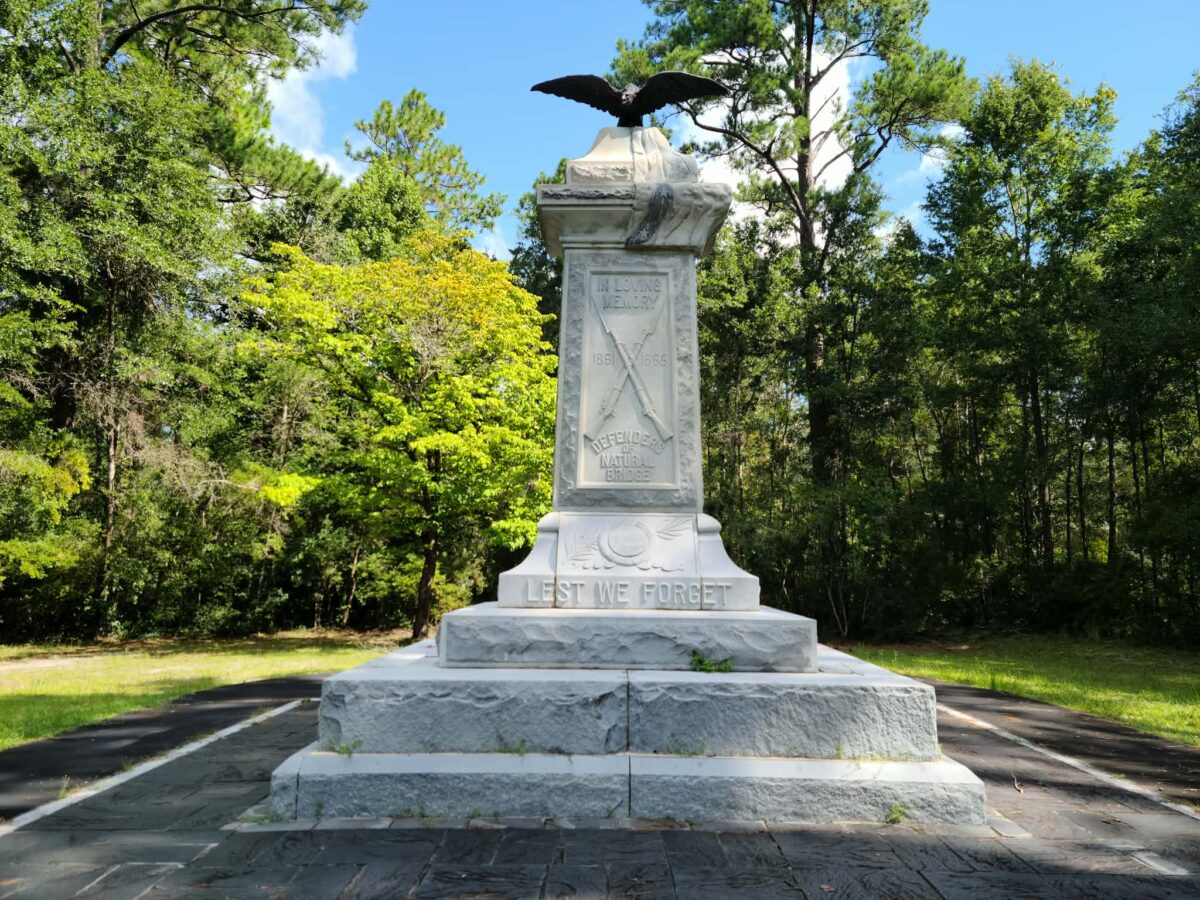
One of the good things about living in the South as a student of the American Civil War is that there is some kind of Civil War site just about anywhere you are. One of the bad things, of course, is that most of the smaller and even medium-size sites are Civil War sites preserved, maintained, and “interpreted” by Southerners, past and present. That’s never stopped me from exploring, however, and so when Heather and I took a quick trip down into Florida to visit my brother and our new(ish) niece and nephew, I also resolved to see if there were any historical sites I might tour if I had a free afternoon. Lo and behold, casual scrolling through Google Maps revealed a pin labeled Natural Bridge Battlefield State Historic Park just outside the greater Tallahassee area, and even on the same side of the city as my brother’s place. On the final full day of our visit, then, I got up a bit early and went for a quick drive before lunch, wondering what I might find. The answer, as it turns out, was “not much.” While Natural Bridge Battlefield did not quite sink to the lows of such barely-marked sites as Tallushatchee “battlefield park”, it certainly did its best to challenge it.
To be fair, the actual Battle of Natural Bridge doesn’t offer all that much to work with. More a skirmish than a full battle, it saw the Union forces of Brigadier General John Newton, 700 strong, pitted against about 1,000 Confederates that blocked their way toward the town of St. Marks, Florida. Rebel soldiers based in the area had attacked Union forces further south in Florida at Fort Myers in February of 1865, resulting in what is considered the southernmost action of the war. In reprisal, Newton’s force set out in combination with a Navy flotilla in March, determined to neutralize the Confederate force and perhaps tighten the Union blockade of the Florida coast. The Navy’s vessels proved unable to fully ascend the St. Marks River, so the infantry continued without them. A scratch force of local Confederates (including cadets from the Florida Military and Collegiate Institute, which is now Florida State University) met them at Natural Bridge, and after a day of fruitless effort to brush the Rebels aside and cross, Newton and his men withdrew to the flotilla and returned home. The Union had suffered 296 casualties, their opponents just 52.
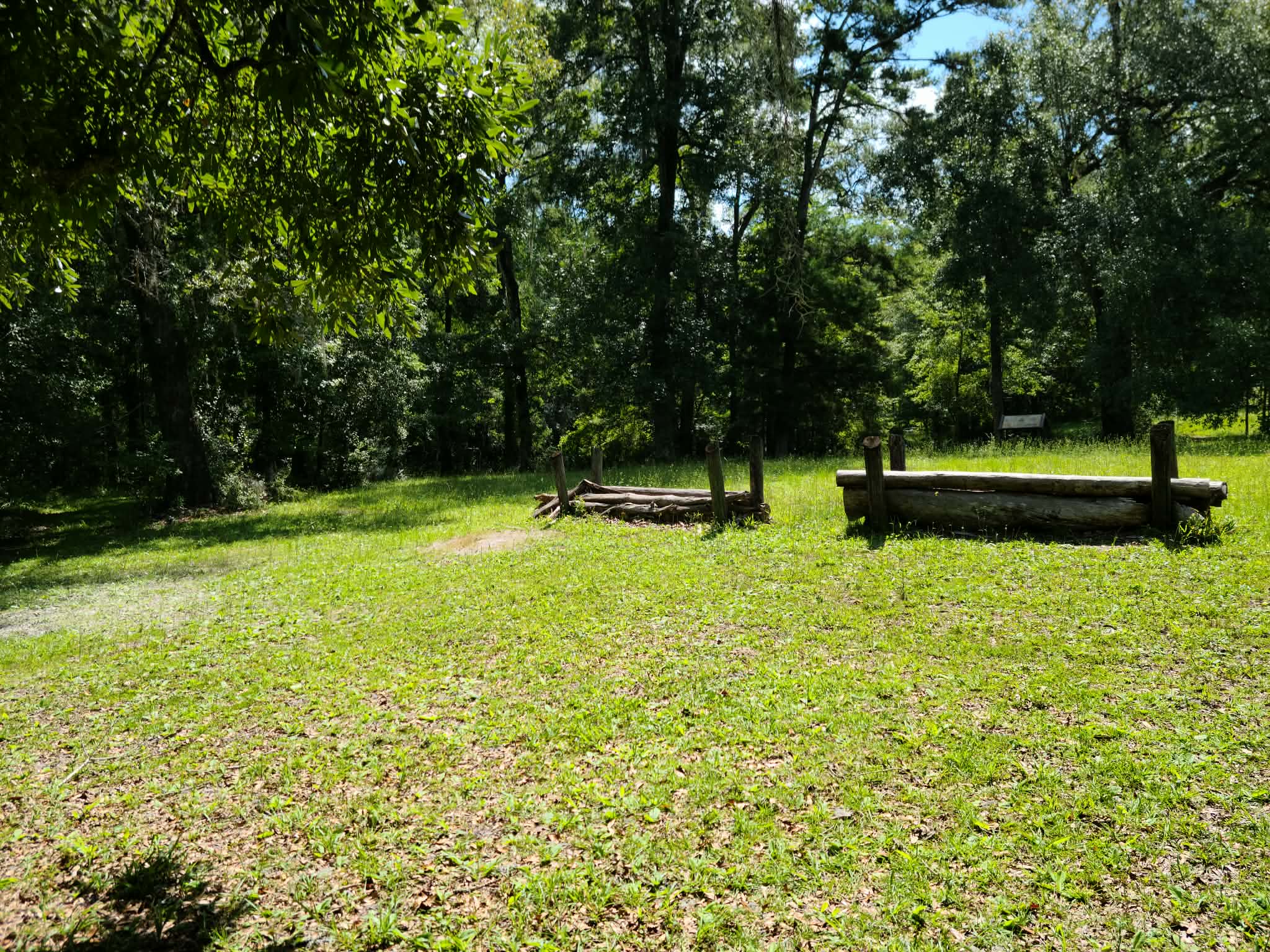
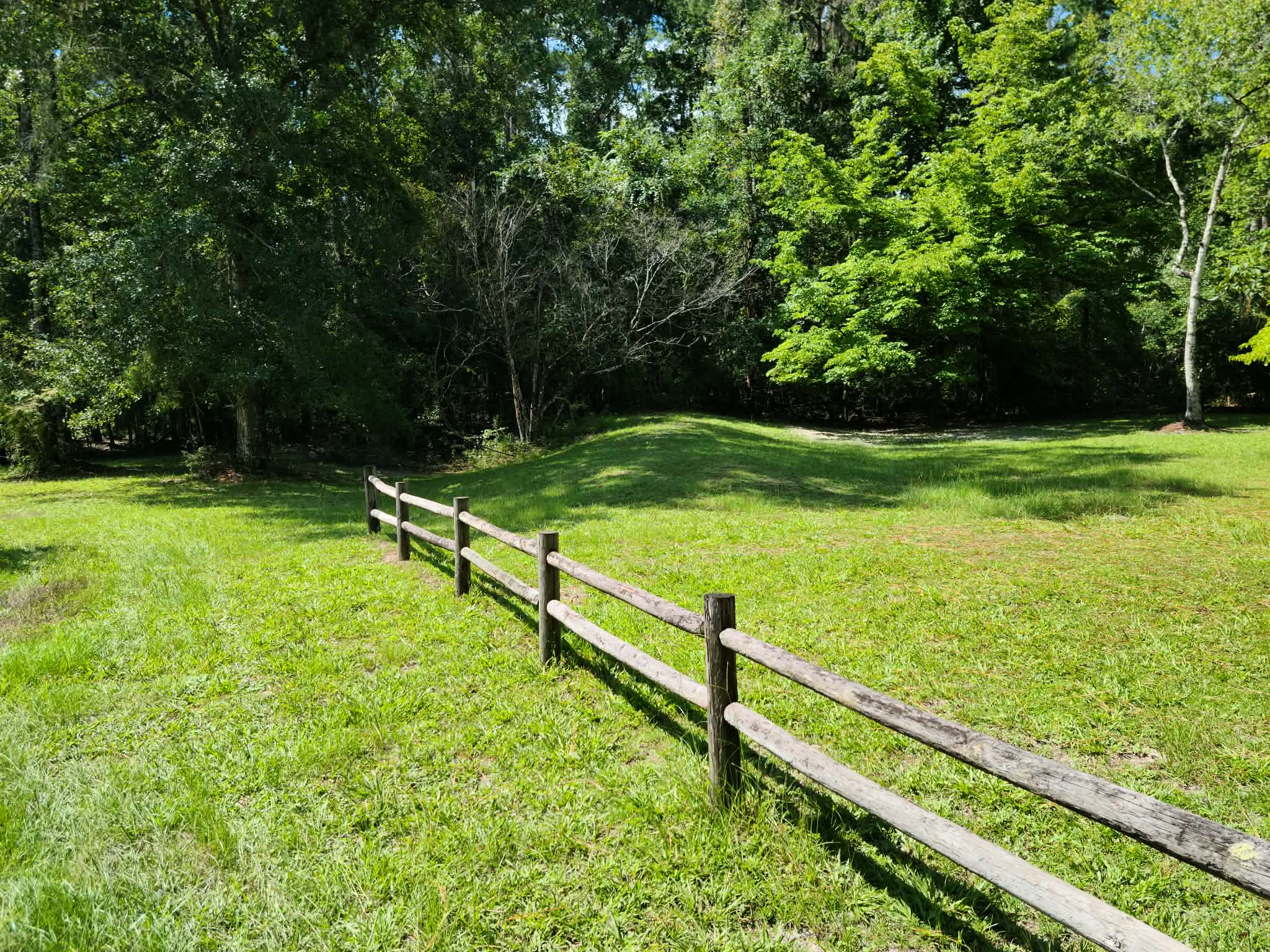
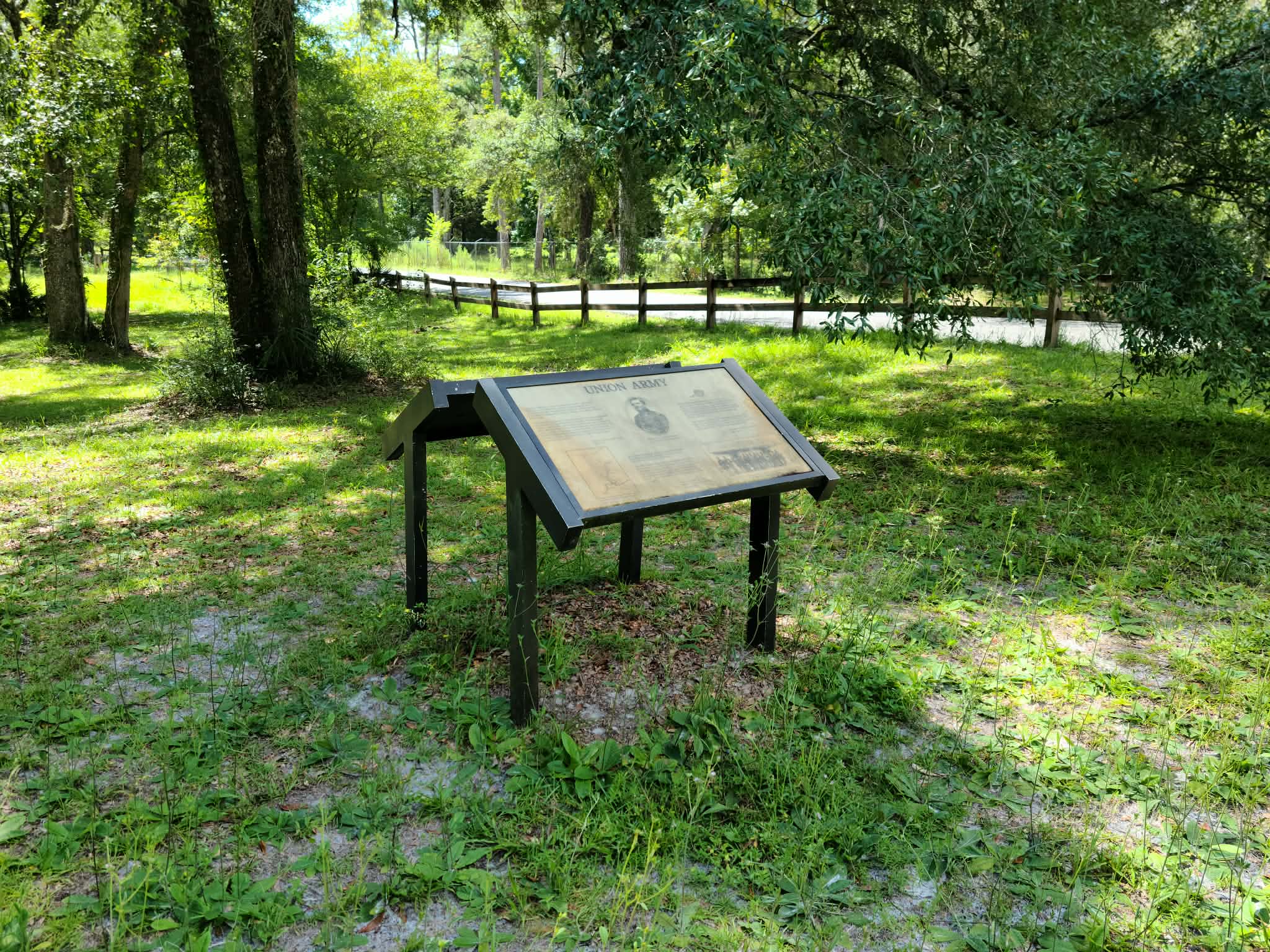
The field as it exists today seems tiny. There are apparently 110 acres preserved, but most of that is simply walking trails. Whatever interpretation exists is clustered around a small parking and picnic area and, across the street, a large granite monument. A kiosk at the parking lot bathrooms displays an unfolded brochure map (that is unavailable to actually take a copy of), and if it weren’t for that small diagram I wouldn’t have been able to find even the few things I did. There is a preserved section of earthwork at the far end of the picnic glen, but it is entirely unmarked. The same goes for a few-yard long, shoddily reconstructed breastwork off to the side of the monument. Only two real interpretive plaques existed, each of them one side of a double-setup and summarizing the opposing forces and their objectives. There is no way to orient yourself to the flow of the battle or picture the action. Power of place is entirely absent.
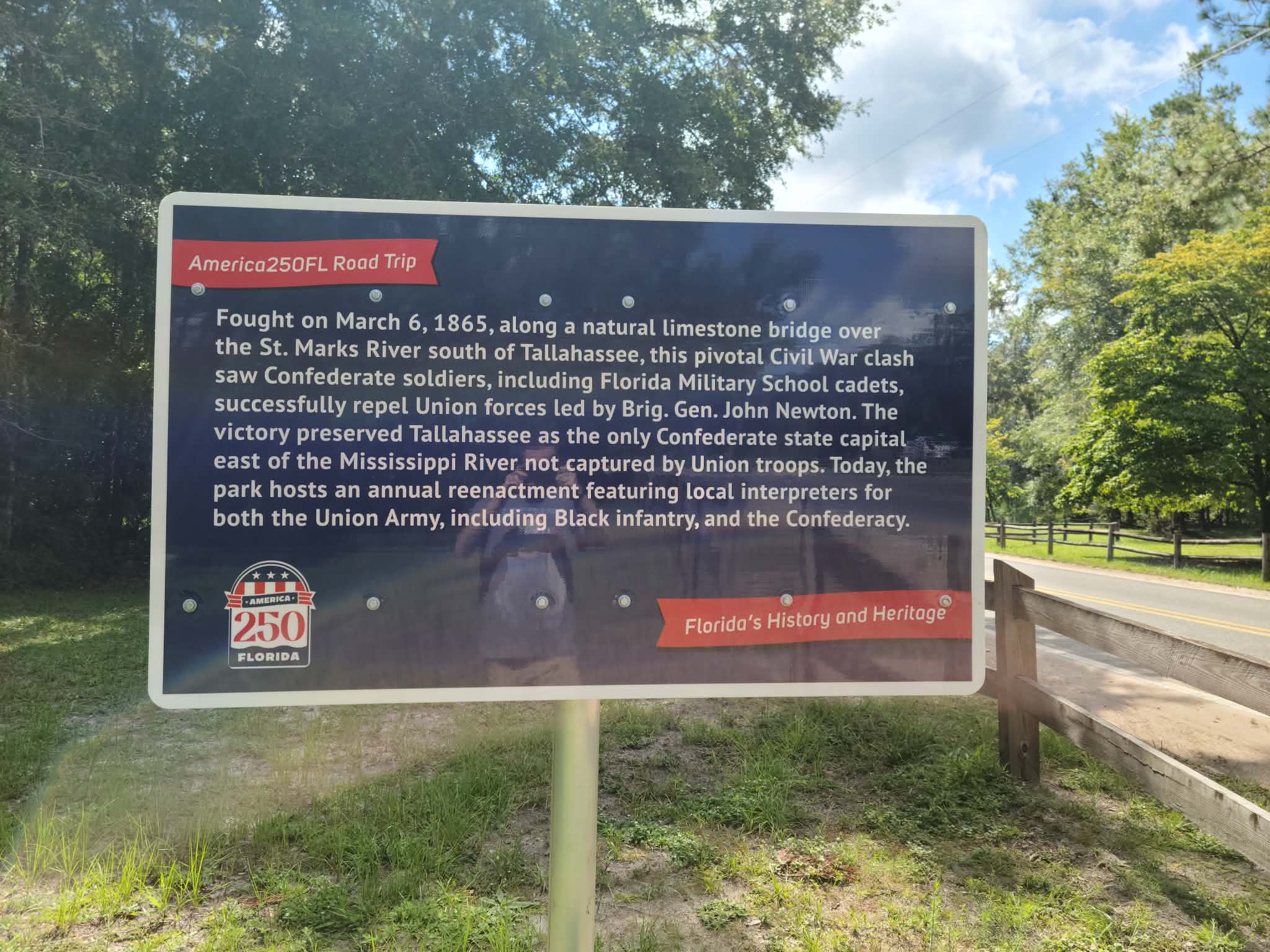
What I couldn’t help but really scoff at, though, was the nigh-desperate attempts to situate Natural Bridge as a relevant, even majorly significant, action. A brand-new roadside sign installed for America’s 250th described it as a “pivotal Civil War clash.” The inscription on the 1921 Daughters of the Confederacy monument alleges that the Confederate victory “saved the capital from the invaders” (oh look, there’s the treasonous Southern commemoration I suspected I’d find!), and an older roadside marker states that the Union force’s next objective would have been Tallahassee. This is apparently a fairly common interpretation of the battle, one that gives the Confederate defense credit for preserving Tallahassee as the only Confederate state capital east of the Mississippi which was not captured by Federal forces before the end of the war. The problem, of course, is that the records do not make this a plausible conclusion. The site’s own marker explaining the Union objective states that Newton did not have any orders to advance on Tallahassee, just to operate against St. Marks. This he did, and it seems foolhardy if not suicidal to me to advance out of contact with the Navy’s vessels to capture a city with only 700 men under his command—and that’s before any casualties would have been incurred in battle. To describe this campaign as pivotal, when it occurred in the last month of the war, involved less than 2,000 men, and had no impact on the actual course of the war is perhaps the most egregious example I’ve ever come across of a Civil War site trying to claim some share of the spotlight for itself by piling on superlatives.
While I cannot quite say that I regret my short venture into the panhandle swamps—it did result in being able to write this post, after all—it certainly comes close. Bug bites, a much-too-personal encounter with an orb weaver and its web, and very little additional knowledge at all were my rewards for trekking around the “park” at Natural Bridge. To be honest, it’s hard to even imagine what potential there might have been here without a massive, radical overhaul and staffing of the site, for a battle that really isn’t significant enough to attract the volume of visitors who would deserve it. Perhaps it’s more accurate to think of these little sites as just hosts for the monumentalization of such groups as the UDC; efforts to reiterate their “ownership” of this land and historical memory even as the world moves on ignoring them. I might start doing so, too.