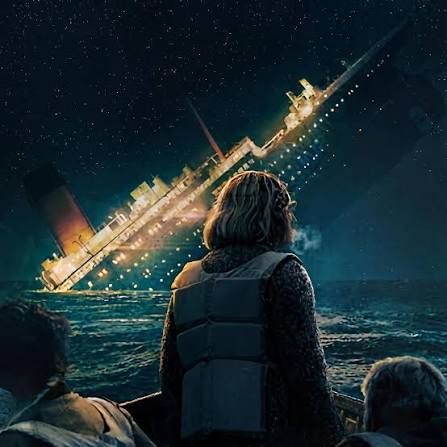
by Bryan & Heather
Ah, the Titanic. We don’t know if fascination with this most famous of maritime disasters (it is not nearly the worst, though it may be one of the most influential) is one of those ubiquitous fixations among young people alongside dinosaurs or if we simply grew up at an opportune moment, when James Cameron’s massively popular 1997 blockbuster created a flood of Titanic and related content for two budding historians to experience. Either way, both of us have had a soft spot for Titanic studies for years, to the point that we planned a day to visit the traveling Titanic Exhibition during our honeymoon when we learned it was nearby. So when Bryan saw promotional material for a docuseries that promised to tell the narrative of the fateful April night in 1912 in a way never before seen, we knew we had to try it out.
At least from first appearances, Titanic Sinks Tonight seemed to highlight the novel format of narrating the sinking of the ship in real time, tracking from the first strike against the iceberg to the final throes of the stricken vessel in just as much time as it really took to sink. This it certainly does, but this approach really doesn’t feel much different than other documentaries in practice. Progressive time cards and the inevitable stretching of the final moments to fit in all the desired information are not exactly novel, and the series really does not feel like anything different—at least on account of this choice.
Where Titanic Sinks Tonight does feel like something new, at least to us, was its decision to not simply include eyewitness accounts in its narrative but to bring them to the fore and combine them with the nigh-mandatory modern documentary convention of dramatically recreating its subject matter using actors. As it turns out, this series actually has two sets of talking heads. There is the usual complement of modern “experts” (more on them later), but there is also a number of the actors we see in the recreations, speaking directly into the camera as if these historical figures were themselves interviewed by the documentarians. Yet little, if any, of this dialogue is fabricated; the opening sequences make clear, the words of these “characters” are all pulled directly from primary sources and reformatted to fit the framework of the series. It’s an intriguing idea, and one that may have led to the BBC classifying it as a “docudrama” (a word for which we could find no functional definition that clearly delineates the differences between documentary, docudrama, and period piece, at least in alignment with the ways we’ve encountered it used). This approach seemed to be a possible next evolution in the quest to make history more engaging for casual audiences while also providing discrete personal narratives for the show to follow and narrow its scope into something more manageable and palatable than attempting to tell an exhaustive, comprehensive account. Unfortunately, this also didn’t really move the needle for us in practice. In the opening episode, it could be hard to tell the difference between “primary source” interviews and modern individuals due to a lack of identification on screen and some older-style wardrobes among the experts. And the words of these survivors were not themselves of clear provenance. We knew they were historical, but the series makes no effort to explain what documents they were pulled from, when these documents were composed or published, or any of their context. Interestingly enough, given the “interview” format, none of the show’s sources seem to have come from the actual inquest performed by the White Star Line in the wake of the tragedy, and some stories may have been from more sensational accounts written for the yellow press weeks or months later.
The information offered by modern talking heads seemed to share this problem of murky sourcing, as well. While the many different individuals did offer relevant general information to contextualize the actions of Titanic’s passengers and crew (such as comments on Edwardian society, operation of a naval vessel, and high-stakes decision making), no one on screen in Titanic Sinks Tonight was actually an expert on the history of the event specifically, and one talking head appears to have been a novelist with no real authority to speak in this context at all. Somewhat predictably, this then leads to the show’s narrative being simplified in ways that make serious historians cringe, with speculation being presented as certainty and numerous historiographical debates being passed over or outright ignored in favor of the tidy narrative the series wants to present.
By the time we had finished the fourth and final episode, we couldn’t say we’d learned anything particularly new about the voyage and sinking of the Titanic, but that’s not to say the miniseries hadn’t been worth our time. While various creative decisions combined to drag it down below its potential, Titanic Sinks Tonight certainly offered us a glimpse of new possibilities for documentaries moving forward, and it could well be possible that a more meticulous, history-conscious production team might realize that potential in the future and deliver a landmark experience.