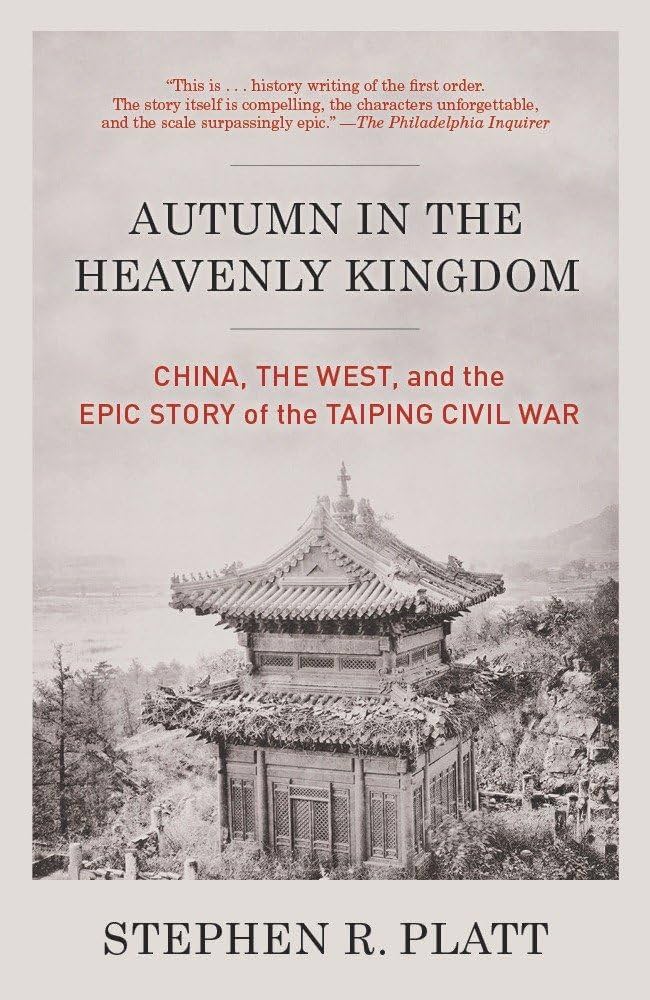
It’s time again for the Concerning History Book Club, where we recreate the experience of the engaging book discussions we’ve had throughout the years in classes and with each other. In this newest installment of our long-running series, Bryan and Francis discuss Stephen Platt’s fascinating narrative of the final years of China’s Taiping Civil War, its international dimensions, and the seemingly-unlikely role of the British Empire in propping up the Qing Dynasty for another few decades.
BC: Years ago, I had the pleasure of reading and reviewing a fantastic history of the First Opium War and the transition between two different spirits of imperialism in 19th century-Britain. I knew that its author, Stephen Platt had, also written a work on the later Second Opium War and Taiping Civil War, but ironically I would not be the first member of the Concerning History staff to read it! Francis beat me to the punch, and we knew that one day I would get around to catching up and we would finally get our book club discussion out of it. That day has finally arrived.
FB: Platt’s first work, Autumn in the Heavenly Kingdom: China, the West, and the Epic Story of the Taiping Civil War, focuses on the diplomatic and military history of the Taiping Civil War. For the uninitiated, the Taiping Civil War (also called the Taiping Rebellion) was a Chinese civil war led by adherents to a syncretic Confucian-Christian religious movement that sought to create a utopia in central China. Taiping adherents believed their leader, Hong Xiuquan, was the younger brother of Jesus Christ and had a divine mission to rid China of the corrupt, demonic, and ethnically Manchu Qing Dynasty. This conflict was the bloodiest war in the 1800s, yet it receives little treatment or coverage. Aside from generally bringing more attention to the subject, one of Platt’s goals in this book was to analyze the causes of British and French intervention in the Taiping Civil War. As this conflict overlapped with both the Second Opium War, the Indian Rebellion of 1857, and the American Civil War, I knew Bryan and I had to discuss it.
Bryan, I concluded that Platt did not really prove one of his central arguments that Britain intervened in the Taiping Civil War to keep its access to the Chinese markets they had secured through lopsided trade agreements with the Qing Dynasty. Platt argues Britain intervened in China after the American Civil War closed off the U.S. market for Britain’s manufactured goods. He also implies that Britain chose to intervene in China, and not in the U.S., since the American Civil War was a conflict to end slavery.
The problem with this point, however, is that Platt does not present ample primary sources from Parliamentary debates or Cabinet meetings to demonstrate that Britain’s ministers knew the extent of the economic damage both these civil wars were to cause the British Empire and then made the explicit goal to intervene in China as a tit-for-tat trade-off to intervention on behalf of the Confederacy. Basically, Platt points out that there was a correlation between the two conflicts (they happened at the same time) but not causation (that their simultaneous occurrence forced Britain’s leaders into explicit debates about either intervening in China or the U.S.)
BC: I couldn’t agree more. One of the first things you asked me after I had finished reading was whether I thought Platt had sufficiently supported this argument, and I replied with a resounding “No.” Not only does he not demonstrate that this was ever an explicitly conceived choice, or even a subconscious pattern of policy, but the idea that, in his words, “Britain’s neutrality in the U.S. Civil War came at the expense of abandoning it in China” creates the false idea that this could ever really be a decision at all. Britain’s experiences in China across the two Opium Wars showed that a far smaller amount of money, materiel, and lives was required to effect a larger result in East Asia than was the case if they intended to influence events in the United States.
Platt also ignores the fact that British public opinion was evenly split towards the American Civil War; many of the country’s elite did indeed sympathize with the Confederacy, but huge swathes of the working classes — even those who would find themselves unemployed due to the “cotton famine” — were staunchly pro-Union, not least because of their support for abolitionism, and the vital role of the American midwest in feeding London cannot be underestimated. Indeed, historians largely agree that Lincoln’s issuing of the Emancipation Proclamation in the autumn of 1862 shut the door for good on any prospect of British assistance for the Southern rebels.
Platt’s inability to lucidly compare the two civil wars extends into other realms, too; a comment in the preface that the Qing force primarily responsible for defeating the Taiping (Zeng Guofan’s Hunan Army) was as “large, loyal, and ruthless” as the armies under Ulysses S. Grant overstates size (the Hunan Army was only about a third the size of Union forces by the end of the American Civil War) and attempts to compare a medieval-style army constructed along Confucian principles of personal loyalty that committed vast and terrible war crimes to a modern army of citizen-soldiers loyal to their democratic republic that at certain limited times waged hard war against infrastructure. Similarly, his contention that Guofan was much more powerful than Grant at the end of their respective wars is technically correct while also conveniently eliding how Grant was later elected to the Presidency while Guofan apparently misunderstood the realities of power in China, fumbled his subsequent actions, and as a result was dismissed, ruined, and possibly assassinated by the regime he had served so faithfully.
FB: Zeng Guofan was, in some ways, a sympathetic figure. But you’re absolutely right that he was ruthless. Platt explains how his armies massacred surrendering Taiping soldiers in several cities throughout the course of the conflict. The most that you could say about Grant and Guofan in a comparable sentence is that they were both generals loyal to the reigning governments in their nation’s civil wars.
That said, there were certainly strengths in the book and reasons that I enjoyed reading it. One facet that intrigued me was the way that the Taiping Regime presented itself, and earnestly sought to embrace, a modernization campaign not unlike the Meiji Restoration that was beginning in Japan.
BC: The conflict certainly had those features of modernization and nationalism, in some ways mirroring Japan’s more successful contemporary efforts. This was the first time I had read any history of the Taiping Civil War, and I was fascinated to learn of the many proposals for modern infrastructure, education, trade, and governance written by Hong Rengan, the Taiping Prime Minister. Chief among these was a desire to conduct commerce with Europeans on exactly the kind of free market principles the British supposedly championed. Many in Britain recognized this and yearned to support the Taiping, not least because the size and strength of their rebellion seemed to fulfil the cyclical nature of Chinese dynasties and indicate that the Qing no longer deserved to rule. How Britain came to support not the somewhat-Christian, free market rebels but the bloated, corrupt, anti-modern Qing that had just been their enemies in the Second Opium War and acted with extreme duplicity in multiple peace negotiations is one of the great ironies of history.
What was far more interesting to me was Platt’s portrayal of all the miscommunications, misunderstandings, and missed opportunities that paved the road towards Britain’s fateful cooperation with Qing authorities in ultimately defeating the Taiping. The hinge of Platt’s narrative can brilliantly be seen as the hubris and prejudice of multiple different officials in key positions across the British and Qing governments who assumed they knew all there was to know without ever actually obtaining any real knowledge of the situation. Frederick Bruce, British minister to China, condemned the Taiping as savages based on nothing more than his own dislike for them; Zeng Guofan believed the only value of European technology was the fear its loud noises inspired; even the decline of the Qing could be plausibly traced in part to an insistence on rewarding filial piety over actual expertise and ruling acumen. If ever we needed more evidence that human beings do not usually behave rationally, Platt does a fantastic, though infuriating, job of demonstrating it here.
FB: I actually credit Platt for writing a work about the Taiping Civil War and European intervention that downplayed the role of European mercenaries and advisors in the Qing Army, such as Frederick Townshend Ward’s Ever Victorious Army. By highlighting the diplomats, statesmen, and generals who were actually more consequential to the outcome of the war, Platt’s work was more of a highly contextualized dual biography of Hong Rengan and Zeng Guofan and the way that their personal experiences of the war highlighted the intellectual, social, and cultural struggles China experienced as it encountered Europe’s New Imperialism.
Your last point, that humans do not behave rationally and in reaction to their own prejudices, also reminded me of the fact that the Taiping Heavenly Kingdom conceived themselves as an ethnocentric kingdom seeking to overthrow the corrupt, foreign Manchu elites who governed the Qing Empire. Far from just an ideological conflict, the Taiping Heavenly Kingdom’s Han and Hakka rulers portrayed their struggle as something of a communal exorcism of the Manchu Qing. Their propaganda and religious mythology even described Manchu people as incarnate demons.
Honestly, the Taiping Heavenly Kingdom’s ideology, and the fact that Hong Xiuquan and Hong Rengan readily convinced millions to believe in their religious and political project, is one of the most fascinating aspects of the Taiping Civil War. Just describing the conflict — a failed Confucian bureaucrat concluded he was the younger brother of Jesus after suffering a mental breakdown and led millions in a religious and political movement to overthrow the Qing Dynasty — is laden with drama. Yet, as a historian, I was disappointed that Platt missed the opportunity to compare the Taiping Heavenly Kingdom to other syncretized and heterodox Christian movements that existed across the world in the nineteenth century, despite his explicit efforts to internationalize his sources. Taiping theology was truly syncretic and its heterodoxy reminded me of the different millenarian and reformist Christian movements that inspired religious renewal and scorn in the United States. The Taiping Movement practiced a form of enforced, communal celibacy when it began, just like the Shakers in America. The Taiping Movement claimed that their leader had both divine and prophetic qualities and created their own religious texts interpreting the dreams he claimed revealed his nature as Jesus’s younger brother, just like the Mormons developed their own scriptures alongside the King James Bible.
Moreover, I think one of the main reasons that Britain and France were unlikely to support the Taiping Heavenly Movement was its heterodox, syncretic Christianity. Just as the preconceived notions that Qing and European statesmen had about the conflict and each other shaped Qing and European cooperation, so too did those prejudices influence how the British and French viewed the Taiping Heavenly Kingdom. For conventional Protestant and Catholic Christian leaders and civilian elites in Britain and France to embrace such a cause, they’d have to overcome both a growing worldview of inherent European superiority and accept a rather heterodox version of Christianity as close enough to Western denominations that the Taiping could be embraced as coreligionists. That seems just too high of a bar for European elites to clear. In fact, one evangelical American missionary (and hustler), Issachar Jacox Roberts, even established himself in the Taiping Court to teach the Taiping about American evangelical Christianity and then, later, condemned Taiping theology after he lost favor and was expelled.
Unfortunately, I don’t think such a historical study of the Taiping Heavenly Movement within a global, evangelical, and imperial context is possible today. The Chinese Communist Party makes it very difficult to complete authentic research about Chinese history and the CCP is invested in its own interpretation of the Taiping Civil War as a proto-Marxist revolution. Plus, as an atheistic regime, I don’t know how much the CCP would sanction comparative, syncretic religious studies.
BC: Very fair! Another noticeable omission, of his, though, and one that’s emblematic of what I would say is the biggest flaw holding Autumn in the Heavenly Kingdom back from being a truly great work of history, is Platt’s own admission that he did not intend this book to be a comprehensive history of the Taiping conflict—which makes the inclusion of the phrase “the epic story of the Taiping CIvil War” in the book’s title rather disingenuous. Instead, Platt wrote a dueling-biography type of narrative, highlighting the paths of Hong Rengan and Zeng Guofan as they rose and fell in service to their respective governments.
What this means, though, is that massive swaths of vital context are left out. While he does provide a general backstory for Hong Xiuquan and the founding of the Taiping Heavenly Kingdom, the narrative truly begins in 1858, seven years after the outbreak of the rebellion. Other theaters of the war beyond the Yangtze and its environs are never more than briefly mentioned, and there is a perennial problem of citing sources and never explaining how these writings could have survived such a brutal reconquest. Most egregious of all, Platt opts for an artsy, ambiguous style to conclude the final moments of Hong Rengan in the narrative, leaving it to the chronology that precedes the text to explain what the actual fate of the Taipings was. That ending just fails the promise that a narrative history is supposed to fulfill; contextualizing and interpreting the causal and correlated events within a historical epoch.
FB: In his conclusion, Platt returns to the historical view that Chinese leaders in the wake of the 1911 revolution had of the Taiping Civil War. He cites a few who explicitly argued that the British and French efforts to rescue the Qing kept a dying state afloat that did not deserve to exist due to the Qing’s corruption, incompetence, and bloat. These Chinese leaders thus saw the Taiping Heavenly Kingdom as a great missed opportunity for China to modernize and resist European imperialism. In some ways, their historical memory of the Taiping Civil War is a metaphor for how I view Platt’s work: a missed opportunity. Platt does several things well, such as recounting a gripping narrative about Hong Rengan and Zeng Guofan, internationalizing the scope of the conflict, explaining the diplomatic oversights and misinterpretations that shaped it, and detailing the effects of British and French intervention. Nevertheless, the narrative is not an actual history of the Taiping Civil War in its entirety and Platt missed the chance to provide some much needed comparative or causal analysis about the Taiping Heavenly Kingdom within the history of the New Imperialism and nineteenth-century religious movements. He also never makes the connection in his sources to prove some of the causal links he implies shaped British intervention. Those flaws mean we can’t really recommend this work as a good general history of the Taiping Civil War, which is a shame since there are so few out there readily accessible to English-language readers — though it is admittedly better than nothing!