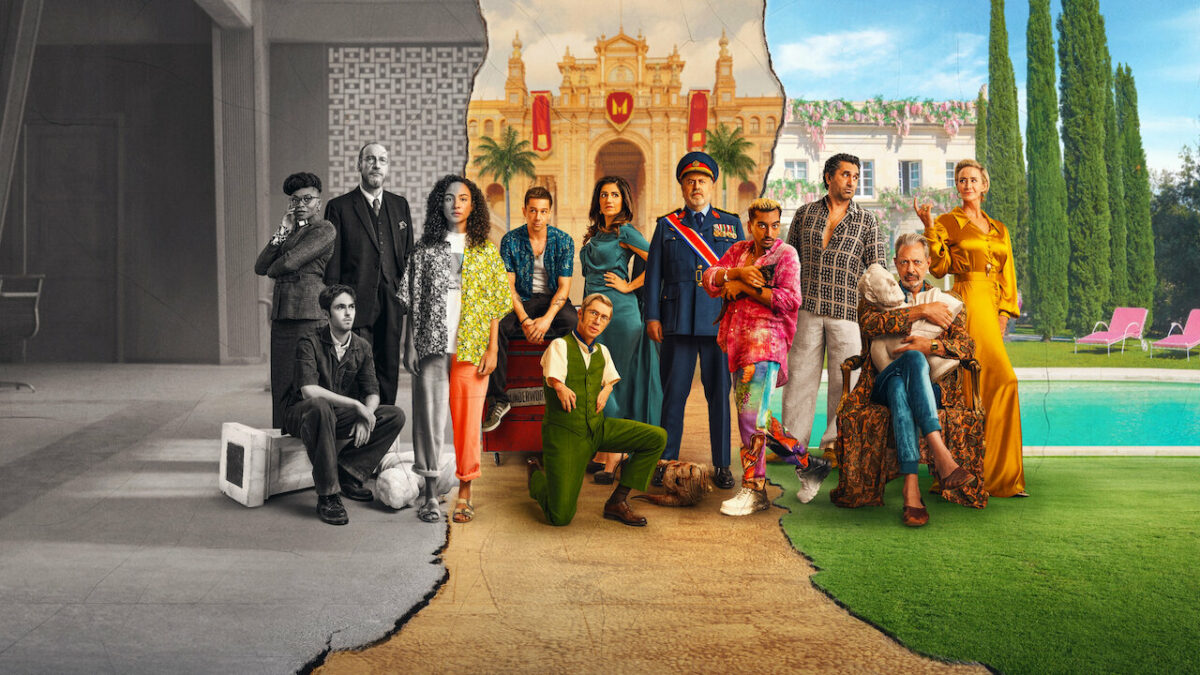
As a foundational pillar of Western storytelling and culture in general, Greek mythology is not exactly unfamiliar ground for adaptations to both big and small screens, nor have all such efforts been confined to the historical era in which those myths were composed or alleged to have taken place. From an extension of gods and heroes into our current time like seen in the Percy Jackson series to more subtle approaches like O Brother Where Art Thou’s take on Homer’s Odyssey, creators have found the modern era fertile ground to retell these timeless stories. I thus expected something fairly familiar when I finally got around to trying out the recent Netflix series Kaos—and was completely blown away by its refreshingly unique and cutting portrayal of its subject matter.
It feels almost a misnomer to say that Kaos takes place in the modern world. On the one hand, it very much does; from technology like smartphones to language, music (both diegetic and as soundtrack), costuming, even architecture, the show is clearly set at the leading edge of the twenty-first century. Yet on the other hand, it is not our twenty-first century. Instead, the mythic world of the show simply takes the ancient Greek world and clothes it in the trappings of modernity as a storytelling device, with none of the millennia of history that would have occurred between now and the Classical peoples who passed down these tales to us. This can take many of the usual forms of modern mythological adaptation, from simply giving characters a cloak of modernity (Orpheus as a pop star, the Furies as a vengeful motorcycle gang, Amazons as a trans-exclusionary feminist commune, Minos’s Labyrinth as a gulag for political prisoners of an authoritarian regime) to cheekily offering less magical, more “reasonable” explanations for certain entities (the Cyclops as a man weaning an eye patch, the Minotaur as a feral human wearing a bull-shaped helmet).
What really set Kaos apart from all the other movies and shows that have done similar things, however, is how it leveraged not just modern imagery but a more modern mindset to frame its narrative. One of the defining features of Classical divinities was always how imperfect they were: not omniscient or omnipotent or certainly arbiters of morality, but flawed, selfish beings that reflected the best and the worst of humanity. The Greeks themselves would have been the first to tell you that the gods did not exactly behave well or value human life, but in the context of a pre-Enlightenment ancient world where fear and raw power were the most common currency, such behavior was never really taken as a reason not to worship Olympus. It’s not like mortals had any other choice if they wanted to continue living (mostly) free of misfortune or divine displeasure. True to form, Jeff Goldblum’s Zeus is deliciously conceited and self-absorbed in a way only Goldblum can play, using mortals as playthings and craving their adoration while thinking nothing of looking after their wellbeing. His Olympus would be right at home among the European villas of the global elite, and it’s likely no coincidence that Poseidon is often shown on his luxury yacht cruising the Mediterranean. Zeus and his divine family can easily stand in for the oligarchs behind many modern authoritarians, pulling their strings and demanding immoral behavior in return for favor. But this time, in Kaos, the world doesn’t take it lying down. In Zeus’s way stands a small group of beings both mortal and divine led by Prometheus who, in good humanistic fashion, defy the gods and resolve to fulfil a prophecy that promises the end of Zeus’s tyrannical reign.
When it comes to accurate adaptation of Greek mythology, though, this overarching plot and the other classic stories that make up its constituent parts do not exactly hold up to their originals—and that’s not a bad thing, or even unfaithful to the source material! Only a small fraction of all the ancient material narrating Greek mythology has survived to the present, and not only do we not know just how widely-known certain texts were in their own time but such a thing as one unified ‘canon’ has never truly been a thing in orthopraxic polytheist religions throughout history. Each town, city, and cult center had their own local traditions that often conflicted with each other (and are why we talk of gods with so many disparate and sometimes unrelated domains, as many local divinities were amalgamated into larger cults). In remixing these stories for its own needs and messages, Kaos not only keeps with broader mythological tradition but updates its material for a modern audience and keeps that audience guessing when unexpected twists makes them realize that they don’t actually know how all of this might end.
If it wasn’t clear enough by now, I cannot recommend Kaos highly enough for any who enjoy Classical mythology, stories of rebellion, or even just messy family dramas. It is a shame that Netflix cancelled it after only one season (and contrary to its showrunner’s comments, it very much does end on an unresolved cliffhanger), but the themes of absolute power corrupting absolutely and tyrants only having as much power as we give them are both timeless and vital for the current moment.