Another September 22 has arrived, and with it the birthday of Frodo and Bilbo Baggins! Bryan continues the Concerning History tradition of exploring the historical inspiration for J.R.R. Tolkien’s legendarium this Hobbit Day with a discussion of the many fantastical islands of Middle Earth and how they come straight from the pages of ancient and medieval authors of our own world.
It should be no surprise to even casual fans of Lord of the Rings (or long-time followers of this blog) that J.R.R. Tolkien drew heavily upon actual history, especially that surrounding his own field of medieval linguistics. From the cultures and appearances of the forces of both good and evil to their architecture and even tactics employed on the battlefield, the Professor employed the historical record to lend feelings of familiarity and veracity to his work. Real events and peoples only supplied part of Middle Earth’s creative fabric, however; Tolkien’s professional work and personal fascination with the mythologies of pagan medieval Europe bled through into the bones of his world, and in one way quite literally. While often used to refer to the entire setting of Lord of the Rings, “Middle Earth” is technically only a single continent of the world of Ea. Much of the land to its south and east will remain forever unexplored and unexplained, but the lands across the sea to the west figure prominently in not only these stories’ narratives but their metaphysics, as well as in ways that directly mirror ancient and medieval Europeans’ relationship with the uttermost West.
For millennia, the ocean that surrounded Europe and Africa was a blank slate upon which the inhabitants of those continents could paint whatever their societies desired or feared. Inland seas like the Mediterranean and even relatively confined waterways like the English Channel or the Baltic could act as highways, connecting just as much as dividing, but in the absence of deep seaworthy vessels and reliable navigation, the Atlantic proper held only death and uncertainty for ancient and (most) medieval mariners. The human mind abhors a vacuum, however, and far from turning their backs to the western horizon, European and Mediterranean peoples began to incorporate this unknown into their mythologies, filling it with lands both fantastic and terrible.
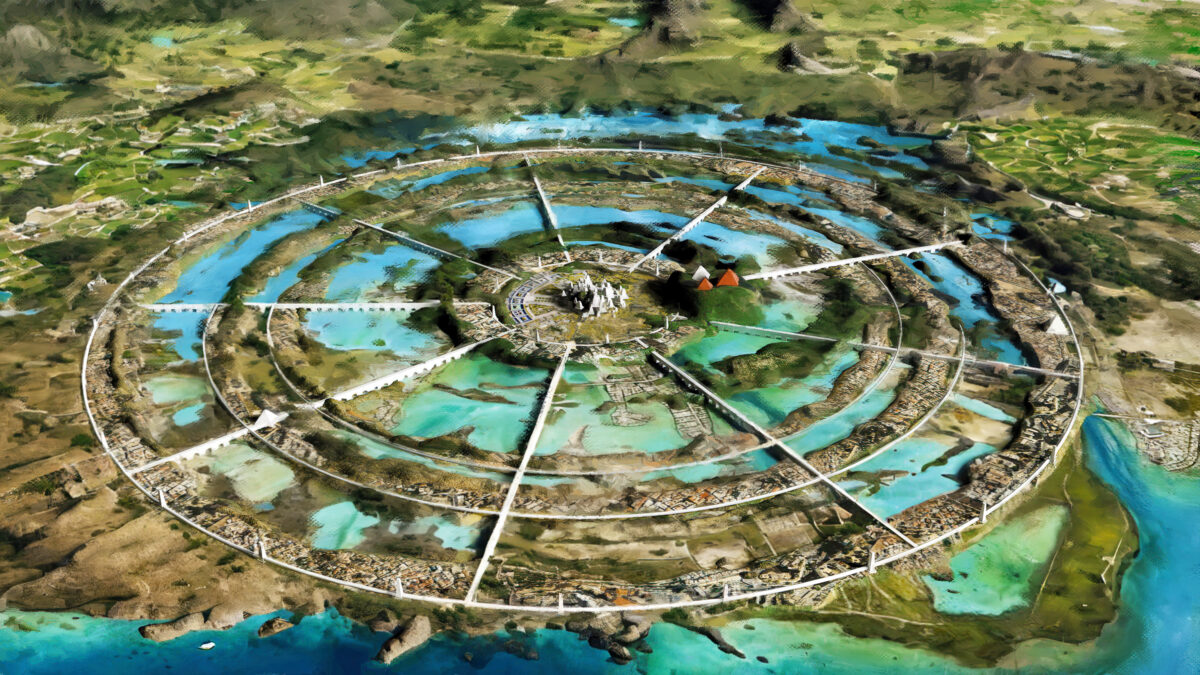
Perhaps the most famous of these myths was that of the lost continent of Atlantis. As the story goes, the Atlanteans were a people especially favored by Poseidon, the Greek good of the sea, and their civilization was the most advanced the world had ever known. Their patron had provided them with a land beyond the opening of the Mediterranean to call their own (and thus our name of the Atlantic Ocean), and from there technology that verged upon magic and unparalleled seafaring skills led them to establish hegemony over the known world. At first ruled by wise philosopher kings and dedicated to bettering their fellow men, soon Atlantis fell prey to arrogance, pursuing a more baldly imperialist agenda and even challenging the status of the gods themselves. Such hubris could not go unpunished, and the gods ultimately destroyed the continent, sinking it beneath the sea in one great cataclysm that drowned the entire people. It’s unclear just how seriously this myth was ever considered part of the Greek tradition—it may very well have just been a one-time parable—but Atlantis has caught the imagination of countless philosophers, explorers, and scientists across the intervening centuries. It’s fitting, then, that this most (in)famous of mythic lands would provide direct inspiration for the most famous of Tolkien’s islands: Númenor. Located to the south and west of Middle Earth, Númenor (also known as Westerness) was the home of a great and long-lived people descended from the men who had remained faithful to the Valar (lesser divine agents of the creator of the universe, like archangels) at the end of the First Age of the world. Their kings were of the line of Elros, son of the great half-elven mariner Ëarendil (more on him later) and brother of the well-known character Elrond. The story of the Númenoreans is essentially identical to that of the Atlanteans, from initial benevolence through to cruel dominance, fall from grace, and destruction. Only those few families who remained faithful to the Valar would escape to found the kingdoms of Gondor and Arnor in Middle Earth. This is more than mere coincidence or poorly-disguised imitation, however; for Tolkien, Númenor very much was Atlantis. In the early drafts and writings of the legendarium where his world was much more obviously our own in the distant, mythic past, Tolkien referred to Númenor as Atalantë. The two were one and the same.
Númenor/Atalantë was not the only island Tolkien took straight from the pages of European mythology. Another comes from the traditions of medieval Britain, Tolkien’s own professional specialization. This one, however, would share only a location and role with its counterpart. In the legendarium, the island of Tol Eressëa is central to the journeys of the elven people and, later, the Númenoreans. When the Valar first led the elves to their homeland of Valinor on the western continent of Aman, also known as the Undying Lands, they uprooted Tol Eressëa to serve as their vessel, ferrying the elves across the western ocean from Middle Earth. When drawing almost out of sight of their old home, some elves begged the Valar to again root the island in place so that they could still see the starlight of the skies they’d come to love. Tol Eressëa therefore became a kind of liminal space, simultaneously a part of the mortal world and part of the ethereal. When they were still faithful, the mariners of Númenor would often visit the island’s western city, the great tower of which was just visible on the western horizon from their own island on a clear day. The name of that city identifies Tol Eressëa with another liminal, otherworldly island, this time from Celtic mythology: Avallónë. For Tolkien, ages after his Middle Earth had fully transitioned into our own world, the mortally wounded Arthur would be borne there, the island now itself known as Avalon, to recover from his wounds and await his prophesied return.
Just as important as mythical islands, though, was the efforts required to reach them. Avalon was but one of the lands between life and death that filled the Atlantic in European mythology. The Greeks, and thus also the Romans, believed that the Elysian fields, utopian reward for those who lived pious lives, existed beyond the pillars of Hercules along with the Garden of the Hesperides, home of Atlas and the golden apples that granted eternal youth. Centuries later, both Celts and Christians located their afterlives somewhere west of the ocean. In the early middle ages, Irish monks began to practice a unique form of devotional seclusion known as the “Green Martyrdom,” sailing out to sea and trusting themselves to the will of God. This may have been the method by which small monastic communities appeared on the Orkneys, Shetland, and even Iceland before their official discovery by the Norse. Out of these journeys came a rich literary tradition, part Homer’s Odyssey and part hagiography, that fictionalized the monks’ experiences and turned them into morality tales laden with fantastical experiences and trials of faith. Only those who trusted in God like the mariner Saint Brendan could hope to find sustenance, deliverance, and be offered a glimpse of Heaven. So it is with one of the foundational heroes of Tolkien’s mythos. As the First Age of Middle Earth drew to a close, the forces of evil under Morgoth, the Black Foe, had all but overrun the world. The surviving elves and men not under his sway lived in scattered communities riven by infighting. The mariner Earendil knew their only hope lay with the Valar in the West, and so sailed to seek their help. Enchantments had been worked around Aman’s outlying islands, meant to confuse and misdirect any who sought its shores. By his faith, goodness, and the light of a holy gem on his brow, Ëarendil and his wife Elwing pierced those enchantments, found Valinor, and successfully enlisted the Valar’s aid. Millennia later, after the destruction of Númenor removed Valinor entirely from the physical circles of the world, there would still remain a Secret Way that only those who knew it could find and move from this world to the next.
Whether Atlantis, Avalon, or the journeys of the faithful, then, the mythic past of the Atlantic Ocean fittingly provided fertile ground for the foundational fantasy world of the modern era. Tolkien maintained that he created his legendarium as an alternate mythology for England, and it is truly astonishing just how many peoples, traditions, and eras he united in his writing. Join us next year for yet another installment on our own journey of (literary) exploration.