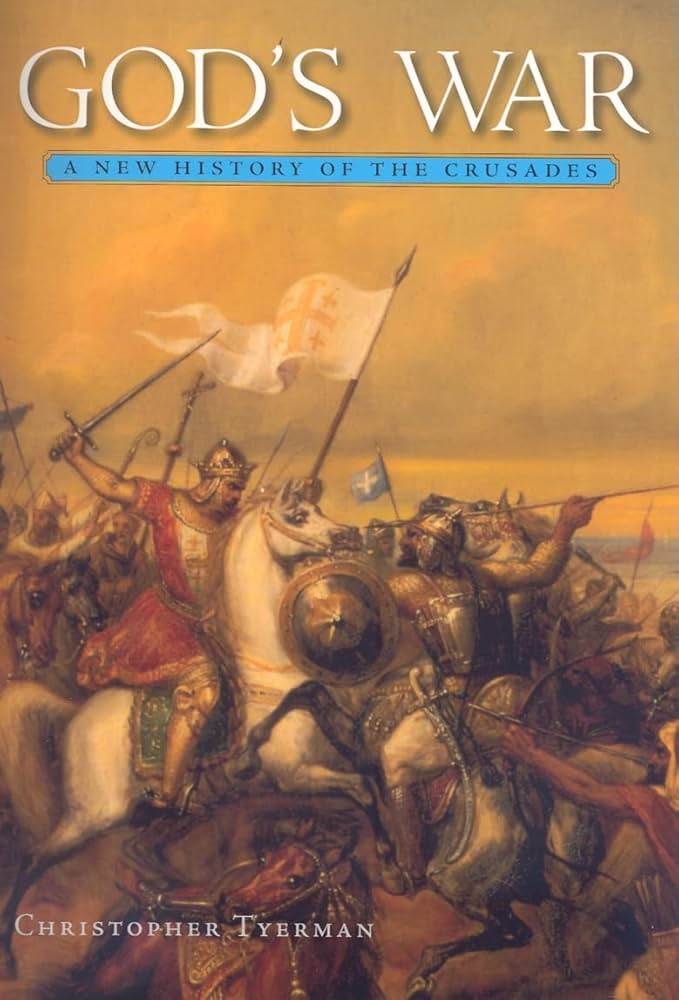
Tyerman, Christopher. God’s War: A New History of the Crusades. Cambridge, MA: Belknap Press, 2009.
I’ve read quite a bit of medieval history over the past decade or so, including material specifically on the Crusades (some of which has been reviewed here on Concerning History), but only recently did I realize that I’ve never read a work devoted to the entire scope of those famous campaigns from the initial invasion of the Holy Land to the final collapse of Christian Outremer two centuries later. It was just my luck, then, that as I browsed the shelves of Barnes & Noble in the fall of 2023, I discovered not one but two such volumes. After some research and consultation with Francis, I settled on Christopher Tyerman’s God’s War: A New History of the Crusades. Little did I know I was in for much more than just the political history I thought I was picking up.
While the Crusades are now a nearly-millennium old fact of history, at the time nothing quite like them had ever occurred before. The fact that the First Crusade happened at all, let alone achieved the success it did, was nothing short of a miracle on multiple levels. Each Crusade was something similar to but distinct from the normal wars of conquest and imperialism these warriors might have fought in under the banner of their own rulers, taking place far from familiar borders and in service of a cause infused with what was increasingly portrayed as divine favor and obligation. Vast systems of practical logistics were required to allow Crusaders to generate the cash necessary to maintain themselves in fighting shape for these journeys and be reasonably sure their families and estates would be safe in their absence. Even more importantly, the Church developed new rhetorical strategies and theology to drive the rhetoric of holy war, a concept that had not previously been part of Christian beliefs (contrary to Islam, in which it was present from inception). Tyerman devotes just as much time to this intellectual and economic history as he does to the military actions that won and lost the Crusader states, demonstrating how the rhetoric of Crusading in particular morphed from a specific goal of defending the Holy Land into a general device for othering and snuffing out other enemies closer to home and, ultimately, problematic elements within Christendom itself.
Such an intellectual history also necessarily attempts to get into the minds of its subjects, and here Tyerman’s analysis can falter slightly. With laudable relativism, God’s War repeatedly emphasizes that medieval European Christians did not conceive of the rivalry between religious devotion and personal gain as a zero-sum contest, and modern historians who claim that the Crusades were motivated solely by greed or, alternately, purely ascetic pursuit of holiness are reading the values of our own time back onto people whom they do not fit. It’s an interesting point, to be sure, and one that seems to fit the evidence of all the knights and petty warlords who to all appearances professed an earnest faith in God while simultaneously exploiting every opportunity for self-advancement regardless of what flag or faith it came at the expense of. It is a shame, then, that so little of this argument is based on explicit primary sourcework; this phenomenon could easily just be the human tendency towards cognitive dissonance rather than any special ethos of the era. Ironically, given my initial expectations, Tyerman’s coverage of the actual military history of his subject leaves a little something to be desired as well, choosing to cover certain campaigns and sieges in tactical detail while letting others pass with only a general summary.
These imperfections aside, however, God’s War is truly a landmark study well worth reading. From an initial desperate Byzantine plea and subsequent Papal power grab, the Crusades evolved into one of, if not the, defining experiences of the High Middle Ages that influenced not only the history of the Near East but Europe as well, both intellectually and politically–even beyond the (surprisingly long) temporal life of the Kingdom of Jerusalem. Having all that history in one well-written volume is not something to miss.