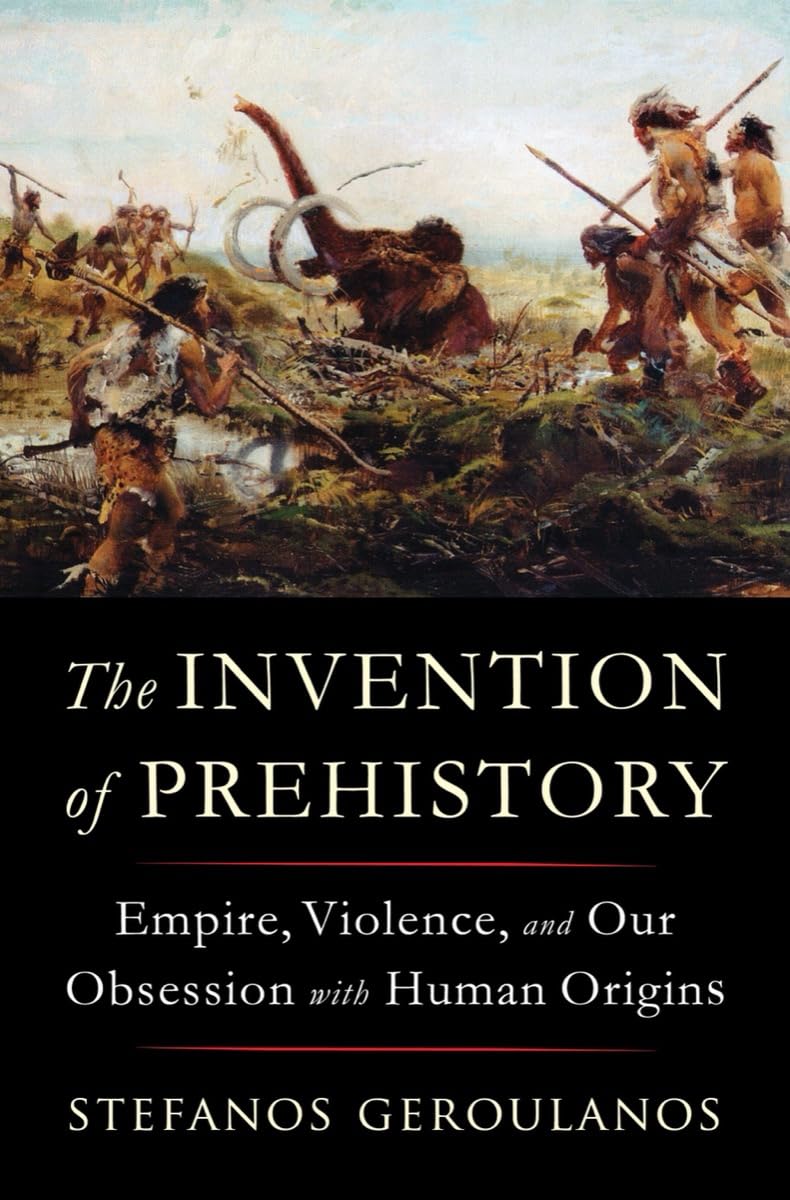
Geroulanos, Stefanos. The Invention of Prehistory: Empire, Violence, and Our Obsession with Human Origins. New York: Liveright, 2024.
While history proper has been my intellectual passion for close to two decades now, it was not always the case. Like many children, my first wonder at the past took the form of obsessions with deep prehistory—namely, dinosaurs and other megafauna. Heather shares that interest as well, and it is one we’ve been able to keep exploring together through such stellar recent miniseries as Prehistoric Planet, Life on Our Planet, and (less seriously) the Jurassic World movies. What an opportunity, then, when I came across a work of intellectual history examining how the field of academic prehistoric inquiry came to be and has evolved across the last three centuries. And then I started reading it.
Stefanos Geroulanos’s The Invention of Prehistory is essentially a grand historiography of how humans have attempted to answer the questions of our own origins through increasingly secular, academic, “scientific” means. Geroulanos begins his narrative with the Enlightenment as European thinkers began moving beyond religious explanations for human behavior and, simultaneously, were supplied with models of less-complex societies in the new lands Europeans were at that moment exploring and colonizing. These inquiries slowly became more and more thorough, inspiring and taking inspiration from the racist pseudosciences of the 19th century that served as justifications for imperialism and ultimately serving as pillars of many of the genocides in the 20th century. Throughout this narrative, Geroulanos makes clear that he is not simply tracing the course of a discipline; he is diagnosing what he perceives to be a fundamental problem with our pursuit of this “obsession with human origins,” one that continues to impact the present.
The first and most basic realm of critique that Geroulanos levels at the study of prehistory concerns the distance and inherent uncertainty of its subject matter. It is already quite difficult to study ancient human history through the scarce fragments of text and artifacts that survive; the deep past of our hominid ancestors is exponentially further away from our own time, with even sparser and more fragmentary evidence. Any conclusions offered, then, must always be no more than conjecture, presenting the most likely or, at the very least, a reasonable interpretation of a miniscule body of concrete data. This is in itself a very cogent point, and I’ve written here on Concerning History before about how there is too much language of certainty in prehistoric documentaries. This gap between available evidence and argument thus leaves fertile ground for the personal biases of scholars to intrude, and Geroulanos clearly demonstrates how so many claims about our human past are fueled not so much by sound methodology as personal preference, with those inclined towards pacifism proposing that hominids were nonviolent, or those active in feminist movements pushing for matriarchal models of early societies without any conclusive proof. This is essential material for any good historiography, but Geroulanos begins to stumble as he further editorializes on these biases as somehow uniquely inherent to the field of prehistory—they are most emphatically not. The unknowability of our subject is a factor inherent to the entire discipline of history in general, and while much more, and different kinds of, evidence illuminates different eras, we will never truly know precisely what happened in the past, and our personal mindsets will always affect our observations and writing of history. The water is further muddied by Geroulanos’s insistence that he is only here to relate all these different evolving schools of thought, and that the evidence and logical reasoning, or lack thereof, of each one does not concern him. This is a gross abnegation of historiographical responsibility, seemingly stating that the difference between an Enlightenment philosophe inventing theories out of whole cloth that conform to his preconceived notions of European superiority and a modern scientist taking a small, reasonable leap of logic to account for one missing piece of a puzzle is negligible, and that both are effectively operating on the same level of irresponsibility. Clearly they are not, and failing to document this (admittedly not always linear) progression towards more sound, scientific, evidence-based study is a major failing of Geroulanos’s own scholarship. This may admittedly be due to his own unfamiliarity with the field—Geroulanos is an intellectual historian, not a prehistoric biologist or physical anthropologist—and thus hesitance to engage with material that is out of his depth, but this seems like all the more reason to confine his narrative to tracing the development of the field and excise any editorializing.
As The Invention of Prehistory moves into the 20th century, though, Geroulanos’s arguments become even more morally charged—and even less sustainable. The flawed sciences and national myths of the 19th century that ideas of human origins played so large a part in would ultimately result in widespread atrocity and crimes against humanity, most famously the Holocaust. Essentially, Geroulanos argues that the questions we ask of the deep human past are, more often than not, answered in ways that encourage racial supremacy and resultant brutality. This is a fair observation, but again, to pretend that prehistorical study is the only discipline which bears blame for those actions is disingenuous. Any discipline can easily be twisted to suit virtually any end, and scholars of many fields beyond this one were involved in supplying the Nazi regime with its ideological foundations.
Throughout his narrative, Geroulanos hints at his own prescription for the ills caused by the misappropriation and corrupted study of prehistory. While he never explicitly goes this far, that answer really does seem to be simply not studying the deep past at all. Geroulanos is very clear that he does not think questions about our origins really matter in the present and that our efforts would be better served in addressing current problems. One would think that if you do not know the origins of a problem, it is hard, if not impossible, to find a fitting solution, but this basic logic is apparently also too much for Geroulanos, who at one point contends that sufficiently-old causality ceases to be any causality at all. What is more, this “solution” seems to deny both the realities of human society and intellectual curiosity in general. We will likely never have any kind of conclusive answer to where we came from or whether violence is an inherent part of our nature or any other foundational elements of what it is to be human, but that does not mean those are not valid questions. One of the enduring constants of the five millennia of recorded history is that humans are insatiably curious beings who abhor an intellectual vacuum and will fill it by any means necessary. Geroulanos’s failure to address, even briefly, that these questions were not new in the 18th century but were simply being addressed using new methods (the old methods usually involving some form of religion) fatally weakens his proposed analysis. Indeed, if these questions are not valid to ponder, are any questions, ever?
If it wasn’t clear by now, I was profoundly disappointed in Geroulanos’s treatment of his subject matter. To approach such a wide-ranging topic with narrow, artificially-isolated criteria that defy logic and nuance is a travesty, and ironically just the sort of personally-influenced scholarship that he condemns so strongly. For all that I reject much of the analytical framework and lessons The Invention of Prehistory attempts to establish, though, I do still think there was a good book in there somewhere–though perhaps not one that Geroulanos could have written. In the hands of an anthropologist, paleontologist, or even just more conscientious historian, this really could have been a fascinating and even relevant discussion of the pitfalls of assuming too much about the distant past, encouraging the right way to study it while constantly resisting the temptation to give in to our own arrogant assumptions and force our evidence to fit them. This work, on the other hand, can be safely passed by; as I remarked to Heather and Francis as I read, any historian whose argument implies that his own field in general should not be studied is not one we ever need to take seriously.