by Bryan & Heather
In our five years in Alabama, we’ve often commented to friends and family that, while there isn’t overly much to do in Birmingham itself, Birmingham seems to be an easy couple hours’ drive away from everything. To this point, many of those drives have taken us north (to Chattanooga and points beyond), east (to Atlanta and Savannah), and south (to Mobile), but none have taken us west to one of the most famous college towns in the country: Tuscaloosa, along the banks of the Black Warrior River (which is in fact the translation of the Muscogee word). As the summer of 2026 came upon us and we began searching for an historical site to visit for our annual Independence Day tradition, we thus cast our eyes towards Tuscaloosa, and seemed to find the perfect destination.
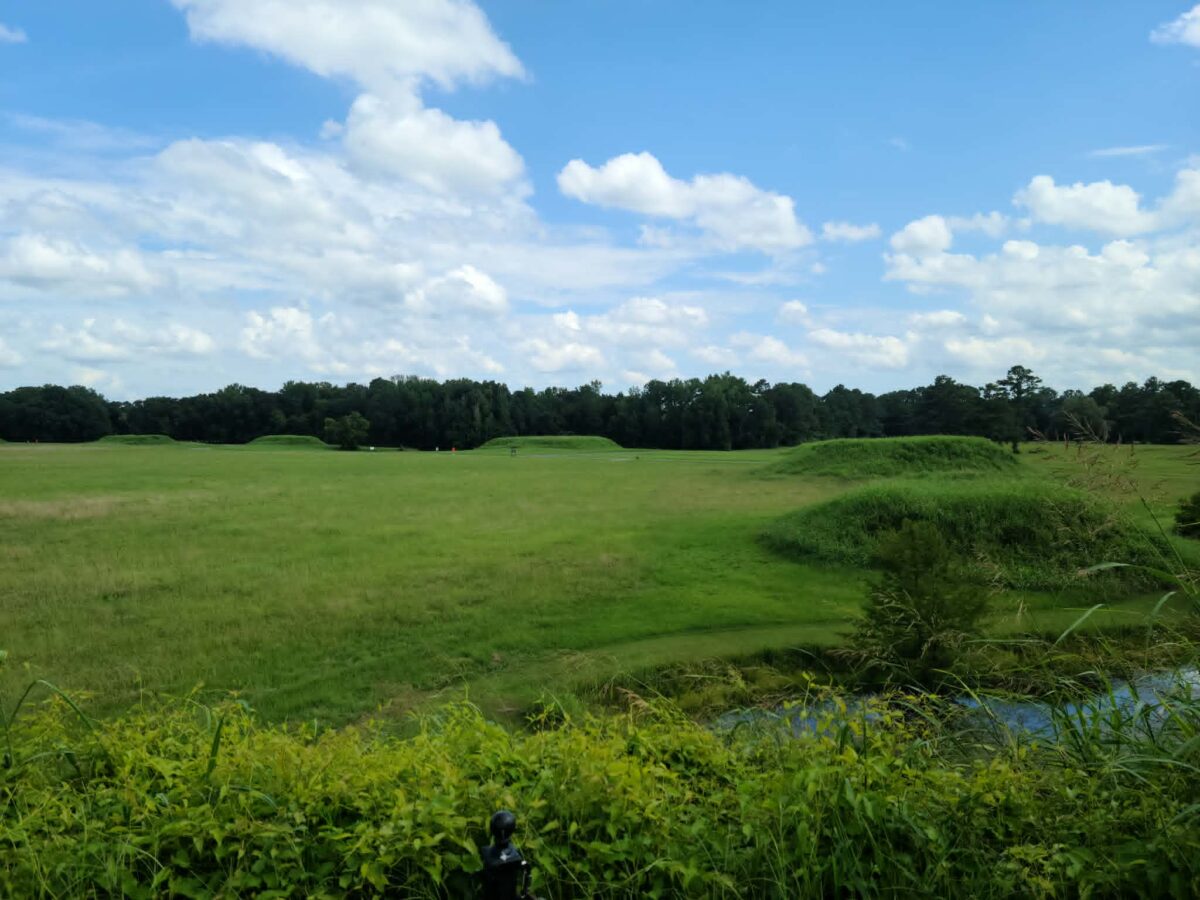
Scarcely more than half an hour south from the seat of the University of Alabama and the third capital of the state (preceded by the towns of Cahawba and Huntsville) lies the appropriately-named Moundville. One the northern limits of the town, itself along the banks of the Black Warrior, is Moundville Archaeological Park. The park and its Jones Archaeological Museum are run by the University of Alabama and comprise the second largest known mound building site of the indigenous Mississippian culture after the great Cahokia itself. The mounds truly are impressive, cast in a broad loop around a wide open field that would have once served as a town plaza and space for the humbler dwellings and workshops of Moundville’s residents, clustered around the feet of the elites’ raised lodges.
As we slowly drove along the park’s drive, we hoped to be able to learn more about each mound and the archaeological work done on the grounds, but there didn’t seem to be any real reason to stop and explore before we reached the museum, at the apex of the loop. There were no interpretive signs or markers anywhere, and of course most mounds are strictly off-limits to climb. No matter, we thought; we have an entire museum of interpretation ahead of us to dissect and explore the vistas we were passing through.
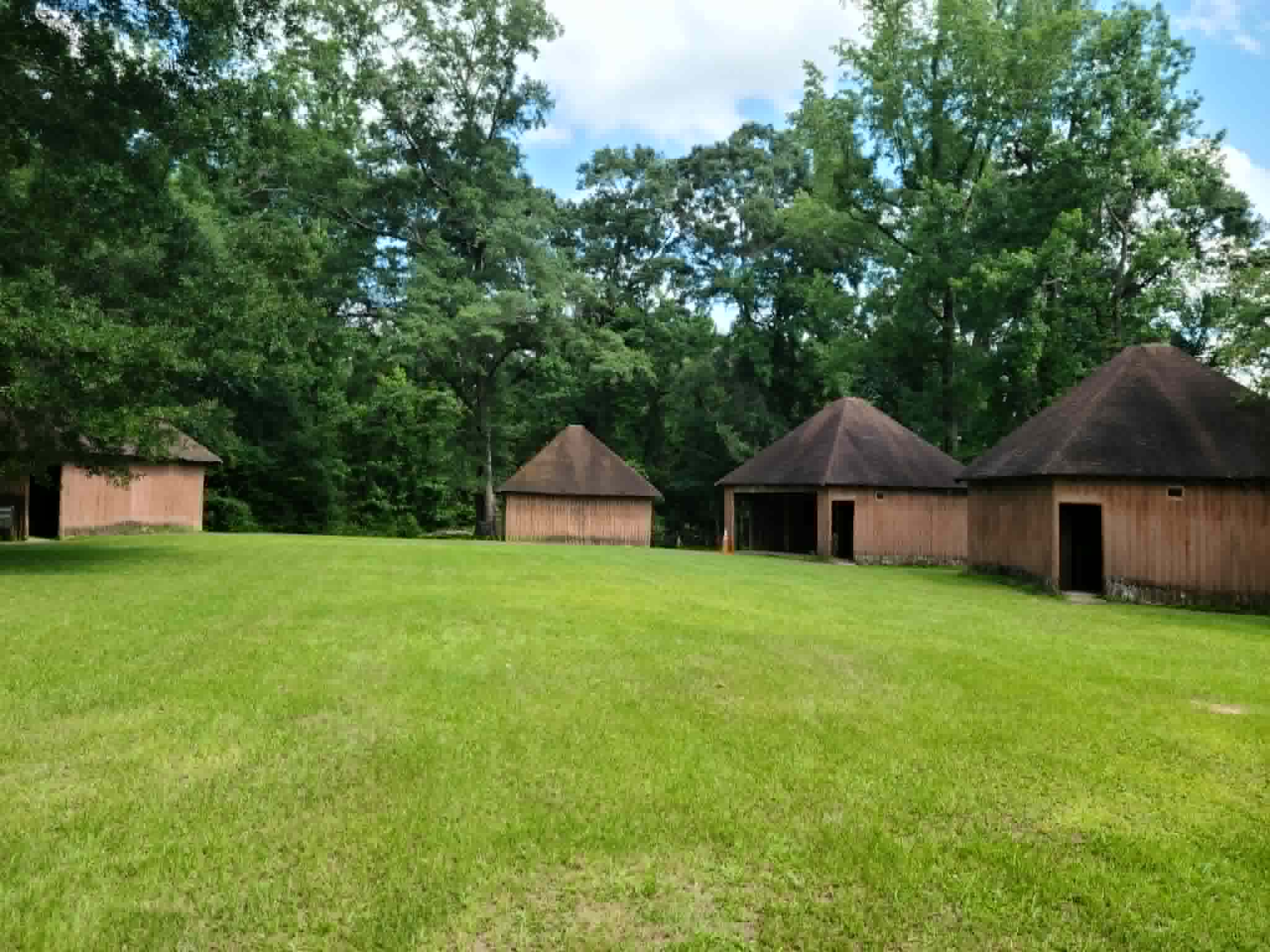
That museum started out strong. Outside its main entrance we found a plaque detailing the role of the Civilian Conservation Corps in constructing the building itself—always a nice touch to interpret not just the subject matter of a site but the modern efforts at interpretation and conservation, as well. Unfortunately, that proved to be just about the highlight. There was certainly some interesting material once we moved inside; the general culture (both material and social) of the Mississippians was displayed reasonably well along with overviews of religious practices and iconography. The problem was that it was all so general. Only once, when we had exited the museum and climbed up onto the only mound featuring stairs for that purpose, did we see any kind of recreation of what the site might have looked like in its heyday, and that was only a section of a painting. There was no model or diorama to really put things in perspective, let alone a description of what specifically each mound might have been used for. The closest we got was a cluster of four huts some distance behind the museum, all clearly intended to look authentic despite being obviously constructed mostly of modern materials. Inside were life size dioramas depicting various crafting and manufacturing scenes (“methods” seems too generous). Rarely have we seen power of place so underutilized and unexplored, especially for one that held such promise!
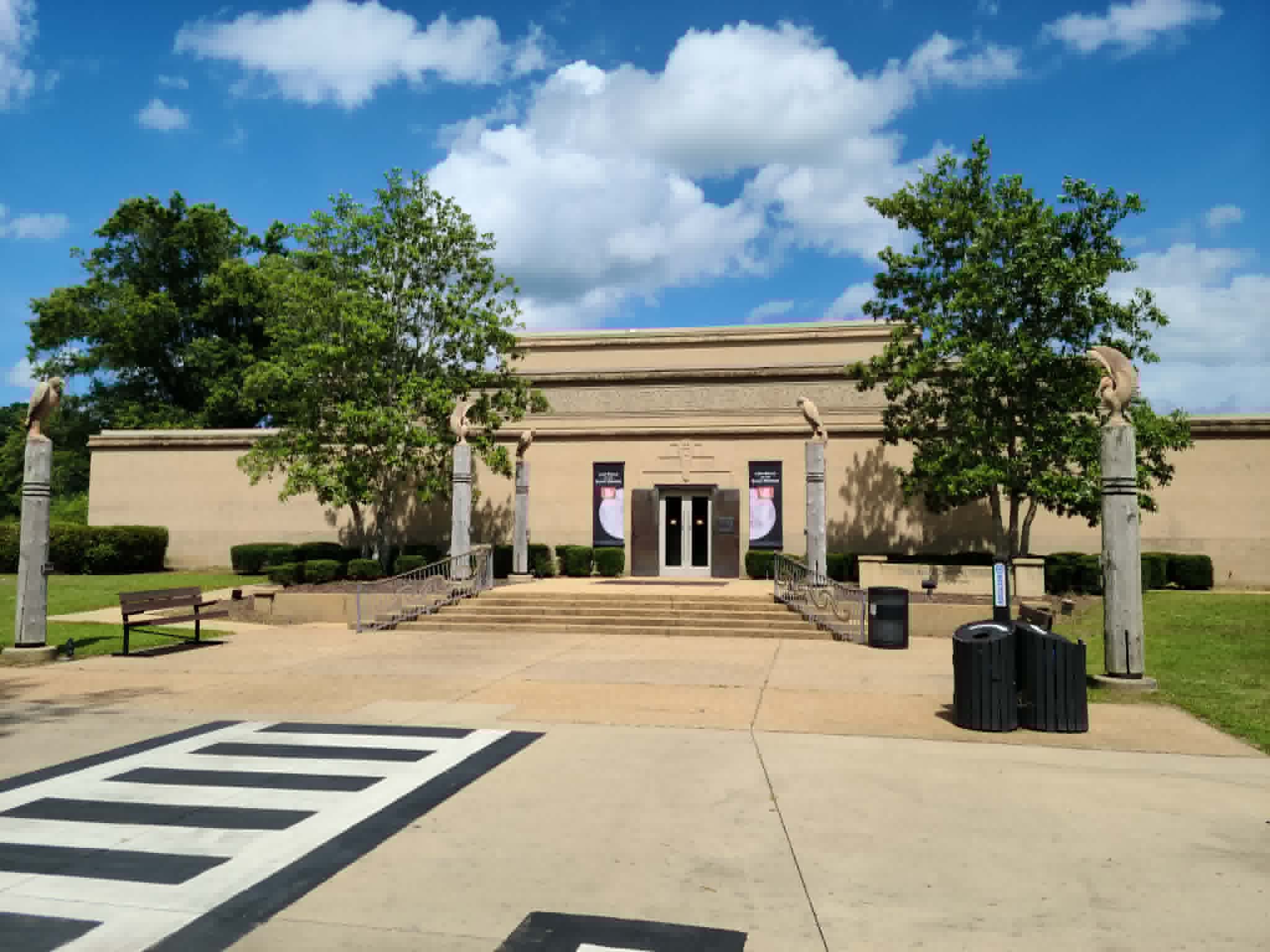
We also couldn’t help wondering why, for what was officially an “archaeological park,” there was so little archaeology actually interpreted or explained. We noticed a number of areas around the grounds covered with tarps or canopies and wondered if perhaps these were active dig sites, but with anti-erosion work and recent flooding we couldn’t be sure they weren’t simply maintenance. Otherwise, visitors who might have wanted to learn more about just how these mounds have been excavated and what we can learn from their physical remains were doomed to be utterly disappointed. Indeed, so much of the information given in the Jones Museum exhibits was presented so confidently with so little actual process to back it up that we found ourselves constantly wondering how accurate it was, or how much it was speculation, and if so what that speculation was based on. It’s not like there wasn’t room for such exhibits; most of the alcoves in one half of the museum were filled with wet specimen jars and taxidermy of local fauna, which seem…not the most important things to display, in this case.
While we certainly don’t regret the chance to appreciate Moundville’s scenery (including a lovely panorama of the Black Warrior itself), we had been hoping for something more intellectually substantial than a nice hike. It really does feel like a whole host of opportunities are being missed there, especially for a site under the jurisdiction of an academic body that could offer so many opportunities for students to cut their teeth on public history and interpretation. Hopefully some of the other historical points of interest we’ve noted for our next trip to Tuscaloosa may prove more our speed.