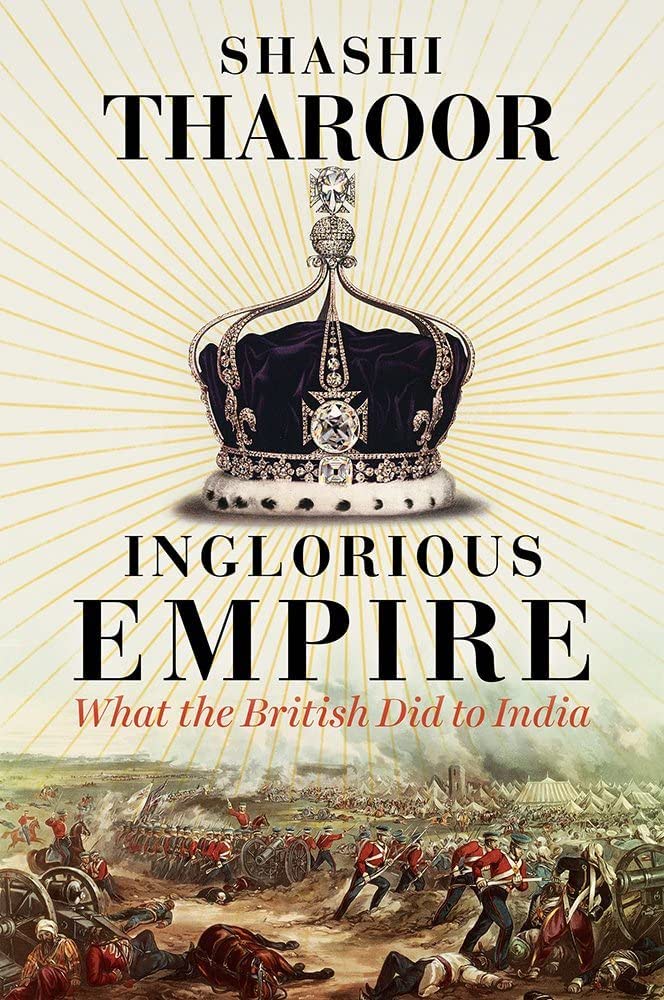
Tharoor, Shashi. Inglorious Empire: What the British Did to India. Minneapolis, MN: Scribe, 2016.
Half a century after its collapse, and over four centuries since its foundation, the legacy of the British Empire is still hotly debated. While its former subjects have largely reclaimed their own narratives to decry the Empire as a rapacious, extractive organism, some in the West persist in claiming that Britain deserves to be lauded for its efforts in establishing the principles of political liberty, democracy, and free trade around the world. One of the forms taken by this clash of memory was a literal debate held at the Oxford Union in the spring of 2015 (only five months before I would matriculate there) over whether Britain owes India reparations. The speech of Indian public servant and author Shashia Tharoor in favor of (largely symbolic) reparations subsequently went viral, and in an effort to more fully explicate his brief remarks, Tharoor went on to publish Inglorious Empire, an historical recounting of all the reasons why, at least for India, the British Empire was in fact a Very Bad Thing.
In this, none but the most hardcore and oblivious neo-imperialist could deny that Tharoor lays out a darkly compelling case. Through a system of brute force and racist governmental policy, Britain intentionally deindustrialized the subcontinent, stripped it of its wealth, and turned what had been one of the wealthiest, most productive regions of the world in the sixteenth century into one of the poorest by the middle of the twentieth. Indeed, Tharoor insightfully points out that this kind of overseas, racially-partitioned modern empire was demonstrably worse than any homegrown variety in that none of the taxes extracted by the British were funneled back into local economies, even indirectly through elite spending on luxuries. Contemporary Britons could not have cared less, their “civilizing mission” rhetoric no more than a convenient cover for their own behavior that benefited Britain first and Indians only as an afterthought. Most of the “positive” legacies of British rule, such as railroads, freedom of the press, and democracy, became so in spite of, not because of, British policy, which was often directly opposed to giving Indians the benefits of foundational Western liberties. Britain cannot even be said to have governed well; too many out of touch laws, loose canon massacres, and catastrophic famines took place over the two centuries of the Company and then Crown Raj for British rule to be guilty of anything other than gross incompetence and mismanagement–at best.
Yet for all its very valid criticisms of imperial misrule, Inglorious Empire remains highly flawed. Tharoor is clear that he is not writing “history,” in that he does not seek to relate the entire history of India under the British, but it slowly becomes clear that he is also not writing “history” in mindset and methodology, either. Rather than simply showing readers that the British Empire was, in fact, an empire, and thus inherently an extractive organism designed to benefit its own core rather than lift up its conquered peoples, Tharoor increasingly relies on counterfactual speculation to condemn Britain for robbing India of a bright, self-determined alternate history it never got to experience. While it is hard to argue that the subcontinent would have been worse off if Britain had not conquered it, the specificities of Tharoor’s counterfactuals and his endorsement of scholars who argue that empire “distorts historical trajectories” reek of the ahistorical modern polemic of nationalist who think, millennia of evidence to the contrary, that imperialism is an aberration and because of it we have lost some ideal world where nations all developed on their own and never interfered with each other in any way.
Much of this is due to Tharoor’s unfortunate decision to essentially continue his Oxford debate writ large, organizing Inglorious Empire around explicitly rebutting the imperial exceptionalist claims of such historians as Nial Ferguson. Thus, rather than questioning why the political unity of the subcontinent is assumed to be “good” in and of itself, Tharoor locks himself into bizarrely arguing that the British shouldn’t be given credit for this “good thing” because Indians probably would have unified themselves anyway. These problems are only compounded by a consistent lack of citation to point readers where the actual history Tharoor is using at evidence has been derived from. Even more concerning, one cannot escape the feeling that Inglorious Empire attempts to finger the British for every misdemeanor while avoiding culpability and even eliding history to absolve Indians of ultimate responsibility. Tharoor’s chapter on British religious policies is by far the worst offender here; somehow, this paper-thin, mismanaged foreign government was supposedly able to convert India from a beacon of religious tolerance to a land riven by deadly strife in little more than a century simply through encouraging Muslim-Hindu political rivalry–yet those Indians responsible for murdering thousands of people and threatening to continue rioting until they receive their demands are never called to account for their own, much more culpable, actions.
By the time I had finished, I was of two minds concerning Inglorious Empire. None of Tharoor’s claims are (or perhaps, should not be) a surprise to any serious student of the Empire, but I am somewhat glad to have them all concentrated in one eminently readable volume that the uninitiated can grasp fairly easily. On the other hand, however, Tharoor delivers a masterclass in how to argue the right thing in the wrong way. Far from being a tour de force of anticolonial rhetoric, then, Inglorious Empire becomes an unfocused, misguided nationalist tract that can never escape dancing to its opponent’s tune. For me, unfortunately, these flaws outweigh it’s strengths, and while it can serve its purpose if it’s the only book available, there are many other works of history out there that, in whole or in part, do a better and more historically grounded job of showing why only a rich white Briton could ever claim that the Empire was a net positive global experience.
One reply on “Counterfactual Refutation: Shashi Tharoor’s Inglorious Empire”
Terrific analysis, in that it coincides with my own. Although unashamedly an Anglophile, one cannot but acknowledge the self serving rapacious impacts of the British in India. Also, by slowing industrial development in India to suit their own purposes, they kept India poorer overall and slowed down the growth in life expectancies that typically accompany industrialisation. However, the author exaggerates the beneficent state of people living in India prior to the British and unreliably argues that Britain was responsible for the worst aspects of the caste system and religious conflict. One interesting indicator of the nationalist character of the author’s writing is the title of the book: not what the British did in India but, instead, to India – starting with the fallacious assumption that a land mass was also a nation.