As part of my ongoing series exploring the Vietnam War, today’s post examines the role of Vietnam veterans in the anti-war movement and explores what makes a protest movement effective. While this post focuses on veterans and their protests, future posts will tackle the anti-war movement and assess its effectiveness.
Three key liberties citizens enjoy in a democratic society are the right to petition their government, the right to peaceably assemble, and freedom of speech. In the US, citizens have used these rights countless times to champion or denounce different causes as part of movements for social or political reform. In the last sixty years, the Civil Rights Movement, the anti-Vietnam War movement, the Pro-Life Movement against abortion, and the pro-gun control movement represent just a few different ways that citizens have organized and deployed their speech and presence to address their grievances against foreign or domestic policy. One key question historians ask, however, is how effective such protests really are. In other words, why did protest movements like the Civil Rights Movement or the movement to overturn Roe v. Wade succeed where others failed? The answer, I think, has to do with who communicates the movement’s message and which institutions are targeted for reform. In the case of Vietnam, the group Vietnam Veterans Against the War was more effective than other anti-war protesters because they peacefully yet passionately protested the Vietnam War, were veterans with lived experience who could not be dismissed as brazen Communist sympathizers, and targeted the Senate Foreign Relations Committee in Congress to convey their discontent.
It is important to note that, throughout the Vietnam War, the anti-war movement, which started early, lacked the broad support of the American public. Gallup, the longstanding pollster of American public opinion, did not find that a majority of Americans (52%) thought sending U.S. troops into Vietnam was a mistake until January 1969, the month Nixon’s new administration took office promising the Vietnamization of the war. Even then, anti-war protesters did not draw widespread support. For instance, on May 8, 1970, unionized construction workers in New York City marched in a patriotic, pro-veteran/pro-soldier march and clashed with anti-war protesters who were flying the North Vietnamese flag. To me, this clash epitomizes the most common way Americans viewed the Vietnam War. They may have had antipathy toward the U.S. war in Vietnam, but they did not condone anti-war protesters’ demonstrations. In fact, as historian Christian Appy has reported, the unionized construction workers who attacked anti-war protesters were from the same working-class demographic overrepresented in the draft. If anything, these men should have been more vocal critics of the war considering their brothers, sons, and friends were more likely to be drafted. Yet, they were the ones countering demonstrators in New York.
That said, Vietnam Veterans against the War, which coalesced out of the broader anti-war movement, did more effectively communicate discontent with the war. There were several reasons for this. First, unlike some of anti-war marches, Vietnam Veterans Against the War staged and targeted protests at and against Congress. Their goal was to move policymaking and express discontent. Second, as veterans, their words carried more clout; it is harder for an elected official to ignore what a soldier who fought in Vietnam thinks than a college student protesting a draft that has not yet affected him or for which he is exempted due to his educational status. Third, these soldiers and veterans had a sympathetic audience in Congress. Prior to the VVAW protests in the early 1970s, Congressional leaders on the Senate Foreign Relations Committee had already started to investigate the Department of Defense for its decision-making in Vietnam. These factors converged to make the Vietnam Veterans Against the War’s protests more effective.
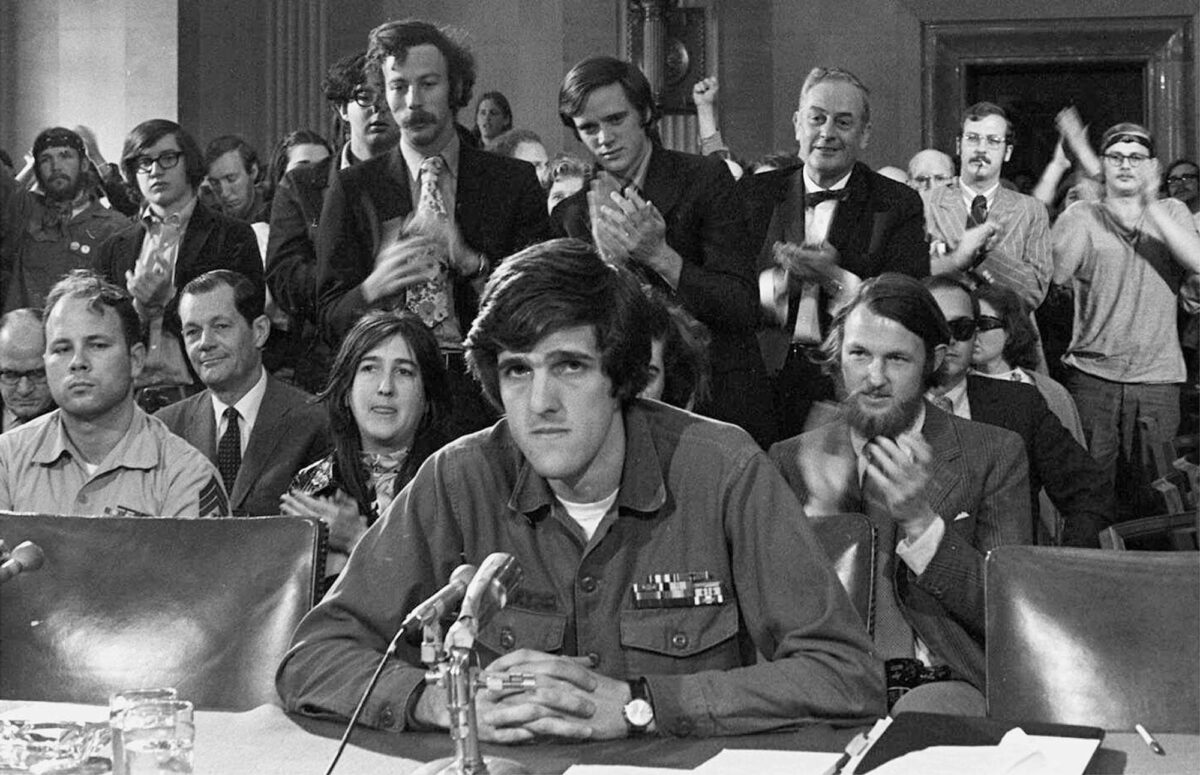
First, in an act of protest Congress could not ignore, VVAW staged a weeklong campaign in April 1971 where they threw back their military medals and ribbons onto the steps of the Capitol Building. That same week, the articulate veteran Lt. John Kerry testified before the Senate Foreign Relations Committee about the atrocities he had witnessed in Vietnam, the degrading treatment U.S. soldiers experienced fighting the war, and his belief that the U.S. could not win. Kerry and his fellow veterans’ testimony was not banal, either. He noted that “We are here in Washington also to say that the problem of this war is not just a question of war and diplomacy. It is part and parcel of everything that we are trying as human beings to communicate to people in this country, the question of racism, which is rampant in the military…the use of weapons, the hypocrisy in our taking umbrage in the Geneva Conventions and using that as justification for a continuation of this war, when we are more guilty than any other body of violations of those Geneva Conventions, in the use of free fire zones, harassment interdiction fire, search and destroy missions, the bombings, the torture of prisoners, the killing of prisoners, accepted policy by many units in South Vietnam.” He argued that the U.S. perpetrated war crimes and failed to acknowledge how racial discrimination affected both the military at war and the nation at home. However, their target was not the Pentagon or White House, but Congress. Kerry himself said, “We have come here, not to the President, because we believe that this body can be responsive to the will of the people, and we believe that the will of the people says that we should be out of Vietnam now.”
In the aftermath of the VVAW weeklong protest in April 1971, the Senate acted. Despite the Nixon administration’s efforts to silence Kerry by smearing him and tamping down on the Pentagon Papers, published shortly after Kerry’s testimony, the Senate passed resolutions setting specific deadlines for troop withdrawals. Though the House tempered them, such legislative action signaled that Congress would not play to the President’s tune any longer. Some may argue that a resolution is toothless, but, in the long history of the Vietnam War, the Senate’s decision was a change in policy. From Eisenhower to Nixon, Congress had largely acquiesced to presidential demands for more money and troops for the Vietnam War. This resolution sent a different message: the White House was wrong and Kerry and his partners were right. The time had come to withdraw from South Vietnam. In fact, the chair of the Senate Foreign Relations Committee J. William Fulbright (yes, that Fulbright of the Fulbright Scholarship Program) even asked Kerry to comment on pending legislative action regarding Vietnam after Kerry delivered his April 1971 testimony. Though the actions of the US government are often too Byzantine to say that there was a direct causation between what the VVAW did and how Congress acted, there’s a strong correlation and I think it is fair to conclude that the VVAW’s protests catalyzed the critique of the U.S. policy in Vietnam from that of a controversial minority into a deep well of civilian opposition that Congress and Nixon could not ignore.
I measure the VVAW protests as effective for a few reasons. First, there was a contingent moment when the veterans involved in VVAW had the momentum of a nation skeptical of the war behind them. Second, unlike protests on college campuses, VVAW had testimony from the American people most impacted by U.S. policy in Vietnam: former soldiers. Congressional leaders could and did dismiss anti-war protestors as deranged college students. They could not do that to men and women honorably discharged or still in the ranks. Furthermore, and this is key, the VVAW targeted their protests toward a particular institution, the Senate Foreign Relations Committee. Rather than choosing an unresponsive institution, like the Department of Defense, which is entirely led by appointed commanders, the VVAW spoke to Congress, the U.S.’s representative, lawmaking body. They also asked for specific actions: that Congress evaluate its funding for the war, that it initiate investigations, that it withdraw troops from Vietnam, and that it wanted Congress to take these steps to end the war. In the end, these veterans earned a sympathetic ear in Congress and had positive press coverage from major news organizations. Though it still took time for Congress to reign in the Vietnam War, the VVAW communicated a radical message with specific policy needs to the part of the government most able to effect change.
As a coda, it should be noted that the VVAW’s protest campaign inspired more militant protesters to storm D.C. and riot over three days as part of the loosely coordinated “May Day Tribe” demonstrations. These protesters faced mass arrests and lost public sympathy immediately. In fact, Nixon thought that these protests eroded sympathy the public felt toward the VVAW as they turned disruptive and violent. Later, the VVAW did embrace more radical plans, including one to assassinate hawkish Southern senators. By that time, however, its more mainstream veterans had left the organization. Still, in 1970 to 1971, VVAW conducted an effective protest against the Vietnam War because its goals and strategies leveraged the power of its members’ status and experience to pressure the institution most able to respond for change.
Further Learning:
Ken Burns and Lynn Novik’s “The Vietnam War: A Disrespectful Loyalty,” Episode 9.
Christian Appy’s Working Class War: American Combat Soldiers and Vietnam (Chapel Hill, NC: UNC Press, 1993).
George Herring’s America’s Longest War: The United States and Vietnam, 1950-1975, 5th Edition (New York: McGraw Hill, 2014)