by Bryan & Heather
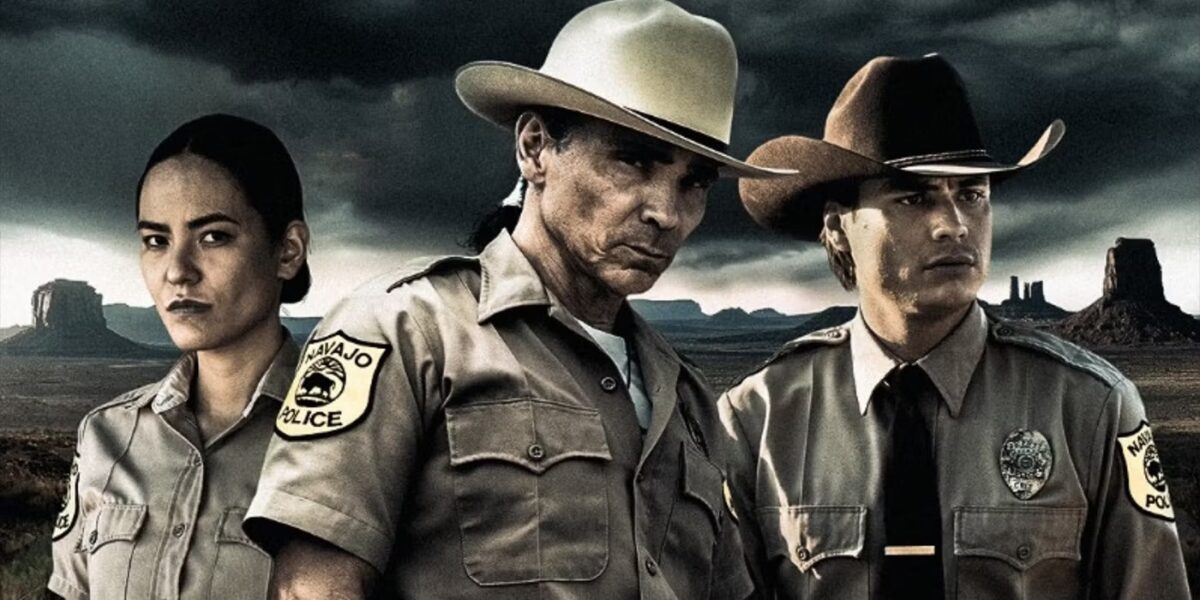
Sometimes, timing is everything. Bryan had just finished working with a student with a passionate interest in modern Native American issues and the indigenous activism of the ‘60s and ‘70s when we saw a new show come across our Netflix banner. From rarely-low-quality AMC, Dark Winds (based on a series of mystery novels written in the ‘70s and ‘80s by Tony Hillerman) promised a gritty combination of noir and Western as Navajo tribal police seek to solve a mysterious string of murders on the largest Native American reservation in the country. Crime drama for Heather, period piece for the both of us. The show was quickly bookmarked, and a couple months later we finally got around to watching.
It’s hard to start a show with higher octane than Dark Winds. 1971 Gallup, New Mexico, is seen to a shockingly violent armored car robbery with the masked perpetrators fleeing the scene in a helicopter that then traverses the Navajo reservation. A short time later, the niece and client of an elderly Navajo medicine woman are brutally murdered in a hotel room. Veteran Tribal Police officer Joe Leaphorn is confronted by the local FBI office over the robbery, and Leaphorn and his deputies Bernadette Manuelito and Jim Chee (himself an undercover FBI agent) slowly discover that these two crimes are intimately related through the Buffalo Society, a fringe extremist group of Navajo committed to fighting for indigenous freedom whatever the cost.
As exciting and compelling as the plot of Dark WInds would turn out to be, however, the history it contains turned out to be more of a mixed bag. Some of the material culture, particularly cars, architecture, and other physical items, is generally pretty good. Costuming, however, can never seem to make up its mind whether it is of the period or just modern wardrobe. In a larger sense, the history that forms the backdrop of these mysteries is very good, but not organized for the best effect. As it should be, militant indigenous activism is front and center in the first season, yet the radicalism of the Buffalo Society unfortunately comes off as rather cliche. Their leader, James Tso, is a classic ends-justify-the-means revolutionary, too consumed with his own quest for justice to notice that he’s turned into the very monster who abuses and kills Native Americans that he’s supposedly fighting against. The conditions that gave rise to those kinds of movements are present in Dark Winds, certainly, but the poverty and health issues are always part of the backdrop, rarely commented on explicitly. Indeed, perhaps the most gut wrenching injustices is saved mostly for the second season: during this period, thousands of indigenous women were sterilized without their informed consent by white doctors, often in the aftermath of coming into the hospital to have their first child. Leaphorn’s wife Emma is one of these women, and as a nurse she attempts to steer young Navajo women towards home births. The series only briefly touches upon this as a plot device in the first season, and while it thankfully develops these women’s trials in their own right in the second, it’s a shame that such a clear justification for the radicalism of the Buffalo Society and organizations like them is left out of their storyline. Indeed, by the end of the season James Tso is revealed to be a thoroughly unsympathetic, despicable person from top to bottom rather than any kind of complicated revolutionary whose fervor took him across a line.
Unfortunately, most Native American history (with the exception of the women’s stories, which is mostly a B-plot) is left out of Dark Wind’s second season as Leaphorn’s story moves into seeking justice, or perhaps vengeance, for the son killed in a mining explosion he now suspects may have been intentionally set. We shall see what the third season, premiering March 9 of 2025, will bring, but as it currently stands those interested in the show as a period piece with historical insight into a certain era can largely focus on just the first season. Any show exploring such an interesting and tragically overlooked element of the radical ‘60s and ‘70s, though, is welcome in our book.