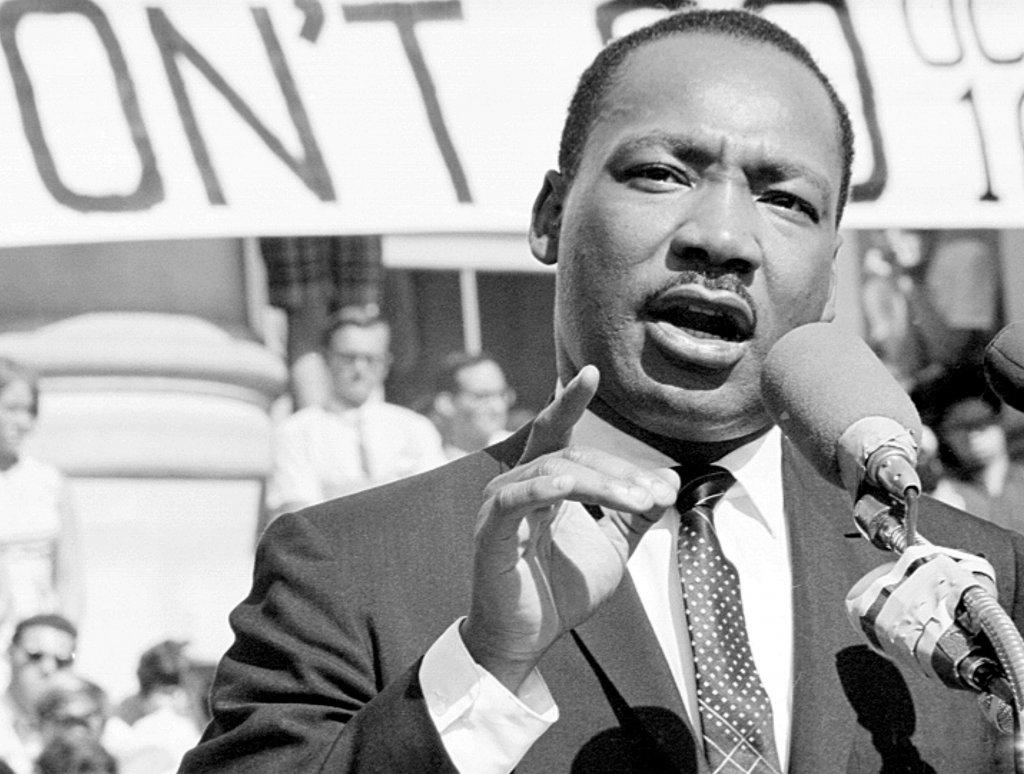
In my last post about the Rev. Dr. Martin Luther King, Jr., I discussed the ways in which Americans either do not know or misremember King’s message and legacy. Americans often admire King as something of an American saint who is unapproachable and irreproachable despite the fact that he was, in reality, a deeply faithful, courageous, sometimes flawed, articulate, and energetic man who left behind a complex roadmap for American society to become a more just community. As a U.S. History teacher, I often challenge myself to rethink how I teach King in my unit on the Civil Rights Movement so that he is not just a caricature or an edifice. Today, I will share some of my thoughts on the challenges of returning to King each year in my teaching.
My goal is that students walk away understanding King’s courage, his core ideas, and have a greater understanding of the larger Civil Rights Movement.
First, I always want students to understand that King was one of many important leaders in the Civil Rights Movement and that there were robust (and sometimes rather heated) debates between different Civil Rights organizations about how to best pressure Southern states and the federal government to dismantle Jim Crow. King’s organization, the Southern Christian Leadership Conference, united Black Protestant Churches across the South and raised funds from a coalition of multiracial supporters across the United States. However, the SCLC also partnered, in various ways, with the Congress for Racial Equality (CORE), the Student Nonviolent Coordinating Committee (SNCC), and the NAACP, depending on the place and issue at hand. The challenge here is to place King in the context of other important leaders like Ralph Abernathy, Ella Baker, Rosa Parks, Bayard Rustin, John Lewis, Diane Nash, or A. Philip Randolph (among many more). The Eyes on the Prize Civil Rights Reader has been a helpful source to do this since it contains excerpts of primary sources from many different activists and can give a sense of the breadth of the movement.
Second, I want students to analyze King’s words but, given the constraints of time, student stamina, and the length of King’s writing or speeches, I often struggle with what excerpts to use. I have found that the three most effective sources from King are his 1963 “Letter from Birmingham Jail,” “I Have a Dream Speech,” and 1967 “The Other America” speech in excerpts. While it may seem terrible to excerpt these speeches rather than teach them in their entirety, together, I think they provide a better sense of King as both an activist against Jim Crow and for economic reforms that could alleviate poverty in America. As I mentioned in my last post, that part of King’s legacy is one scholars of King’s philosophy and public life often emphasize as an underdeveloped area of knowledge Americans have in general.
Third, I have started to use artistic interpretations to share what King did and to communicate some of the trials he faced personally. The 2015 movie “Selma” has a sequence in it in which the FBI harasses Corretta Scott King with threats and surveillance. This movie is one of the first to really interpret King in a fictionalized way and students often react when they see the type-writer script of FBI bulletins on the screen narrating what King is doing at a particular moment.
Lastly, I always end with an overview of the real achievements of the Civil Rights Movement and how all the people who worked to overturn Jim Crow did, in fact, succeed in changing U.S. law and pulling the federal government into enforcing the Constitution in ways it had not for a century.
The challenge of all this is that King has so many facets to his life and work that balancing what to share and interpret with students is a recurring conversation I have with myself and coworkers. For instance, I tend to focus less on his philosophy of nonviolence and more on his critiques of Jim Crow or poverty, but it is fair to say that King ought to be studied alongside Gandhi’s nonviolent teachings and practices or within a larger unit on challenges to imperialism and discrimination across the world during the Cold War. Moreover, I teach King before I address the Black Power Movement, since I tend to go through this chronologically, whereas many units of study available online will emphasize an intellectual interrogation of the Civil Rights Movement rather than one focused on institutions and causes and effects. In the end, I hope that my students leave my class understanding King as a man with more ideas than just his “I Have a Dream” speech and one who asked Americans deep questions about who we were, are, and want to be.
The beauty of this intellectual question is that I feel I am in dialogue with King, like any other historic figure studied and taught in a curriculum year after year. The challenge is that my students often only get one chance to study King and move beyond the simpler overviews they learn in elementary school about who King was. Ultimately, I tend to emphasize the man’s words and the causes and effects of his work more than anything else since I see a more intellectual history of King, or the study of his memorialization, as too abstract. That doesn’t mean I’m right and those who do it differently are wrong. It just means that King often becomes a man of ideas and action in my class more than a prophet, savior, edifice, or flawed leader.
My primary worry, which frames my larger schema for teaching students about historical figures, is that they are reduced to caricatures who seem irrelevant to us in the present even when the differences in their lives and context do not obscure the questions that their ideas, lives, and actions ask us to consider about ourselves. Whether I am teaching about Washington, Lincoln, or King, I hope that students in some way see that these people are worth returning to in their study or interest, even if it is in a YouTube video or a National Geographic documentary that they watch a decade from now. Returning to King each year has helped me think about what it means to be a good person, a clear thinker, and a good citizen and that, ultimately, is what I hope I can achieve in my classroom as well.