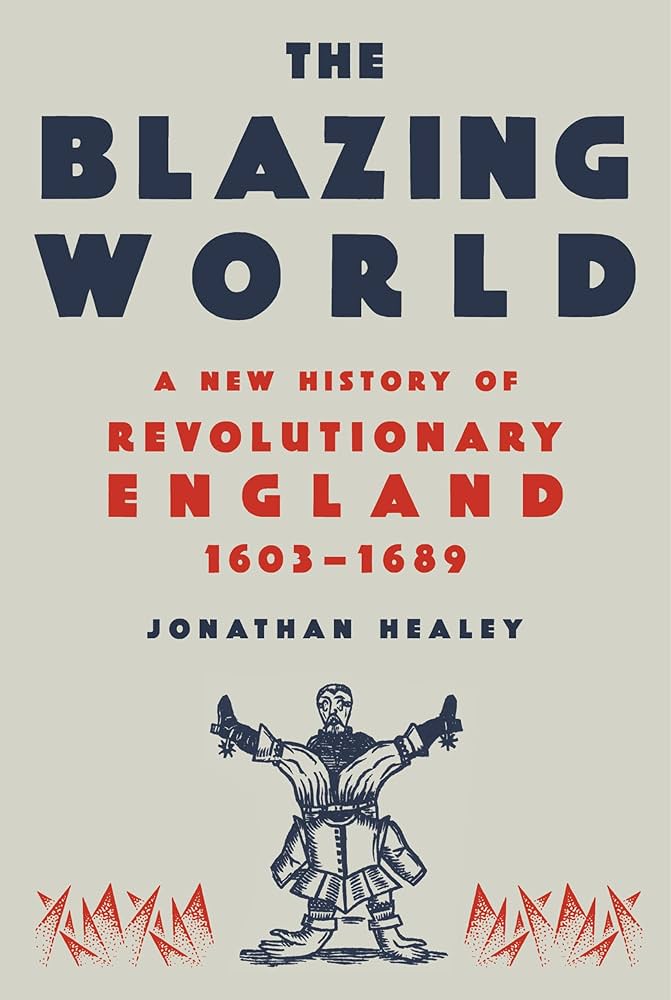
Healey, Jonathan. The Blazing World: A New History of Revolutionary England, 1603-1689. New York: Alfred A. Knopf, 2024.
For all my professional specialization has focused on Britain, and specifically her empire, in the eighteenth, nineteenth, and twentieth centuries, so much of the country’s history hinged on developments during its tumultuous 1600s. The enduring shapes of not only its political institutions but its religious establishment and financial infrastructure would all take shape during that century of dynastic change, revolution, and counter revolution. Only recently, though, have I delved back into this early modern English world on my own after previously having only studied it in classes and briefly touched on it with the foundations of empire and colonization. Jonathan Healey’s new history of England in this period, then, looked right up my alley for an in depth refresher.
As it turned out, The Blazing World was all I hoped it would be and more. Not confining himself to just a history of the English Civil War, Healey begins his narrative with the death of Elizabeth I and the transition from Tudor to Stuart dynasty with the ascension of James VI of Scotland to the throne of England as James I. In thus starting decades before the outbreak of armed hostilities against James’ son and successor Charles I, he is able to focus on the broad themes and trends that primed the powder keg of revolution and resolved themselves not just through the war, but in Parliamentary rule, Cromwell’s Commonwealth, the counterrevolutionary Restoration, and ultimate Glorious Revolution. Far from simply a clash between absolutist monarch and republican aristocracy over the pursestrings of state, the Civil War—and indeed the entire seventeenth century—was a drawn-out conflict over England’s religious future (fittingly, given it was contemporary with caused in part by the Thirty Years War on the Continent), with class and economic agitation spawned by London’s growing pains often catalyzing the mix unpredictably. Healey’s background as a social historian is perfect for this narrative, tracing all these strands as they interact and influence each other while admirably not neglecting the political and military events that give it structure and move it forward. Unsurprisingly, with everything placed in its proper context both broad and specific, England’s revolutionary era makes a whole lot more sense than when studied through lists of terms from a textbook chapter. In the process, any number of usual misconceptions are dispelled and even some reputations tarnished or partially restored.
Whatever weaknesses exist in The Blazing World are more those of absence than of presence. It is understandably a feat of organization and prioritization to write a monograph covering nearly an entire century, and some things will be left out or covered brief than others. Still, when compared to the space devoted to the reigns of James I and Charles I and the period of the Civil War, the Restoration and Glorious Revolution were positively skimmed through as Healey rockets toward his conclusion. A fairly minor criticism, to be sure, and one that takes nothing away from my very highest recommendation to those interested in the topic, and even those who might have soured on it after underwhelming instruction of years past.