by Bryan & Heather
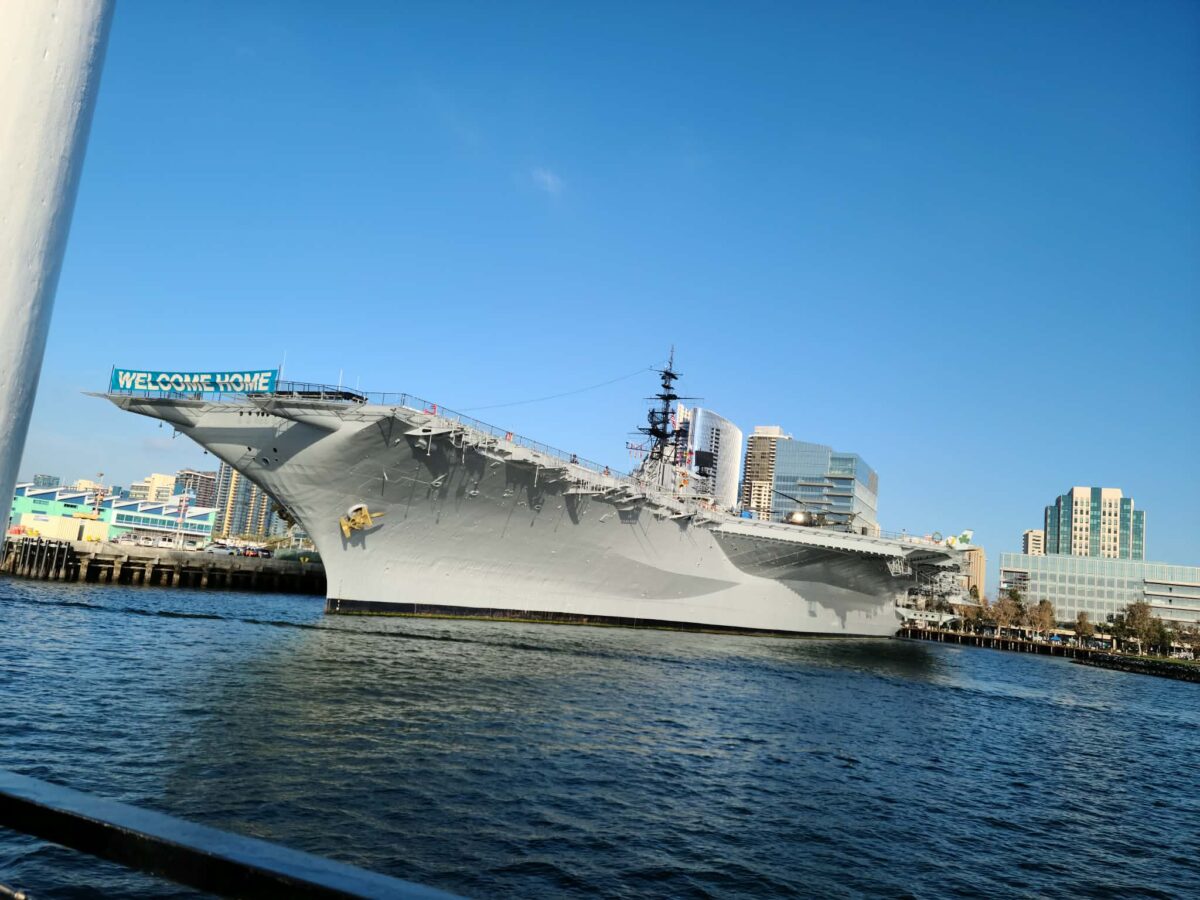
It’s hard to miss the presence of the United States Navy in San Diego, California. The northern half of Heather’s home of Coronado, the island-turned-peninsula across the bay from San Diego proper, is one of the biggest Naval bases in the country, and countless vessels in active service can be seen from the shore or, especially, while crossing the Coronado Bridge. There is only one of those massive vessels that the public can visit, however: the USS Midway. Commissioned in 1945 just as the Second World War was drawing to a close, the Midway bears the distinction of having served for the longest time of any aircraft carrier in history, only being decommissioned in 1991 at the close of the Gulf War. Ironically, however, given her own interest in history and familial connections to the Navy, Heather had never visited this floating museum, and thus naturally neither had Bryan. While visiting Heather’s family for Thanksgiving in November of 2025, we decided to finally correct this blindspot—and what a day we had in doing so.
It’s hard not to feel small next to an aircraft carrier. The Midway looms over visitors as you walk down the pier and up its gangplank, and while its size takes on different forms throughout your visit, it never really goes away. We quickly learned that the ship houses in essence four different museums. The first and most obvious, hints of which can be glimpsed peeking over the edge of the flight deck and then on full display as one enters the cavernous hangar deck, is a history of naval aviation since the Second World War through the display of real aircraft. With only one exception, these aircraft are originals, and many were at one time part of the Midway’s own complement. The second, understandably, is a survey of the Midway’s own history and service through Korea, Vietnam, the First Gulf War, and numerous other humanitarian missions. The third is the ship itself; visitors can proceed through a number of “loops” through the bowels of the ship, visiting the quarters and messes for officers and enlisted sailors, machinery and engineering compartments, and command centers. It’s a truly fascinating, daunting, and, at times, disorienting labyrinth of passages for a landlubber, and it formed the bulk of our nearly five hours onboard. The fourth and final museum is the least directly related to the ship, but is perhaps understandable: a film and plaques discussing the history of the Battle of Midway, the ship’s namesake. Together, these four interpretive rivers combine into a veritable ocean of modern naval history, both specific and general. We’ve seldom encountered such an overwhelming amount of history to digest, and even after almost the entire day, we weren’t able to fit everything in.
Normally, such a massive volume of interpretation can easily become tiring, if not outright mind numbing, after a few hours. Another feature of the Midway, however, not only mitigated this danger but brought the ship and its aircraft alive in ways few museums can match. Immediately upon entering the hangar, free self-guided personal audio tours are available. Rather than an extensive monologue or only a handful of lengthy talks, this tour is split into eminently manageable bites that are played through scanning certain icons throughout the ship’s decks, many in conjunction with small interpretive plaques. What’s more, every single talk is narrated by a veteran that served on the Midway at some point during its half century of service (and in one case, a Vietnamese girl whose family were rescued by the Midway after the fall of Saigon), imparting unique insight and color to visitors. These individuals are not confined to audio files, either; any museum docent who wears a yellow hat is one of these veterans and, as you might guess, more than eager to talk visitors’ ears off in person. Not simply power of place, then, the Midway doubles down with the power of people, primary sources in the flesh.
This is not to say, though, that the Midway necessarily makes our list of the best museums we’ve ever visited. There is a tendency for major tourist destination military history institutions to deliver a more-or-less classic, unreflective narrative, especially where the Second World War is involved. The Midway is no exception in this regard. While there are a few plaques devoted to women and their role in both the Second World War and the military in general, there’s really no mention of any other social issues or complicated questions about any of the material covered. If the purpose of interpretation is to inform, the Midway receives highest marks; if the purpose of interpretation is to challenge the public to think critically about history and continue reflecting long after their visit, the Midway fails in any way that matters—but that does not mean that it’s not a hell of a way to spend a day, no matter what your interest or historical background.