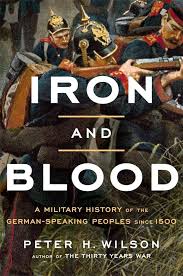
Wilson, Peter H. Iron and Blood: A Military History of the German-Speaking Peoples since 1500. Cambridge, MA: Belknap, 2023.
Few modern nations have such a reputation for military excellence as Germany. While the Federal Republic has thus far broken decisively with its imperialist and fascist 20th-century past, even its armed forces have been recognized for their skill and competence, not least in counter-terrorism operations. At the same time, few modern militaries have accrued as much, shall we say, controversy, as Germany’s, much of it directly related to that reputation for excellence and its dark side, the infamous German militarism of society in the 19th and 20th centuries. As someone of German heritage myself and a sucker for long duree histories to boot, then, Peter Wilson’s military history of the German-speaking peoples over the entire modern period immediately caught my eye. Yet while it certainly provided a wealth of information about the evolution of German and European warfare more generally since 1500, the impact of Wilson’s larger arguments proved more of a mixed bag.
Iron and Blood takes as its main themes the refutation of precisely those two pillars of German military history: that Germans, especially after 1700, possessed a special genius for war and that German society was militarized to a unique degree. Wilson succeeds at the first, while largely failing at the second. Related across five centuries, the narrative of German military development unfolds as one that came increasingly to rely on an overwhelming first strike in an effort to win a given war quickly and decisively before it could spiral out of control and beyond a state’s resources to continue the conflict. Such a reliance led to too high an emphasis on granular tactics and the failure to plan for long-term strategy beyond that initial campaign. While efforts to prepare adequately for war led to a pronounced edge at the outbreak of hostilities, the deprioritization of diplomacy simultaneously made those hostilities much more likely. The First World War is the model conflict for this “German way of war,” but Wilson persuasively exposes elements of it that are easily seen in conflicts from Frederick the Great and earlier right up through Hitler’s invasion of the Soviet Union. Along the way, he also takes pains to address other less-than-accurate traditions like the supposed prowess of Swiss militia or claims that the Wehrmacht was somehow not complicit in the crimes of the Third Reich.
Unfortunately, however, the strength of all this analysis cuts the legs out from Wilson’s other argument, that German society has never been as militarized as many across the centuries have argued. Much of his evidence in this regard seems to consist of showing that the military was not the be-all, end-all of civilian society and that spending/conscription/preparedness was not that much higher relative to other European nations of any given time. That all may be, yet this is not all that constitutes militarism (a term never actually defined at any point in Iron and Blood), and repeated instances of German military leadership ignoring civilian authority, claiming special status in society, and behaving as if any attempt to avoid or mitigate conflict is worthless demonstrates that militarism was certainly present in these countries, especially the Second and Third German Reichs, in ways that simply were not the case elsewhere.
Iron and Blood’s organization can also prove somewhat problematic, especially to readers who seek a more holistic historical narrative. Wilson’s work is divided into a separate section for each century, each consisting of three chapters that discuss military history, organizational/tactical history, and wider cultural impact during that period. It is one of the more tightly regimented organizational schemes I’ve come across in recent memory, and while it certainly leads to a well-ordered monograph, it also separates events and developments from vital context and causation, not to mention rushing the discussion of certain periods that deserve much more attention–in the most egregious example, both World Wars are shoved into the same 20th century section that also contains all Cold War and modern developments.
None of this is to say that Iron and Blood is a poor work of history; far from it! While it cannot necessarily take the place of a general European history of the last five centuries on its own, there is enough overlap, and Germany is so central to that history, both literally and figuratively, that one could do far worse in a pinch. The evolving nature of societal organization, logistics, recruitment, and training are truly fascinating, and the opportunity to learn from the mistakes of the past are very clear–though that is always more easily said than done. On balance, Iron and Blood’s strengths outweigh its flaws, and I look forward to exploring Wilson’s more focused works in the future.