by Bryan & Heather
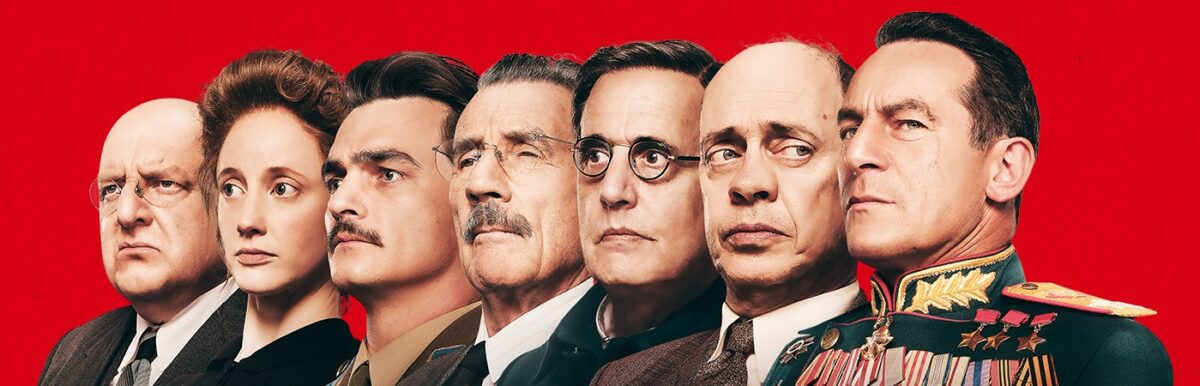
We often find ourselves remaking that if current political events weren’t so tragic and concerning, they’d be absolutely hilarious. Perhaps that’s the reason Bryan’s had the 2017 film The Death of Stalin on his mind lately, or maybe it’s just the desire to make fun of some despicable men for the hapless fools they really are. In any case, we were finally able to find Armando Ianucci’s black comedy in a format we could watch here as May of 2026 drew to a close, and so we braced ourselves for whatever this Cold War political farce might bring.
The Death of Stalin tells the story of the days following, well, the death of Joseph Stalin. The brutal dictator of the Soviet Union died of a stroke on March 5, 1953, and left a vacuum both politically and psychologically for the residents of the world’s first Communist state. Stalin’s arrests, purges, and executions had resulted in a suffocating blanket of anxiety and terror among all levels of the populace, even and perhaps especially for the high-level party officials who worked directly with and under Stalin. This sudden removal of this source of dread left open a world of possibility for these officials either to reform the nation or seize the mantle and power of autocrat for themselves, if their compatriots could be outwitted and outmaneuvered. Yet running a country on a demand for yes-men and reflexive, unthinking loyalty for decades is not exactly a recipe for competence or efficiency, and it is this phenomenon that Iannucci mines for the source of his biting satire. From a parade of physical comedy surrounding the discovery, mourning, and moving of the “Big Man’s” body to prisoners correcting their final praise of Stalin before execution to praise of his replacement upon their correction by guards to the simultaneous professions of loyalty and murderous intent by numerous characters, The Death of Stalin felt to us like it truly captured the dark absurdity inherent in authoritarianism.
The problem historically, however, is that the film does not capture the realities of specifically Soviet, Stalinist authoritarianism well at all. Really the only details faithful to the historical record are the dates of Stalin’s death and subsequent funeral four days later. Multiple individuals in the film hold ministerial posts they did not hold at the time (or ever) in real life, especially including the antagonist Lavrenti Beria, who had not been head of the NKVD secret police for seven years—largely because the NKVD had been divided and dissolved in 1946 and thus did not exist at the time the film is set. Multiple small details of Soviet procedure are ignored (such as who chaired certain important meetings), and hero of the Second World War Georgy Zhukov is not only given the wrong rank (he was Marshall of the Soviet Union, not Field Marshall) but a much greater role in the choosing of Stalin’s successor than is accurate—that is to say, any role at all, as he was posted to the provinces at the time and was not head of the Soviet Army (though maybe we can forgive that, as his portrayal by Jason Isaacs is so bombastically fun that he becomes the hero of the film, in many ways). Even the circumstances of Nikita Kruschev’s final plot and victory over Beria are almost entirely fabricated; Beria was not arrested due to secret police forces massacring mourners only attempting to see Stalin’s body (not the only slaughter Iannucci made up, as the execution of all Stalin’s domestic staff after his death did not happen, either) but in relation to an uprising in East Germany months later, and would be executed six months after his arrest, not immediately, and certainly not by Zhukov and his generals in dress uniform and wielding assault rifles. Some of these decisions might be forgiven in the pursuit of telling a more condensed, dramatic story for viewers, yet so many of these other details are inexplicable. Most audience members have no idea who any of these figures were, anyway, and a more accurate lineup would have changed nothing about the film. Indeed, it feels at times like Iannucci and his screenwriting partners only did enough research to give their film a Soviet wallpapering. Indeed, Cambridge historian Samuel Goff quipped in his review that it is “fundamentally ill-equipped to locate the comedy inherent to Stalinism, missing marks it doesn’t know it should be aiming for.”
So maybe The Death of Stalin is a bit more generic than we at first thought. That doesn’t mean that it doesn’t get at least the broad details of this dire-yet-farcical historical drama correct, though, and it certainly still fulfilled the reasons that first drew us to it. One must simply note that it is functionally useless for learning much of any history beyond those extremely broad strokes.