Here we are at last. After exploring the legal indivisibility of the United States under the Constitution and how the basic premises of American Federalism precluded notions of so-called “nullification” and secession on the part of individual states. Both of those previous discussions dealt entirely with legal issues, however, even if general ones. Yet there remains one last weakness in Southern states’ contention that secession in 1860 & 1861 was not only legal but “right,” and it lies not so much in the realm of law as those of democratic principles and basic logic. Indeed, the legality of an action should never be confused with its morality; helping slaves to escape was against the law in the South, and our own Revolution was undeniably illegal, constituting high treason against the British Crown. It’s the context and details of an action that matter, and there we must turn to close the case against secession.
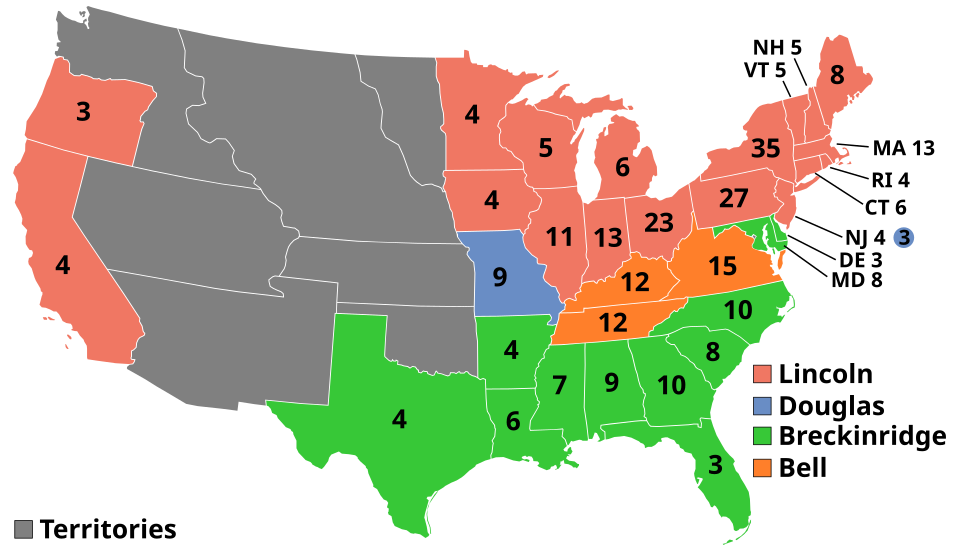
While the Civil War formally began in April of 1861, secession itself dated back five months, to the Election of 1860 the previous November. In the end, it would not be a law or tariff or act of the Federal government that precipitating the first (and to date only) instance of states attempting to leave the Union; it was the fear of what the new Republican administration of Abraham Lincoln might do that so terrified and outraged Southerners. Even before the votes had been cast, firebrands in South Carolina had threatened that the election of a Republican president would be met with secession. “Paranoia” may be more accurate than “fear;” while the Republican Party was avowedly anit-slavery and was supported by radical abolitionists in the North, its official platform in 1860 went no farther than barring the extension of slavery into the nation’s western territories. In fact, most Republican politicians in 1860 (including Abraham Lincoln) believed that it was not just illegal but unconstitutional for the Federal government to abolish slavery in the states where it already existed. No matter who won the election, then, the South’s “peculiar institution” was in no danger, and these threats of secession show just how entitled slaveholders had become: if they could not control the Federal government, they wanted no part in the country at all.
When the dust settled and it was clear Abraham Lincoln had indeed won the presidency, South Carolinians made good on their threats and voted to secede from the Union. Here, we come to the crux of secession and how it is ultimately unjustifiable in any way. The Election of 1860 was free and fair, with no hint of impropriety that would occasion a rejection of its results. While he had not won the popular vote, he had won a clear majority in the Electoral College and that is the only measure by which the United States elects its chief executive. Yet solely on the basis of these imagined future slights from an administration that would not even be sworn into power for four months, seven states voted to leave the Union. That they did so to protect the institution of slavery is in large part irrelevant (and they most certainly did; if you disagree, go read those states’ Articles of Secession where they explicitly say so). Even if neither of my previous posts were correct and a state could theoretically nullify a law or leave the country entirely, the Founders could not have sanctioned secession under the circumstances of 1860. That is just not how democracy works. All parties in a democracy consent to abide by the decision of the majority, fairly decided. If any entity, from individuals up to state governments, could deny the results of an election simply because they do not like them, then that democracy cannot function. This is why so many Northerners were willing to fight and die to preserve the Union, and why Lincoln himself was so clear that the Civil War was a fight not just for the future of the United States, but for “government of the people, by the people, and for the people” in general.
There was of course a second wave of secession, this one coming in the opening days of the Civil War proper and with even flimsier justification. In response to Lincoln’s call for volunteers to put down the rebellion of the so-called Confederate States of America after they had fired on the United States military at Fort Sumter in South Carolina, the four “Upper South” states of Virginia, North Carolina, Tennessee, and Arkansas themselves attempted to leave the Union, outraged that Lincoln would dare to use force against seceding states. To recap: seven states had rejected the results of a free and fair election, pursued the illegal course of secession, stolen government property in the form of fortifications and armaments, and finally directly attacked Federal forces who would not surrender one of those forts—and in this situation, these four states alleged that Abraham Lincoln’s insistence on militarily enforcing the supreme law of the land only after being attacked was actually the offence worth fighting. Clearly, the delay in these states’ secession wasn’t on account of any lack of sympathy for their Deep South brethren, and they managed to execute their own with a uniquely self-serving opportunism.
So there it is. While my previous posts laid the groundwork for a thorough refutation of the legal philosophy of secession, this reflection here has always been my first and definitive reaction to the crisis that sparked the American Civil War. Not only was secession never legal in any possible interpretation, but the reasons behind the Confederacy’s specific attempt to secede were morally bankrupt, even before accounting for its white supremacy and defense of owning fellow human beings. I’m sure that the forces of the Lost Cause will continue spewing their vapid justifications for some time yet, especially given the dire political climate of the country at present, but I hope that in some small way, my salvoes in this series might help those inclined to jump into the fray marshal their own forces and hold their ground.