by Bryan & Heather
In what will be a decade ago this fall, Bryan traveled to the United Kingdom to become his year-long masters program in Global and Imperial History. The academic content and experience he gained there has been mentioned frequently on this blog, and has fueled it in general to great extent, yet the people he studied with there have received little mention. It was a fairly small program, about a dozen students from the UK, America, Canada, Australia, and Taiwan. Easy to know and speak with everyone, but he would only consider a handful of them to have become friends. One of those was a Canadian First Nations student named Julian Brave NoiseCat. After the final exam and close of the program they didn’t actively stay in touch but did remain passively connected via social media. Julian often shared his activities, whether articles, projects, or just the most recent powwow at which he’d danced, so Bryan wasn’t particularly surprised when it turned out that some pieces on recent archaeological work at a Canadian First Nations boarding school Julian had shared turned out to be related to a documentary on the subject he was working on as a co-director. Then, a slew of award nominations and appearances at film festivals. Then, a win for documentary directing at Sundance. We made a mental note to look into where we might find it on streaming to watch at some point.
Then, a nomination for Best Documentary at the 2025 Academy Awards, the first ever for an indigenous filmmaker from North America.
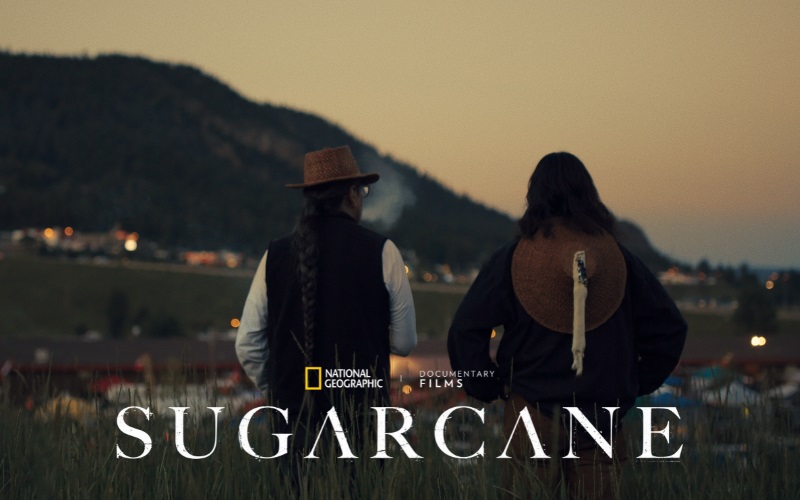
Once we got over the novelty of personally knowing someone nominated for an Oscar, we realized that clearly we needed to watch this film sooner rather than later, and so, on the very night of the 97th Academy Awards as it turned out, we sat down to watch the National Geographic documentary Sugarcane.
NoiseCat’s film is, perhaps unsurprisingly given its accolades, in the style of a more modern documentary; it does not attempt to instruct viewers on the history of Native American boarding schools in general or particular, but rather emphasizes the lived experiences of individuals and the impact these schools had on their lives—including his own life through the story of his father, Ed. As such, NoiseCat is just as much a star of the film as any other of his subjects, in front of the camera interviewing, investigating, and just talking with his father as much as behind the camera guiding the production. What develops is a gut-wrenching exploration of injustice and generational trauma that continues to affect Native Americans to the present day. The system of residential schools established throughout the United States and Canada in the late 19th century is not particularly well known to most laypeople. They were designed as a tool of what we now call cultural genocide, meant to separate indigenous children from their parents, communities, and traditional modes of life before then indoctrinating and Anglicizing them through education and, inevitably and pervasively, beatings, torture, and other forms of physical and mental abuse. Many students attempted to run away, with most of those dying of exposure, under questionable causes, or simply disappearing. As the documentary repeatedly shows, school administrations held themselves blameless for these deaths. In fact one of the inciting incidents for the film was the discovery in 2021 that the school cemetery extended far beyond its formal boundaries, including over two hundred unmarked graves whose size indicate they were of children.
In Canada, these schools (including the specific focus of Sugarcane, St. Joseph’s Mission) were often run by the Catholic Church, making their crimes hypocritical as well as heinous. While all forms of abuse are highlighted, NoiseCat zeroes in on sexual abuse in particular, and with good reason. Not only was there rampant sexual assault at St. Joseph’s at the hands of priests and school officials, but multiple eyewitness accounts—including some reports made to law enforcement and buried until now—were discovered of female students’ babies born of such encounters being carried down to the school incinerator in a shoe box and disposed of. The documentary is unclear whether the infants were alive, or if any of the newly-discovered graves are theirs. In fact, NoiseCat’s father Ed is the only known infant to have survived being born at St. Joseph’s Mission. In light of these revelations, Pope Francis’ formal, rote apology delivered during a recent visit to camera (with NoiseCat and other Sugarcane contributors in the audience) rings emphatically much too little and far too late.
One of the most poignant elements of Sugarcane, however, is not just that these horrific events occurred, but that they continue to be relevant in the present. The last boarding schools closed shockingly late, in the early ‘90s, and, as is clear throughout the film through their interviews, remain very much in living memory of former students. Whether through tearful conversations or even a charged conversation-turned-confrontation with his father over his own abandonment as a young boy, NoiseCat demonstrates that trauma never entirely goes away, and often echoes in later actions of the traumatized.
Like many somber and serious documentaries, we would not say that Sugarcane is particularly “enjoyable” to watch, but is fascinating and even necessary viewing, nonetheless. Its lack of overt running historical narrative does mean that some prior reading, even just of a few summary articles, might be helpful but is no means required to make sense of its tragic events. Our own recommendation pales in comparison to its many award nominations (unfortunately, the Oscar instead went to No Other Land), but we’ll add it to the pile for good measure as well. Definitely give this one a watch, when you can muster the motivation to do so.