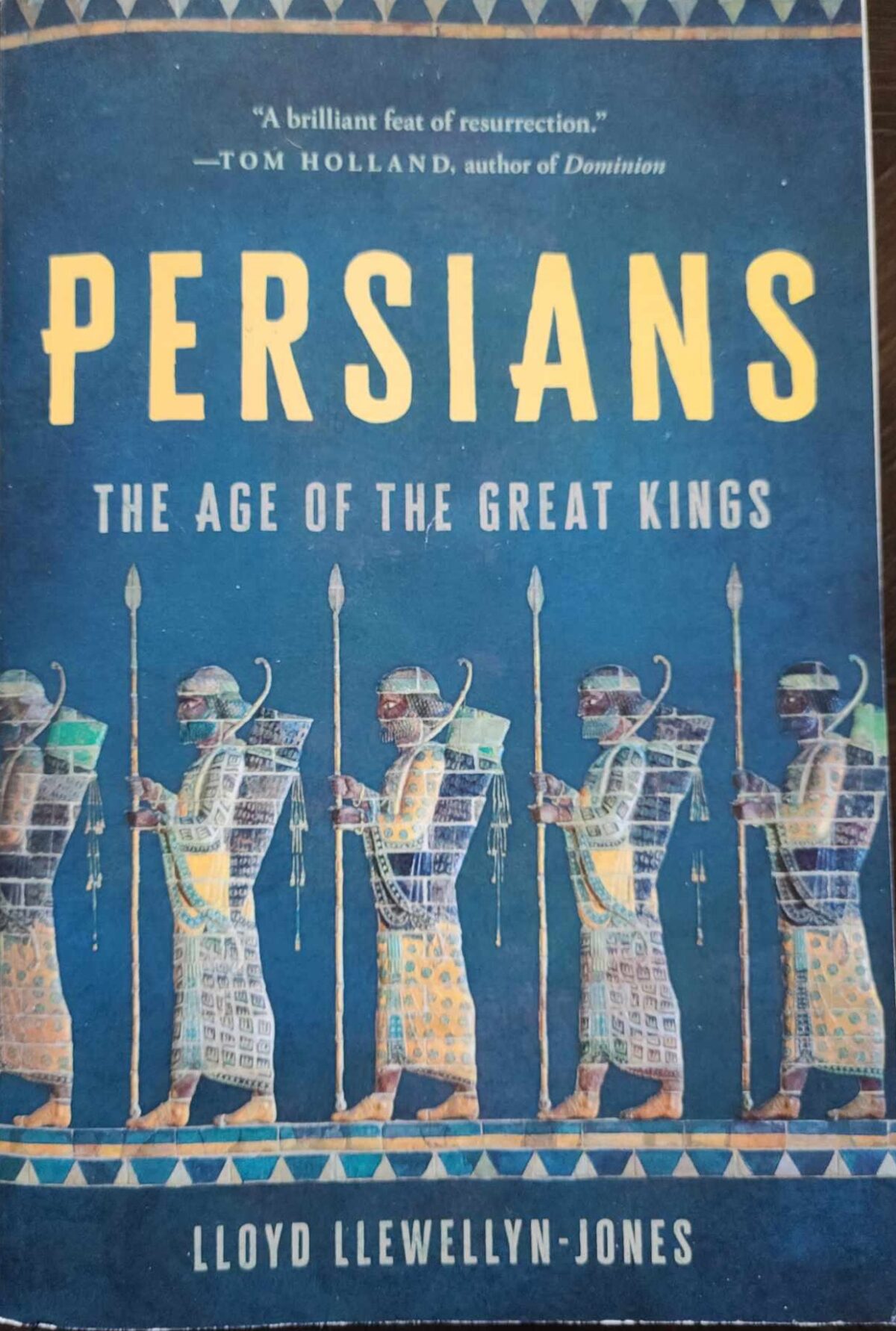
Llewellyn-Jones, Lloyd. Persians: The Age of the Great Kings. New York: Basic Books, 2022.
It’s a regrettable reality of ancient history that many of the “adversaries” of Classical Western civilizations have mainly been examined through the eyes of their enemies. Just as the surviving sources concerning Carthage were almost entirely written by Romans, so too have the Achaemenid Persians been primarily described by Greek authors, particularly Herodotus of Halicarnassus. Recently, however, modern historians have been attempting to correct this trend, using archeological excavations and reading against sources’ grain to reconstruct a more accurate picture of these civilizations on their own terms. Yet while some of these works, like Richard Miles’ Carthage Must Be Destroyed, largely succeed, my most recent work on the ancient Near East demonstrated how tricky this approach can be in practice.
Lloyd Llewellyn-Jones’ Persians covers the history of the first Persian (Achaemenid) Empire from its founding in the sixth century BC under Cyrus the Great through to its ultimate dismemberment at the hands of Alexander the Great’s successors two hundred years later. Combining socio-cultural and political history, Llewellyn-Jones admirably interweaves how the Persians lived, viewed the world, and conceived of themselves with the major events of their time in the Near Eastern Sun in a way that provides mutually reinforcing context for each chapter, rather than simply splitting them into two separate, self-contained sections. The prose of this “Persian version” of history (a phrase that quickly begins to lose its luster the more it’s repeated) is highly readable as well, and it’s clear that Llewellyn-Jones is a skilled storyteller–if his teaching style is at all similar, his lectures must be a real treat.
A key aspect of this style, however, ironically proved to be Persians’ undoing for me. As with so many popular histories I’ve read in recent years, Llewellyn-Jones does not really discuss the source work through which he arrives at his final narrative. He does take pains to discuss the problems of using Greek written sources and how the Persians processed the events of the past differently from that of other more empirical Western traditions, and yet with only a few exceptions it’s not quite clear where he found other sources of information, let alone how he was able to process it into a modern, Western-style work of history. It also quickly becomes clear that perhaps Llewellyn-Jones has a slight bias himself, as his attempts to resuscitate the image of his subjects falls into the trap of denigrating Classical Greek civilization in turn (or ignoring the achievements of other Near Eastern states–calling Persia “the world’s first superpower” is an insult to New Kingdom Egypt and the Assyrians) or waving away legitimate criticisms, such as his assertion that the Achaemenids were an unusually stable, competent dynasty–only to launch into a discussion of decades of tangled harem plotting and succession disputes. Similarly, his argument that the Persian Empire was still strong, even at its peak, when Alexander launched his campaign is unconvincing given all the previously-discussed scheming, let alone that reality of the campaign itself–can you really say an empire of this size was healthy if a single army could so decisively bring it to its knees?
Innovation and revision of our conception of the past is the lifeblood of the discipline, yet by its very nature any such effort needs to be impeccably sourced, researched, and argued, and unfortunately Persians falls short in this regard. As a narrative history of the Achaemenid dynasty and their unification of the Near East, it serves fairly well, but ultimately cannot live up to the lofty promises of Llewellyn-Jones’ own arguments. This time, at least, a change in perspective only resulted in getting lost in shifting historiographical sands