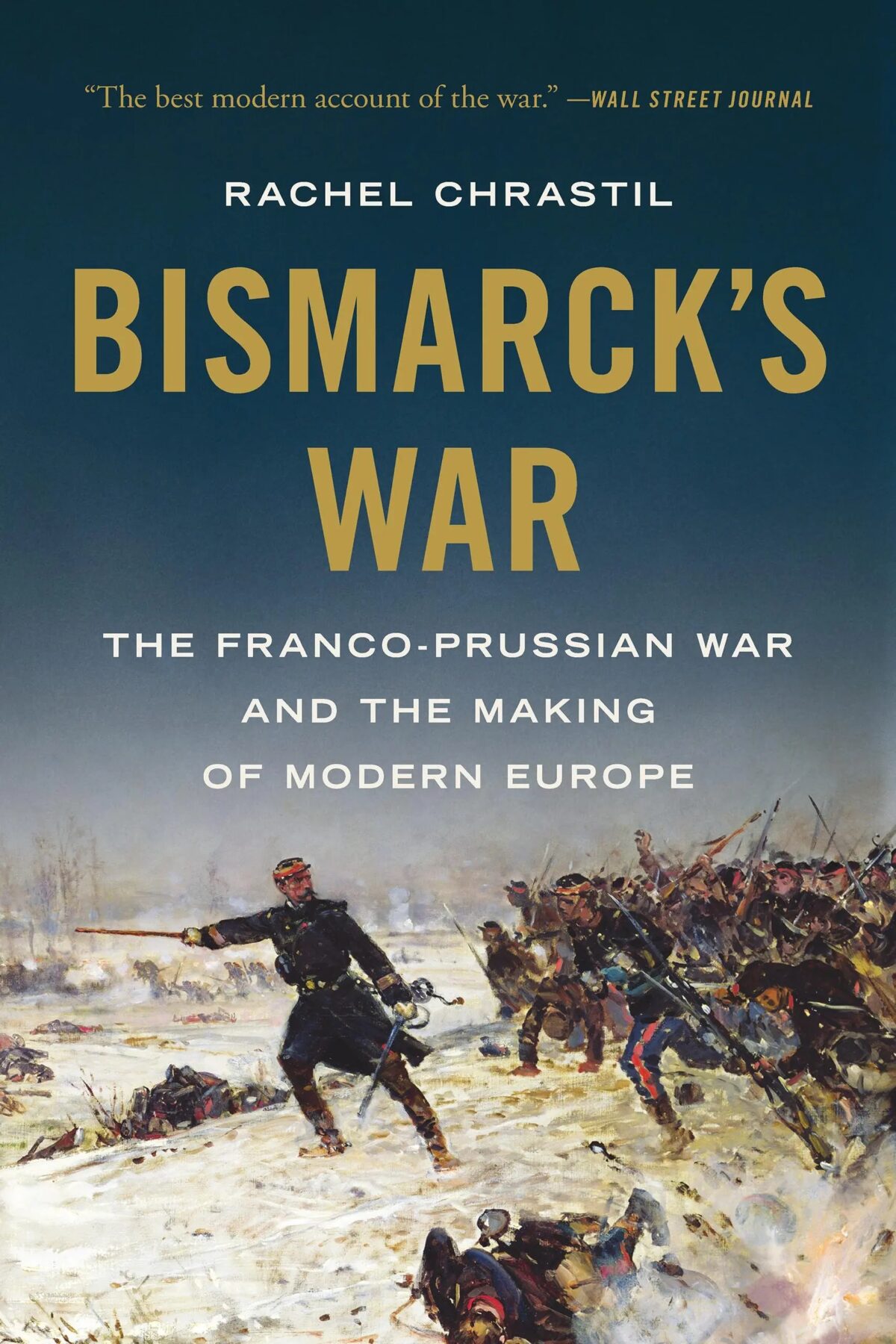
Chrastil, Rachel. Bismarck’s War: The Franco-Prussian War and the Making of Modern Europe. New York: Basic Books, 2023.
For all the importance of the unification of Germany to the subsequent history of Europe in general and some of my own fields of study in particular, I recently realized that I’d never actually read a work devoted to its facilitating incident, the Franco-Prussian War. I knew all of its highlights, of course, and even some trivial details (like how many former Union officers from the American Civil War wrote to the Kaiser seeking to serve with Germany during the conflict), but not a detailed account of its political and military campaigns. Rachel Chrastil’s recent Bismarck’s War, then, looked like exactly what I needed.
As a work of new-style military history, Chrastil certainly fulfilled my expectations in spades. Through the eyes of officers, enlisted men, and civilians, Bismarck’s War traces the course of this ten-month war from the opening campaigns along the border between the German states and France to the siege of Paris and concurrent declaration of a unified German Empire under Prussia. The brevity of the war and spectacular coup of the Battle of Sedan, wherein the bulk of French forces surrendered along with their Emperor Napoleon III, had always left me with the impression that the conflict was essentially over before it began, a woefully-underprepared France totally and immediately defeated by the overwhelming professionalism of Prussia. On the contrary, Chrastil’s narrative shows how neither strength nor incompetence were confined to any one side, and multiple opportunities for French victory, or at least less-rapid defeat, existed and were not capitalized upon. Even after Sedan and the investment of Paris, German victory was far from certain—France’s demographic and industrial might had only just begun to mobilize, and German officials were anxious to conclude peace negotiations before their own overstretched position deep within enemy territory became untenable. The ways in which the war was waged are also explored, and in so doing Chrastil persuasively demonstrates how the Franco-Prussian War, much more than the American Civil War, should be seen as the liminal conflict between early Napoleonic warfare and the modern, industrialized warfare that would reach its full expression in the First World War. Beyond just a mix of technologies both martial and logistical, the intellectual and cultural software of this conflict would look to the future. The Prussians in particular mobilized according to more modern planning and timetables, and their General Staff would conduct it under centralized, professional leadership. Even more striking was the birth of certain worrying trends in Germanic conduct towards civilian populations. The Franco-Prussian War infamously saw the employment of francs-tireurs, or irregular guerilla fighters, in the later months of the conflict to harass German armies of occupation. The frustration of dealing with what was perceived to be dishonorable fighting, if not illegal banditry, manifested in German forces all too willingly enacting reprisals against legitimate forces and civilian communities that foreshadowed what was to come in Belgium four decades later.
Unfortunately, however, Bismarck’s War seems to really only be concerned with the narrowest definition of its subject matter. I’ve often noted how some authors can tend to cast their narrative net a little too widely, describing more-unrelated-than-not information in greater detail than it really deserves, and at first I applauded Chrastil’s ability to concisely summarize just as much context as necessary. Soon, though, I noticed glaringly deficient summaries, to the point of negligence. If it did not occur between France’s declaration of war on July 16, 1870 and the signing of the Treaty of Frankfurt on May 10, 1871, Chrastil does not discuss it in any detail. This includes the entire diplomatic context for the outbreak of hostilities, to which only a couple sentences are devoted (ironically so, given the book’s title; without this, the role of Bismarck himself in the narrative is very minor), and the entire history of the Paris Commune, which gets perhaps a paragraph in its own right. There was also a golden opportunity to explicitly link the German experience with partisans during this conflict to their occupation of Belgium during the First World War: the entire German army developed such a complex surrounding francs-tireurs that they expected to encounter them around every turn and blamed the stiff resistance of Belgian forces on invented guerillas, leading to mass atrocities. Indeed, the actual conditions of this original use of francs-tireurs seems to not have been all that different, and a pattern of German expectation of easy victory leading to frustration and massacre seems to define the life of the Second Reich. It’s not like Chrastil lacked room to examine any of these topics in greater depth, either; my paperback version clocked in at 439 pages of text. In fact, devoting that entire length to just ten months of conflict had a telescoping effect, making the conflict seem longer than it actually was in lived experience.
While it may not quite succeed as a comprehensive general history of all the Franco-Prussian War entailed, then, Bismarck’s War is still a compelling resource for those interested in the course of the conflict itself. I’m always a fan of any work that adds contingency back into our understanding of history.