by Bryan & Heather
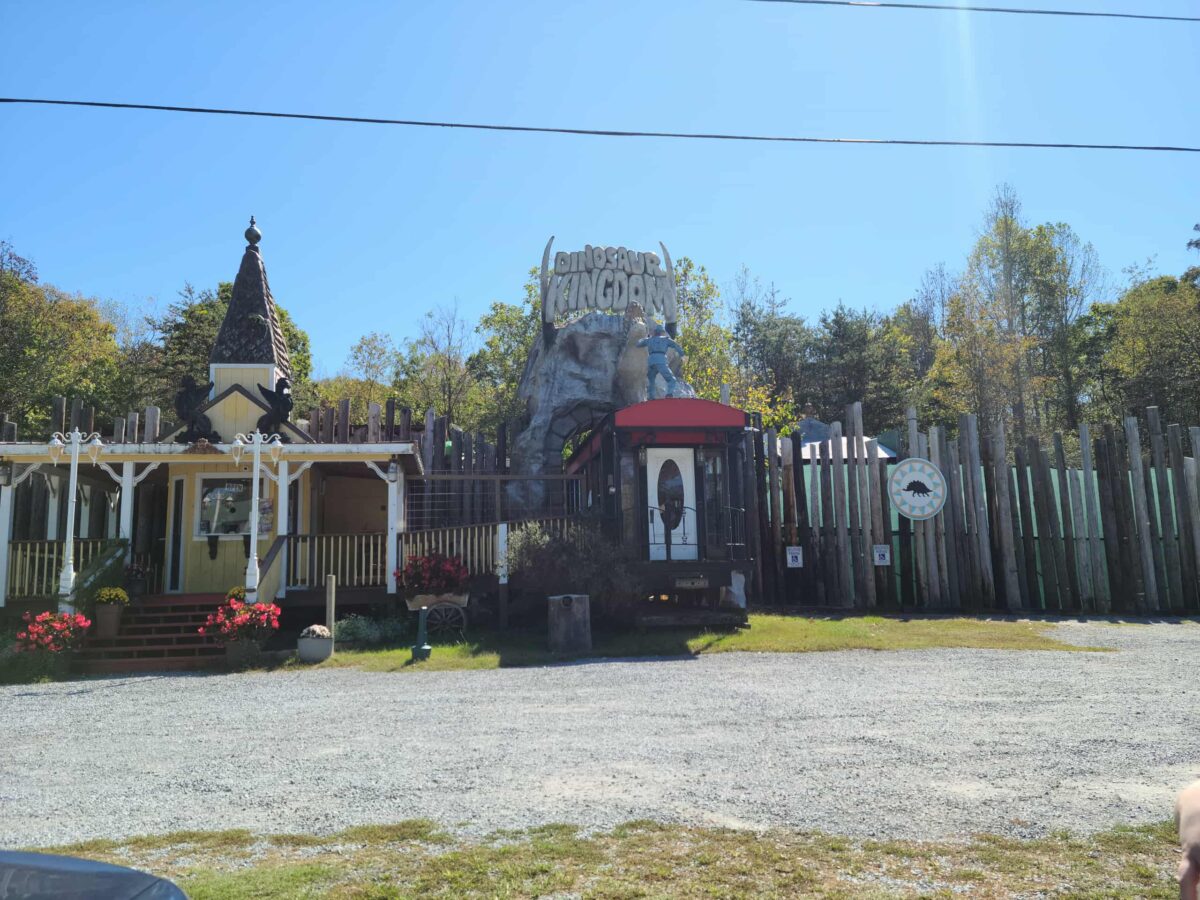
Virginia’s Shenandoah Valley is the epicenter for so much related to the American Civil War. There are so many battlefields there that it is considered an entire historical district by the state, and the role of Lexington as the hometown and resting place of both Thomas “Stonewall” Jackson and Robert E. Lee makes the Valley a major pilgrimage destination for a different reason. And yet, as we passed through the Shenandoah on our way to and from our 10th College Reunion at Gettysburg in October of 2025, it wasn’t any of these more respectable points of historical interest that caught our attention. No, the one place we knew we had to make time for was an obscure little roadside attraction just off the main highway:
Dinosaur Kingdom II.
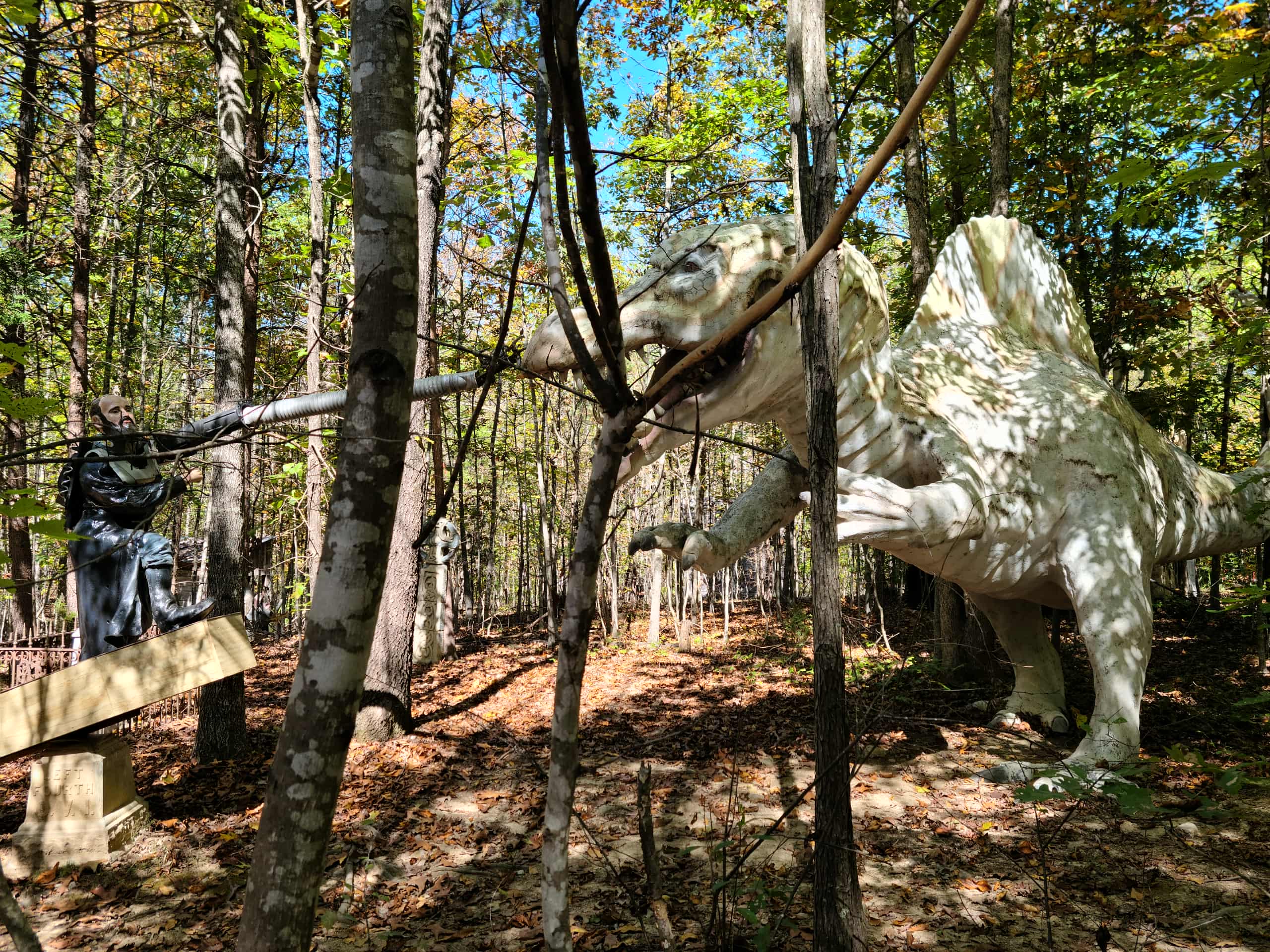
Yes, you read that right. Just north of Lexington exists a bizarre little compound. Through an imposing stockade and “time tunnel” lies a small town and surrounding forest trails in turmoil. In this “real story no one will tell you” counterfactual of the Civil War, the Union Army happened upon a hidden valley filled with living, breathing dinosaurs near Natural Bridge, Virginia. Excited to find a new weapon that might finally turn the tide against the Confederacy, the Yankees attempt to domesticate the creatures and turn them into an unstoppable new form of cavalry. Dinosaurs prove much more difficult to train than other animals, however, and the entire effort erupts into mayhem as the Union forces find themselves beset on all sides by their erstwhile mounts. Meanwhile, a time-traveling professor from the future (who has no connection to the dinosaurs) was able to not only save Stonewall Jackson’s life in May of 1863 but fit him with a mecha-arm to replace the one lost after the Battle of Chancellorsville, allowing Jackson to fight the dinosaurs while racing the professor for a fabled local treasure.
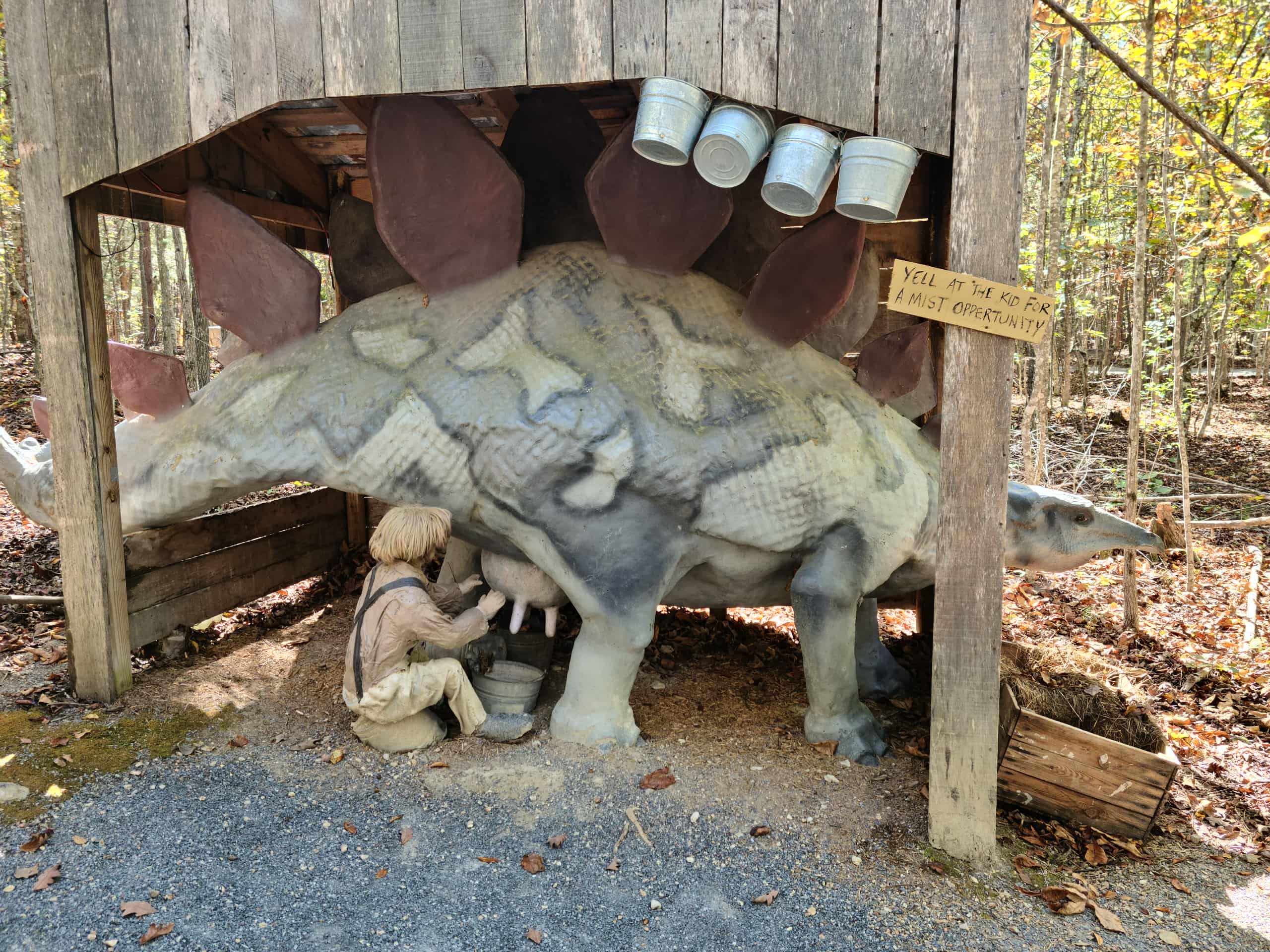
The presence of one of the idols of the South, as well as certain phrases referring to the dinosaurs as “weapons of mass destruction” in the description found on the park’s webpage, made us suspect there might be some element of that inveterate enemy of responsible Civil War historians (and in many ways American democracy itself), the Lost Cause. Could this have come from the mind of an unReconstructed Rebel that, unironically, believed the North to be so heinous, so morally bankrupt, that they would use even so terribly a weapon as bloodthirsty dinosaurs against the innocent people of the South (and, fittingly, not realizing that such an action would not have been a war crime, but no different than any other domesticated animal of war like horses or elephants)? Conversely, though, Dinosaur Kingdom II’s premise was so ridiculously over the top that we wondered if it was perhaps a conscious effort to skewer the Lost Cause, mocking the endless protestations of overwhelming Yankee might to the absurd point of including prehistoric terrors filling out the Northern ranks. As it turned out, neither was really the case, at least overtly. The park’s storyline was so divorced from actual history that there really wasn’t anything obviously pro or anti-Confederate either way; indeed, the only real human Rebel that appears is Jackson himself. There are hints, though, that designer Mark Cline may be at least a casual Confederate sympathizer himself. He has described the Union as the villains of the story, even though we didn’t see anything particularly villainous going on. More suspect is a highlighted panel of the companion comic that, in bold text, emphasizes that the Yankees “enslaved” the dinosaurs—a statement that both conveniently ignores how animal training has always worked and mirrors comments from Confederates and their descendants that attempt to smear the North for its own social inequity while simultaneously denying distracting from the horrific, objectively worse realities of chattel slavery.
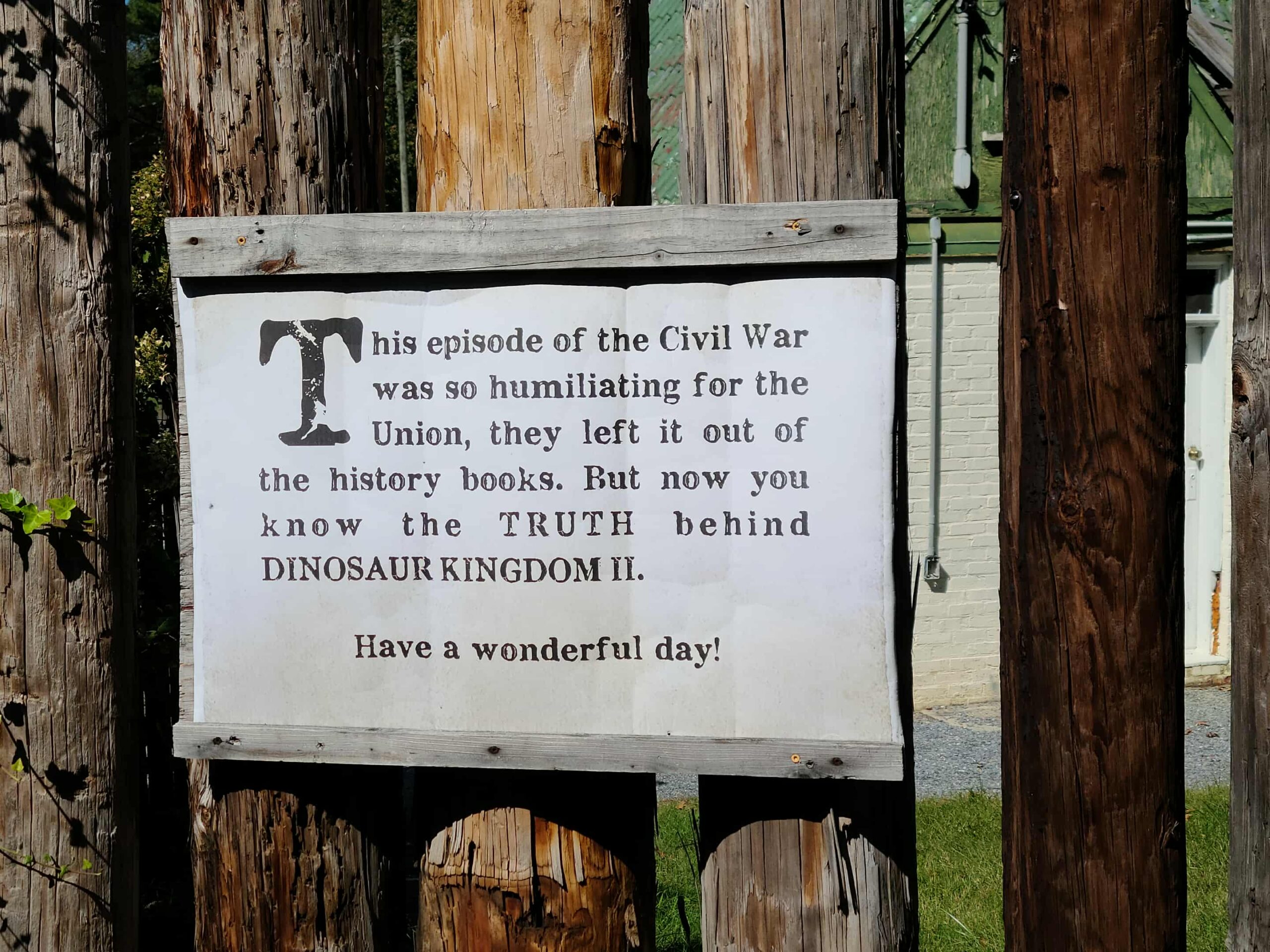 It’s hard to find a less serious, more unhinged way of engaging with the American Civil War than this. There is essentially no historical value here, with multiple timeline inaccuracies and misinterpretations. The above summary is honestly a little more logically put together than the actual park; only the loosest, illogical series of events tie together the many statuary tableaus and interactive games that litter the grounds. Many other non-saurian creatures, some fantastical, some fairly ordinary, also make appearances in this madhouse. Even the name is puzzling; as hard as we searched, we never found any trace of a Dinosaur Kingdom I, and it’s never explained whether the original was the Mesozoic era itself, an earlier version of this park, some other obscure attraction, or none of the above. In a way, it’s almost refreshing to see what is normally such a heavy, serious topic portrayed so lightheartedly. You could even say it’s the logical conclusion of the glut of material on the conflict; the only way to really say something new about the American Civil War in 2025 is to jump the shark and include dinosaurs and slime monsters in the telling.
As we resumed our long drive back to Alabama, we were thoroughly bemused by the last hour we’d spent tramping through the woods and investigating this wonderfully weird piece of Americana. We can’t say we’d ever go back if passing through the area in the future; once seems enough to grasp all it has to offer. Yet we certainly would recommend it to any others in the mood for some wacky fun and silly remixing of American history. It will definitely be hard to forget.