In the fifth installment of his series unpacking Supreme Court Cases that reveal unsavory truths about our country and how the legal interpretation of its founding principles have evolved throughout the centuries, Bryan discusses the landmark case Schenk v. United States and how our treasured liberties are not quite as unlimited as some people like to think.
The past few decades have seen discussion of the principles of “free speech” reach a fever pitch in American society. Much of this has stemmed from the modern conception of free speech, as protected under the First Amendment to the United States Constitution, as absolute—a right that in no way, for any reason, be curtailed by the government. But is this the way the First Amendment has always been understood? While many, even most, Americans might think the answer to this question is a resounding “yes,” a Supreme Court decision just over a century old shows that such unbounded speech has not, in fact, been the default understanding of the First Amendment throughout our history. For better and for worse, past generations have viewed this foundational American right as much more susceptible to modification than we do today.
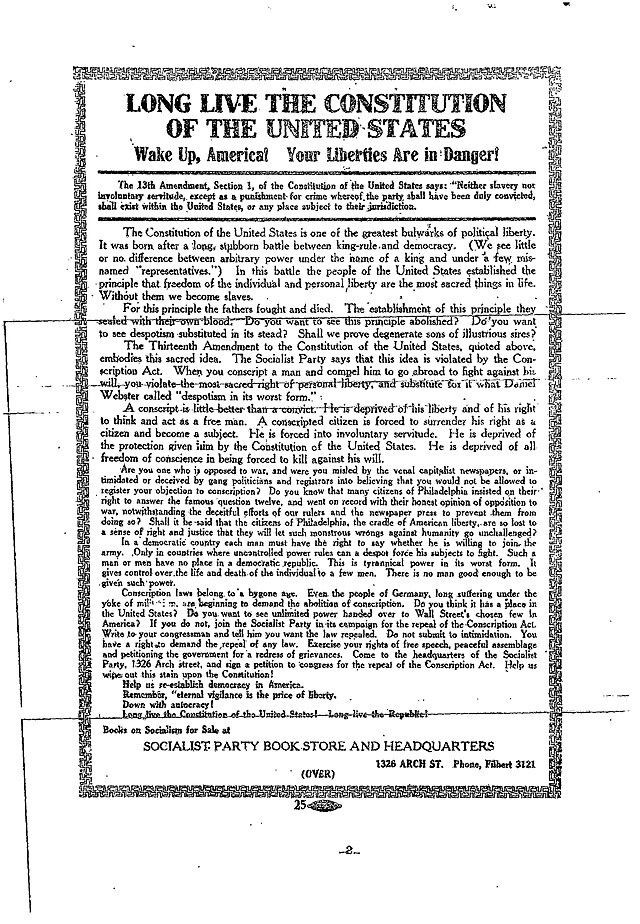
In contrast to the Second World War, America’s entry into the First World War was far from universally popular. President Woodrow Wilson had won reelection in 1916 based in large part on his promise to keep the United States out of the war, and the bloodletting on the Western front since 1914 did not make the conflict particularly attractive to those who could afford to not get involved. The imperialist ambitions of all belligerents, too, did not help matters, nor did the perceived role of capitalist arms dealers and financiers in stoking Europe’s catastrophe. When Wilson ultimately did lead the nation into declaring war on Germany and the Central Powers, then, there were many citizens who protested, especially when compulsive military service was used to bring the army rapidly up to its necessary strength. Opposed to this measure, not to mention the war in general, the U.S. Socialist Party printed and distributed over 15,000 flyers to military-aged men urging them to peacefully resist the draft, as it was a violation of the 13th Amendment’s prohibition on involuntary servitude (a loaded argument that I’ll be sure to explore further in a future blog post). The government naturally did not look kindly on such a direct effort to interfere with the prosecution of the war, and so the general secretary of the party, Charles Schenck, and his assistant Elizabeth Baer were arrested and charged with conspiracy to violate the Espionage Act of 1917 by obstructing recruitment and inciting insubordination in the military. They were convicted but, believing this conviction to be in violation of their First Amendment Rights, Schenck and Baer appealed their case, eventually reaching the Supreme Court in January of 1919.
Three months later, on March 3, 1919, the Court unanimously upheld Schenck and Baer’s convictions. The opinion for Schenck v. United States was written by Justice Oliver Wendell Holmes, Jr, a veteran of the American Civil War and staunch defender of free speech in other previous contexts and cases. In his decision, Holmes delivered for the first time the famous “clear and present danger” test for whether speech can be prosecuted under the Constitution, the most famous example of which is knowingly falsely crying “Fire” in a crowded theatre. While the actions of Schenck and Baer would have been perfectly legal and protected in peacetime, Holmes pointed out that the context of an action matters, and when in wartime, these deliberate attempts to directly interfere with the prosecution of the war through disrupting recruitment amounted to a plausible crisis that Congress had the power—and the duty—to prevent through legislation and resultant prosecution.
Here, we can see the clear conflict between modern interpretation of the First Amendment and those of centuries ago. In the early 20th century, a sovereign government’s right to wage war, and through doing so protect the safety of the majority of the population, meant that personal freedoms and liberties could be Constitutionally curtailed if certain citizens’ actions and speech posed a specific, direct threat. This last part was key for Holmes; in another case appealing Espionage Act convictions that year, Abrams v. United States, Holmes instead wrote a blistering dissent. Here, the defendants had simply denounced the American role in the Allied intervention in the Russian Civil War and the production and sale of arms to fight Bolshevik forces in that war. No specific action was called for, and there was never any real threat to the military or war materiel. Holmes argued that these convictions, then, were tantamount to prosecuting citizens for their very ideas—and this was never allowable under the Constitution. The rest of the Court would ultimately use these cases as a springboard, discarding “clear and present danger” for a “bad and dangerous tendency” doctrine that widened the ability of the government to prosecute citizens for their speech throughout the next three decades.
Ironically, however, the combination of Holmes’ decision in Schenck and dissent in Abrams pointed the way towards the gradual liberalization of the Court towards the First Amendment in the twentieth century, ultimately leading to our present moment. In 1969, Brandenburg v. Ohio officially abandoned the language of both earlier tests, instead stating that only speech that is “directed to inciting or producing imminent lawless action and is likely to incite or produce such action” can be prosecuted under the Constitution. To many scholars, though, including myself, this just seems like a slightly more detailed, explicit version of Holmes’ “clear and present danger” filtered through the clarifying guardrails of Abrams. Whatever the case, Brandenburg’s standard has, so far, been the Court’s final word on what the First Amendment protects as free speech: not completely unfettered, but very close to it. The series of cases that Schenck inaugurated, though, are vital in understanding how our understanding of the Constitution and its attendant freedoms have evolved, often radically, across the two and a half centuries of our nation’s history. Our speech, in particular, has not always been as free and absolute as it is now. But should it be? That is a topic for another post, and another case. Stay tuned.