by Bryan & Heather
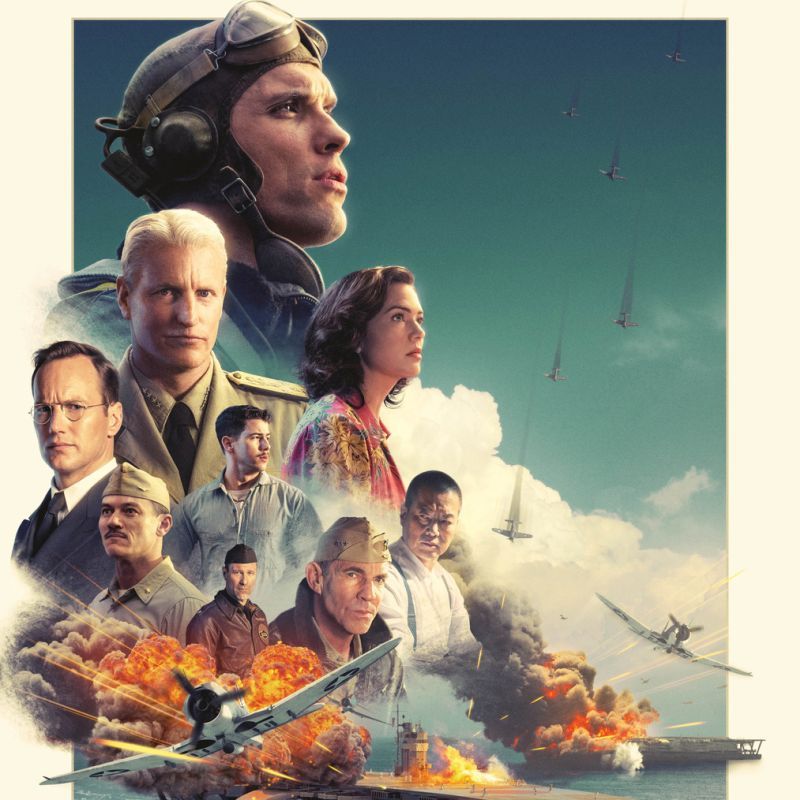
We all have our ever-lengthening lists of movies and shows to watch. For years, Bryan’s has sported director Roland Emmerich’s Second World War flick Midway. He had never quite gotten around to it, as Heather had expressed lukewarm interest, but our trip to the USS Midway floating museum a few months ago not only reminded Bryan of it, but piqued Heather’s interest just enough for us to give it a watch together. To our memory, there’s never really been a modern film depicting major naval combat during the Second World War, a combat that would increasingly rely more on the role of aircraft and their associated carriers than the massive battleships that had previously dominated naval tactics and strategy, so we were hopeful that what we were about to watch would prove a unique experience. We couldn’t imagine how right we were.
Midway purports to tell the story of the “most significant naval battle in American history,” the June 1942 Battle of Midway that saw the United States Pacific fleet, centered around its three aircraft carriers (which had fortuitously been on training exercises on December 7, 1941 and thus escaped destruction during the Japanese attack on Pearl Harbor), destroy four enemy aircraft carriers, best the Japanese navy, halt Japan’s advance across the Pacific, and prove that the future of naval power lay with naval aviation; the surface vessels of the opposing fleets never came into sight of each other. Emmerich’s film certainly does that, but the battle itself is actually a relatively small part of the film. The narrative begins on the morning of December 7, 1941, showing the experiences of all levels of naval personnel—including the crews and pilots of the USS Enterprise—during the Japanese attack. Snapshots of the ensuing months follow, from Admiral Chester Nimitz’ assumption of command in the Pacific, James Doolittle’s bombing raid on Tokyo and crash landing in Japanese-occupied China, the aftermath of the Battle of the Coral Sea (in which the aircraft carrier USS Yorktown was damaged), and finally the plans, of both sides, that led to the clash in the waters surrounding the island of Midway. The film is thus more of a narrative summary of the first year of the naval war in the Pacific, and while gratifying to see many of those events mentioned or portrayed briefly on screen, we were mystified as to what most were doing there at all. Yes, all history builds upon every preceding event, wars most especially, but the devotion of extended sequences to such not-directly-relevant topics like Doolittle’s odyssey struck us as bizarre over-crowding that diluted the film’s central narrative power while needlessly inflating its runtime. Numerous scenes, including its very first, could and should have easily been included in some manner of offhand or briefing-oriented dialogue, a rare example of when it is better to tell rather than show.
Once the battle commences, however, Midway certainly does not disappoint—at least, from what it shows on screen.The movie follows the course of the historical battle quite closely, from the failure of many of the American torpedo bombers’ ordnance against the Japanese fleet to the last-second location of one of the Japanese battle groups by the Enterprise’s dive bombers and subsequent destruction of four enemy carriers. It was also clear that historical models had been extensively used to faithfully recreate the vessels and aircraft involved, and we knew from our visit to the USS Midway that production had constructed replicas the TBD Devastator torpedo bombers so accurate that the museum uses one in its exhibits, as no original Devastators remain in existence. Even some of the more sensational elements of the climax, like main character Richard Halsey Best scoring direct hits on two Japanese carriers in the same day or the attempt by the American submarine USS Nautilus to infiltrate the enemy fleet and torpedo a carrier, are accurate. Indeed, there were so many little moments with the ring of truth that we suspect a number of oral histories and memoirs were combed for elements to add in, and the result was actually something of an unfocused narrative, more scattershot than a true culmination of themes.
Yet this seeming attempt to include every small detail possible stands against the baffling decision to only show a small segment of the larger battle itself. Only three Japanese carriers are shown being hit, no aircraft from either of the other American carriers besides the Enterprise are ever explicitly recognized as such, and despite a scene wherein captured American pilots are tortured by the crew of a Japanese destroyer to reveal the location of the American fleet, there is no inclusion of the Japanese strikes against US naval forces at all; the destruction of the Yorktown is only mentioned in an after-battle aside (in reality, the Yorktown was crippled during the battle, but not sunk; a Japanese submarine later torpedoed her while being towed back to the West Coast for repairs and finished the job). On the human interest level, the film also does not show or even mention that a second pilot, Dusty Kleiss, also hit two enemy carriers as well as sinking a cruiser, for a single-day record better than Best’s! Perhaps if the rest of the movie had been more streamlined we could have excused such oversights as necessary for a streamlined, effective personal narrative, but the earlier inclusion of entire plotlines that were not directly relevant to Midway itself, along with the film not clearly being about any one individual, makes such cuts inexcusable.
Ultimately, we had mixed feelings about Midway. As a piece of pulse-pounding action spectacle, it certainly delivered, and with a surprising amount of historical accuracy for that genre; we could easily see a high school teacher using segments of it in an American history course, with much less guilt than other popular films. Ironically, however, its insistence on cramming as much historical detail and context into only a moderately-long film meant that other, more crucial, events were inexplicably left out. Worth one watch if you haven’t seen it, perhaps, but we can’t say it will become a particular favorite in our repertoire.