by Bryan & Heather
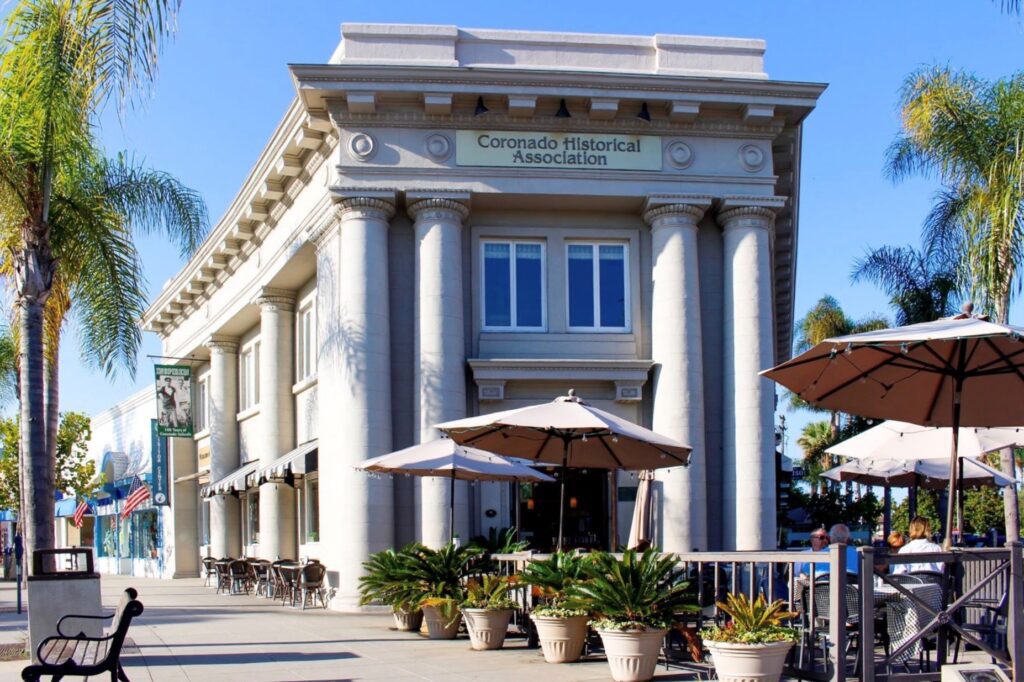
Our time in the San Diego area over Thanksgiving 2025 turned out to be a trip of regional historical firsts. Not only did we finally rectify our unfamiliarity with the floating USS Midway museum, but we were finally able to visit the museum of the Coronado Historical Association together. Heather, of course, was very familiar with the CHA, having volunteered there for a short period after college. Their shorter and somewhat unpredictable hours of operation meant that they never seemed to be open for Bryan to experience whenever we were back visiting—until this time.
As it turned out, our visit to the CHA museum couldn’t have been more different from our expedition to the Midway a few days later. As with many small-town historical societies, the CHA does not have extensive facilities, in this case sharing their museum space with a neighboring restaurant through nothing more than a partition curtain! The museum itself is comprised of just two exhibit rooms and a small auditorium in which lengthy video relating eclectic bits of local history plays on a loop. Only one of those exhibit rooms was open when we visited, the other in the middle of changing to a new display.
That one exhibit, however, was a doozy, and blew the Midway out of the water in terms of serious historical interpretation per square foot. The main subject of the displays was the Allied landings on D-Day and the connections between Coronado, California and that most famous of amphibious landings. Using a parallel structure, the CHA relates the context and course of the invasion along the upper half of the room’s walls, while along the lower half cases contain artifacts and personal interest stories of local history and its intersection with the events above. Other cases and plaques throughout detailed related topics such as notable wartime residents, the treatment of Asian-Americans during the war, and the remarkable life of Tom Rice, a paratrooper in the 101st Airborne and the only Coronadan to take part in the landings. And if that were not enough, material towards the end of the exhibit interprets the very art used to depict scenes from D-Day, all of which were the work of three artists embedded with American forces through the Navy Combat Art Program.
The result of all this multilayered, multifaceted interpretation is an excellent example of how small town history, some might say microhistory, can be done. Without myopic navel gazing or exaggerating any importance, the CHA interpreted a major historical event for its visitors while demonstrating the local community’s place in it. Myriad human interest stories, large and small, not only served to inject humanity into the exhibit but demonstrated the variety of experience to be found throughout Coronado and, indeed, the country and world at that time. And while there may not be too many major revelations for students of history, there are still tidbits here and there (like the Navy Combat Art program and its participants) that may still catch one by surprise. Our visit there may only have taken a small fraction of the time we spent at the Midway and elsewhere across our travels, but the density and complexity of the interpretation at CHA deserves praise in its own right.