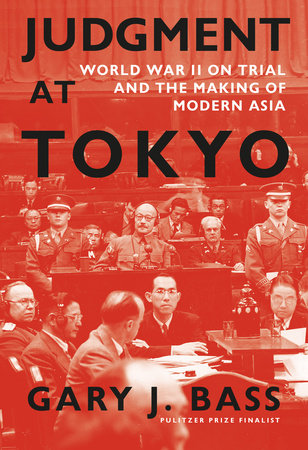
Bass, Gary J. Judgment at Tokyo: World War II on Trial and the Making of Modern Asia. New York: Vintage Books, 2023.
A couple years ago, I picked up Herbert Bix’s Pulitzer-prize winning biography of Emperor Hirohito of Japan. I felt it was a bit too old to review here on Concerning History at the time, but, combined with Robert Lyman’s A War of Empires not long before, it sparked a larger curiosity in me about the Second World War in the Pacific and specifically the atrocity-filled arch-imperialism of the Japanese in the first half of the twentieth century. From there, it was a short step to my inaugural playthrough of Hearts of Iron IV as Japan and somewhat-unplanned theme of reading through the reconstruction of Germany in 2024 with Harald Jahner’s Aftermath and Frank Trenmann’s Out of the Darkness. Then, as if on cue, the shelves at Barnes and Noble delivered unto me Judgment at Tokyo.
Gary Bass’s magisterial tome takes as its focus the oft-overlooked Asian counterpart to the more famous Nuremberg Trials at the conclusion of the Second World War. Set in Tokyo and running for over two and a half years, from April 1946 to November 1948, the International Military Tribunal for the Far East was established by the Supreme Commander of the Allied occupation of Japan, Douglas Macarthur, in an attempt to seek justice for the actions of Japan’s leaders in instigating and conducting the war. Defendants were indicted under three classifications of crimes: Class A War Criminals for “waging aggressive war,” Class B War Criminals for standard war crimes, and Class C War Criminals for the new charge of crimes against humanity. The Allies, and the United States in particular, hoped to establish a twin landmark of jurisprudence, demonstrating to the world the culpability and inhumanity of the Axis powers, vindicating their own war efforts, and marking a decisive break that would allow the bulk of the Japanese people to move on from questions of complicity and reestablish themselves a friendly, modern, pacifist democracy.
Bass brilliantly explores not only the history, motives, and personalities behind the Tokyo trial, but how its complexity and realpolitikal demands led to it going awry almost from the very beginning. American belief that the Japanese people would rebel if their Emperor was deposed led to Hirohito being exempt from the indictments—which then meant that the prosecution conducted a nonsensical dance wherein the Emperor was portrayed as ineffectual and a mere figurehead contrary to the reality of the situation as made abundantly clear in testimony and certain slips of the tongue on the part of the defendants. The panels of judges (one each from Australia, New Zealand, Britain, Canada, France, the Netherlands, United States, Russia, the Philippines, India, and China) couldn’t agree on if they even had jurisdiction under international law, let alone if the waging of aggressive war was a crime or a new (highly imperfect) concept being implemented ex post facto by a United States out for revenge for the attack on Pearl Harbor. Indeed, the crimes before the tribunal would prove much murkier than those adjudicated at Nuremberg. The actions of the Japanese were clearly heinous, but not all that far removed from the racist policies of European colonialism only decades previous, not to mention that the bombing of Japan by America that culminated in the atomic bombings was itself a war crime by the standards of the time. As the trial proceeded, the lead prosecutor, American Joseph Keenan, would prove to be an incompetent alcoholic that hamstrung what compelling arguments could have been made, and much evidence that could have assisted had been destroyed either in the firebombing of Japan or intentionally by the Japanese government. The Soviet judge railed against the presence of American defense lawyers in a telling glimpse into just how far from real justice the Russian legal system of the time was, and, most damaging of all, the Indian judge wrote a separate dissenting opinion denying Japan had committed any crimes at all, even conventional atrocities under the laws of war—an opinion that many in modern Japan now point to as a vindication of their nation
Judgment at Tokyo weaves all this together in a compelling, readable, and highly approachable narrative—perhaps at times too approachable. In his introduction, Bass comments that the work needs to be as long as it is (clocking in at 690 pages); I emphatically disagree. In conducting readers through events—including the course of the trial itself—chronologically, Bass often revisits topics that have already been discussed, using much the same language. By the time I got to the defense’s arguments, it was fully the third time I’d encountered certain topics! This means that, contrary to many of the more academic monographs I read, Judgment at Tokyo is perfectly suited for someone who has even the most minimal knowledge of the Second World War and its aftermath, but it certainly comes at its own cost. It may even have been an opportunity cost; while Bass’s subtitle seems to promise a case study-esque use of the trial in explication how East Asia developed geopolitically throughout the rest of the second half of the twentieth century, he largely doesn’t deliver. The echoes of the trial and animosities it engendered are briefly explored, of course, as are events that occurred contemporary with the tribunals, but Judgment at Tokyo never grows beyond simply a history of its main topic.
That history, though, is one I can’t recommend highly enough. Its implications alone are ones we all should ponder. What really is international law? How does legality interact with moral responsibility? Are ‘new’ atrocities unpunishable because no laws against them yet exist? What defines aggressive war in the all-too-often zero-sum game of geopolitics? Is the idea of war crimes just a fig leaf, attempting to impose polite order on what is inherently desperate chaos? Can justice be impartial in the wake of a world war, and if not, does that mean that no justice should be pursued at all? What does it take for a defeated nation to accept its culpability and seek true penance and reconstruction? The implications of any of these discussions are profound for how we view the world in the present and moving forward.