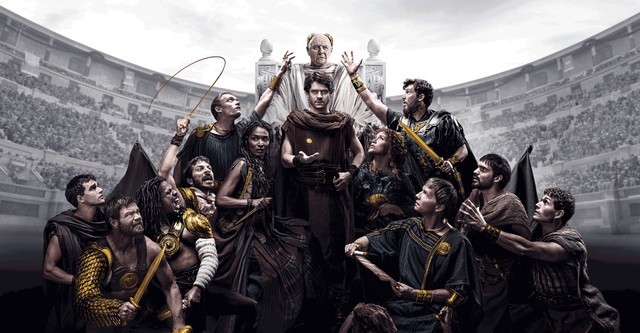
Do we really need another gladiator period piece? Yes, looking at you, Gladiator 2 (that doesn’t mean I won’t watch it, look for a review a few weeks after it hits streaming), but that was actually my initial thought upon hearing of the new streaming series Those About to Die a few months ago. I’m not tired of Roman history on the big or small screen, to be clear; far from it! I just know there are so many more interesting facets of the era that haven’t been given their due, and seeing the same material reskinned, over and over again, just doesn’t get me excited. Once I finally got around to trying this one, however, I was pleasantly surprised by the rich historical detail and some unexpected narrative foci of this first season.
In a slight twist on the standard gladiator fare, Those About to Die opens just before the completion of the Flavian Amphitheatre, better known as the Colosseum. The conception and construction of this famous edifice fuels a subplot of the show, and the dedicatory games form the setting of its final two episodes, but choosing this specific moment also allows the show to explore other themes and realities of Rome that often get eclipsed. Chariot racing, for instance, plays a larger role than gladiatorial combat—as it did for the masses of the Roman Empire right through into the Middle Ages. The seedy underbelly of the races and games is also given center stage through the character of Tenax, a gangster with larger ambitions who runs one of the city’s many gambling taverns. Yet high politics is present, as well; the pilot sees the entirety of the Flavian Dynasty alive and attempting to remake Rome in its own image. The casting of Anthony Hopkins for the avuncular old campaigner Vespasian is particularly inspired, and unlike other swords and sandals epics, Those About to Die treats its historical context with the utmost respect, dropping deep-cut context exposition and preserving the official political narrative as we know it, even if the “secret history” might be slightly different than recorded. Caught between all this Roman intrigue, high and low, are the marginalized peoples empire has chewed up and spit out. Through the eyes of a Numidian family and a trio of Spanish brothers, the viewer sees the exploitation that comes with imperium for slaves of both genders and the free non-citizens just trying to protect their loved ones and survive.
All that does not mean that the show gets high marks all around when it comes to accuracy, however. As with so many modern shows set in the ancient world, an admirable drive for more diverse casting ends up with the inaccurate portrayal of North African cultures (in this case, Numidia) as more akin to sub-Saharan peoples of later millennia. The (almost-mandatory, given the time frame) inclusion of Vesuvius’ eruption is problematic as well; eye witness sources described the ash cloud blowing out over the Bay of Naples to the south, not northward to blanket Rome for days like in the show. Furthermore, the modernist casting of crowds of refugees as invading “outsiders” in subversive political rhetoric makes no sense; not only were their very few survivors from Pompeii and Herculaneum, these people would have been considered politically and culturally indistinct from the inhabitants of Rome or, indeed, all of Italy at this point.
Yet perhaps my biggest thematic criticism of the show was its cliché assertion that by the middle of the first century AD, Rome had transformed from a beacon of civilization into a cesspool of venal corruption and unchecked power. I have no argument with the second half of that statement, but pretending that the Republic was much better than the later Empire smacks more of nostalgia and romanticism than any clearheaded analysis of history. That said, Those About to Die certainly delivers on its promise of a Rome that corrupts all it touches. No one character comes out the other side clean, whether having sacrificed their morals for the lives of their loved ones or showing that they are perhaps not the entirely upright figure they pretended to be. While there are small victories throughout, most are Pyrrhic in some way, and the show is more a tragedy than anything else, delivering an emphatic confirmation that if ever “there was a dream, once, that was Rome,” in the words of Gladiator’s Marcus Aurelius, that dream had long since been smothered. It’s only part of the picture, but I’ll take it.