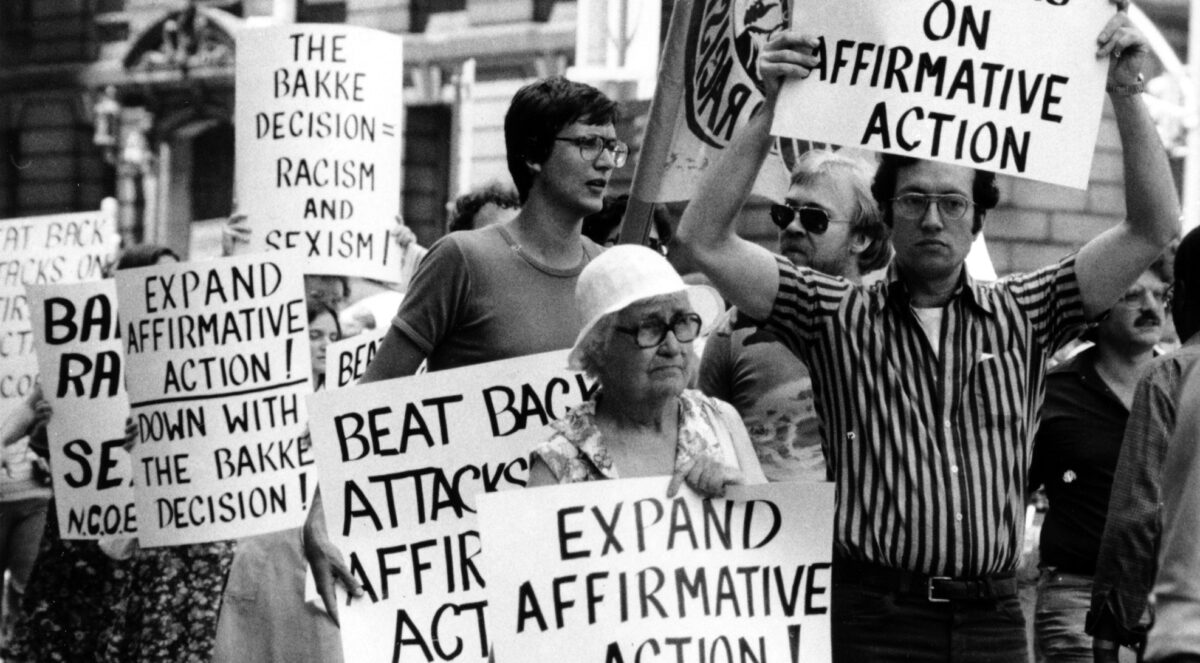
In the third installment of his series highlighting some of the worst Supreme Court decisions in American history, Bryan examines what the Court has had to say about affirmative action, one of the most misunderstood and misinterpreted movements for diversity in recent decades, through the landmark Regents of the University of California v. Bakke.
Americans’ list of little-understood yet much-maligned terms has only grown throughout this past decade, with such things as “DEI,” “woke,” and “critical race theory” morphing into symbols of certain groups’ fears and hatreds for all that’s supposedly wrong with our country. New life—and subsequently, death—was breathed into one of the oldest of these modern bugbears last year in a series of Supreme Court cases centered on college admissions: Affirmative Action. A catch-all term for the methods schools use to promote a diverse student body and attempt to redress centuries of racist admissions policies, Affirmative Action has, perhaps unsurprisingly, become a by-word for much of the general public that stands for the practice of hiring or admitting an individual that is unqualified for and undeserving of their position solely because they are a certain race or identity—and often to the direct negative exclusion of someone else who is more qualified, and thus implicitly more worthy, individual. The tension between these two interpretations is nearly as old as the practice itself, and the resistance to Affirmative Action scored its first victory with the 1978 Supreme Court decision in Regents of the University of California v. Bakke.
By all accounts, you could not have asked for a better medical school applicant than Allan Bakke. A National Merit Scholar, a Marine Captain who served in Vietnam, and an engineer for Nasa, at 33 Bakke had resolved to apply to medical school and continue pursuing his fascination with how space travel interacted with the human body biologically. And yet, as he began sending out applications in the early 1970s, Bakke was met with rejection after rejection. Many of these were due to a prevailing climate of ageism at the time, with Northwestern explicitly telling him he was too old for their program. With the University of California at Davis’s rolling admissions process, however, he encountered something different. In an effort to actively pursue program desegregation in the wake of the Supreme Court’s decisions in the Brown v. Board of Education cases, Davis had instituted an Affirmative Action quota system wherein 16 of the 100 annual spots for new students were reserved for minority applicants. In 1973, Bakke applied near the end of the admissions cycle and despite his overall stellar qualifications (at 468, only two points short of an automatic acceptance on the internal rating system and in the 97th, 96th, and 94th percentiles on the science, verbal, and math sections of the MCAT, respectively), he was rejected yet again. School officials encouraged him to apply the following year, but to no avail.
It would seem that even after his first failure at UC Davis, Bakke thought he had identified the real reason for his rejection: minorities. His interviewer for 1974 raised a red flag, saying that Bakke’s personal opinions against recruiting minority students had come through in their conversation, and recommending he not be accepted. Fed up after his double rejection, Bakke pursued legal action and sued the University of California for racial discrimination.
Surprisingly, this case stands out from so many other Affirmative Action complaints in that Bakke did directly lose out on admission to Davis due to Affirmative Action. In 1974, he applied late enough in the cycle again that all 86 spots open to white applicants had been filled, and a number of minority applicants who were accepted possessed lower scores and less impressive credentials than he (though it should be noted, as always, that they were still qualified for the program—Affirmative Action DOES NOT and NEVER admits someone who is unqualified). The only complication was that an informal system of special recommendations was also in place, wherein the dean of the medical school could use his influence to get the children of “friends of the institution” accepted, one even without having submitted an application, but it’s unclear just how many spots may have been used as a result and Davis understandably downplayed his system throughout the ensuing legal battles.
In 1977, Regents of the University of California v. Bakke finally reached the Supreme Court. At issue was the question of whether policies designed to rectify historical discrimination by prioritizing minorities, and thus de facto discriminating against the majority population, violate the civil rights of white people in turn. In a complicated 8-1 decision, the justices delivered a split majority opinion. Four believed that the quota policy at UC Davis was a violation of the Civil Rights Act of 1964. One, Lewis F. Powell, Jr., went further and declared it a violation of the Equal Protection guaranteed to all citizens by the 14th Amendment. Yet a total of five of the eight majority justices, including Powell, also declared that this decision only applied to explicit quota systems, and that other Affirmative Action programs were permissible. Bakke was, then, both a defeat and a victory for Affirmative Action. While UC Davis’ specific implementation was ruled illegal, perhaps even unconstitutional, the existence of such efforts in general were lauded and confirmed by the Court.
So why is this an installment in “Remedial Case Studies,” and not part of the ranks of my other series, “Inconvenient Suits”? The answer lies in a combination of logic and the wording of that majority decision. Most basically, if discrimination and the inequality that results from it are Bad Things for society and must be eliminated, then simply ending discrimination is not enough. One of the reasons the legacies of slavery are still with us, and why Reconstruction was such a failure, is that freeing slaves and giving them not only citizenship but suffrage did not change the fact that no slave possessed any wealth of any kind at the close of the Civil War. Mandating that things like hiring practices and college admissions be based exclusively on merit ignores the fact that communities who were not repressed will naturally have more resources and yield better candidates in much higher numbers without some effort to actively rebalance the scales until those differences subside. In this, five justices at least partially agreed and confirmed this underlying principle of Affirmative Action. And yet in rejecting quota systems in particular, they argued that to so blatantly base its actions on race alone, a government entity must have a compelling interest to do, and pursue narrowly tailored means to execute it…while denying that promoting diversity and desegregation as the Court had ordered schools to do was not such a compelling reason! Further, clearly some sort of quota system must exist in order to desegregate, even if the quota is a measly 1 out of 100—and thus a single white person would conceivably be discriminate against. The University of California’s quota of 86 slots out of 100, broadly matching the contemporary demographic of white people in the United States, seems more than fair in this regard, and to this layperson a prime example of “narrowly tailored means.”
Admittedly, my opinions on Bakke have also been colored by the 2023 decisions against Harvard and the University of North Carolina that have effectively killed Affirmative Action as a discreet admissions policy. While they are a little too recent to be within the scope of Concerning History (20 years is our general benchmark, for those curious), those cases are even more egregious. Generally speaking, modern Affirmative Action accounts for many intangible demographic factors, awarding points for race, gender, and other categories just like a school might award points for high SAT scores, extensive community service, or excellence in a leadership position. In fact, when I applied to Gettysburg College, I received a Affirmative Action point for being male; more women applied to college at that time, and that point helped balance out results. This then creates a holistic measurement of the desirability of each applicant for the institution to measure against others. This system, and modern essay-based college admissions in general, prioritizes soft skills and intangibles just as much if not more than quantitative grades and test scores, and in an ironic twist not white but Asian students sued Harvard and UNC for discriminating against them in favor of other minorities. This didn’t surprise me at all; my experience in the college counseling industry showed me how many Asian families processed the pressure of being a Model Minority into a push for perfection in grades and on tests while ignoring equally-important things like leadership and service. This then leads to those students submitting applications that lack individual personality, and with it not only the chance to be remembered by admissions officers but also any real way to stand out from all the thousands of other applicants with scores just as good. A sense of injustice was perhaps inevitable, and it’s the American way to blame minorities for complex problems or simple bad luck. The conservative-dominated Supreme Court once again agreed, stating in a 6-3 decision that the institutions’ policies were unconstitutional because they did not set an end date—as if diversity does not require constant attention and maintenance—and did not set any quantitative goalposts—which the Court itself had explicitly prohibited in Bakke!
This brief history of Affirmative Action in the Supreme Court, then, is a history of missing the forest for the trees. Whether willfully or not, justices across the past half century have doubled down on the clerical, bureaucratic details of policies instead of considering their intent, effect, and societal need while grounded in practical context. I cannot be hopeful it will change anytime soon, especially considering the results of last month’s election, but I can certainly decry it here. We deserve better.