by Bryan & Heather
Living in Alabama these past few years has come with its share of frustrations, but being “behind enemy lines,” as we like to joke with our friends, has also had its historical silver lining, too. From Indian Removal through antebellum slavery to the Civil War, Reconstruction, and Civil Rights movement, Alabama is rich in the kind of history we had never before been geographically close to in this way. Indeed, sometimes we stumble upon without even looking, as we did recently with an intriguing Netflix documentary exploring the search for and discovery of the last known slave ship to make landfall in the United States and its impact on the community descended from its survivors.
The 1860 voyage of the Mobile, AL-based Clotilda was undertaken in utmost secrecy. Slave trading from Africa had been banned by the United States just over half a century before, in 1858, and while slavery itself remained legal throughout the South, anyone caught taking part in the slave trade could be executed if caught. Potential profit from such a venture, however, was well worth the risk in the eyes of those like the Clotilda’s owner, local magnate Timothy Meaher. Having enslaved over a hundred people in West Africa, Meaher and his captain William Foster slipped back up the Mobile River and unloaded their human cargo in the swamps surrounding the city before Foster burned the ship to the waterline in an attempt to destroy all evidence of the voyage. Despite well-known tales and rumors, the remains of the Clotilda would not be discovered until 2018 by a team from the University of Southern Mississippi working jointly with a local reporter.
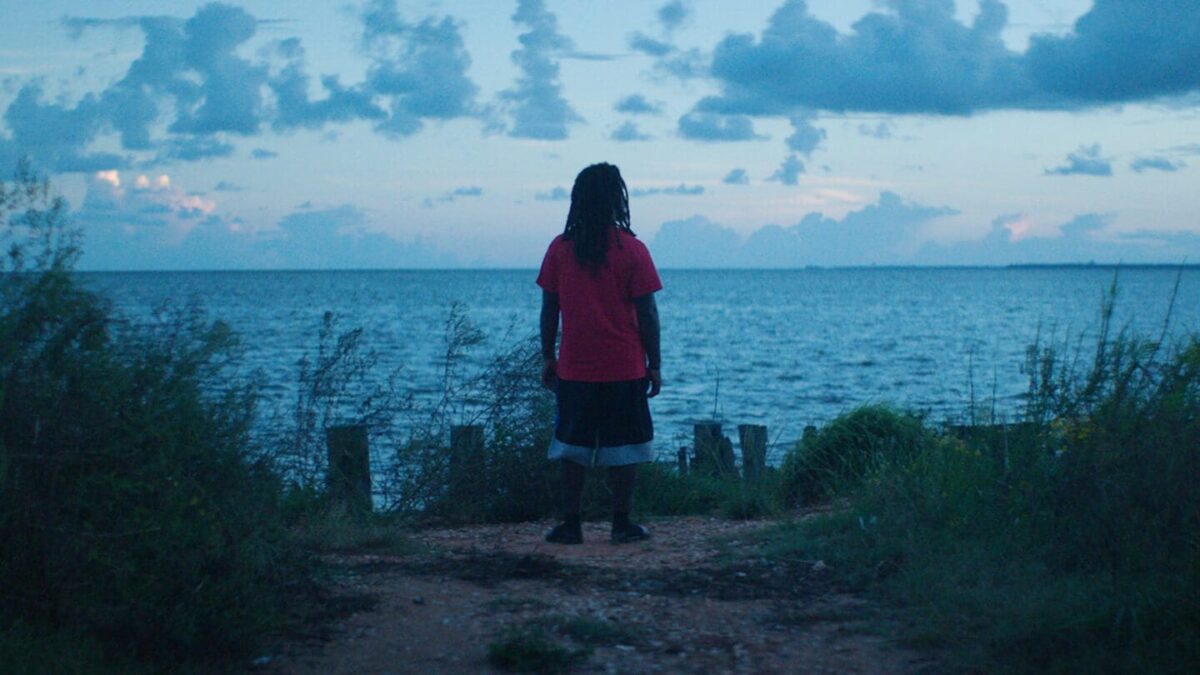
Margaret Brown’s documentary Descendant takes these events not as its focus, however, but as a launchpad for a wider examination of the community that grew up out of those captive Africans and their descendants, and what the long-hoped for discovery of the Clotilda means to them. After spending only five years enslaved on Meaher’s three plantations in the region, these Africans regained their freedom and formed what came to be known as Africatown. Their leader, Cudjo Lewis, survived until 1935 and was the subject of Zora Neale Hurston’s recently-rediscovered and published work Barracoon, the text of which is featured throughout the documentary so that “Uncle Cudjo” can tell his story in his own words. Africatown’s population swelled to 12,000 after the Second World War as workers flooded in to man various nearby paper factories, but later plummeted as those industries closed and the surrounding land was leased by the Meaher family to even more toxic industries. Now, the community is a poor shadow of its former self, its inhabitants suffering from the pollution of their home and looking for the validation—and hopeful economic lifeline—discovery of the Clotilda can bring.
While we were admittedly disappointed to not here more about the archaeology and other historical work surrounding the wreck, the twists and turns of Descendant’s narrative grabbed our attention with its poignant portrayal of just what racial justice means and demands in the modern world. Perhaps inevitably, especially due to the unique contemporary criminal nature of the Clotilda’s last voyage, discussion and interviews at one point turn to the idea of reparations for slavery. Many white people, especially of certain political dispositions, decry such talk on the grounds that they should not be held responsible for the sins of their ancestors—yet Africatown, like so many other similar places throughout our country, stands as testimony that slavery is only the foundational that must be repaid. The last century and a half have been filled with successive efforts to marginalize, exploit, oppress, and eliminate black people in the United States, from sharecropping to lynching to redlining to the current environmental racism that sees minority communities disproportionately neighbor and be poisoned by the kind of heavy, toxic industry that surrounds Africatown. In the face of these generational wrongs, denial itself makes one complicit, and the Meahers might have gone even further than that. Circumstantial evidence presented by local journalists seems to indicate that the family knew exactly where the Clotilda lay and conspired to keep it a secret for a century after any legal action could have been pursued against them. The wreck even allegedly showed signs of being dynamited—though ironically is now the best-preserved slave ship site in North America. Even its discovery in spite of the odds is not necessarily the boon so many of Descendant’s subjects hope it will be; in the wake of the official celebration ceremonies, one organizer and former real estate agent voices her fears that the financial windfall of a museum and tourism will be snatched out from under Africatown as outside investors buy up property and gentrify the area for their own benefit. The cycle continues.
What we thought would be a Civil War-era doc, then, turned into a farther-reaching film on one hundred and sixty years of injustice. It may not exactly be thrilling, but the questions it raises are essential ones to wrestle with if we are ever to live up to the promise of our country’s founding. While we wish it would have been a touch more explicit about making all these connections for its audience, it is still very much worth the watch.