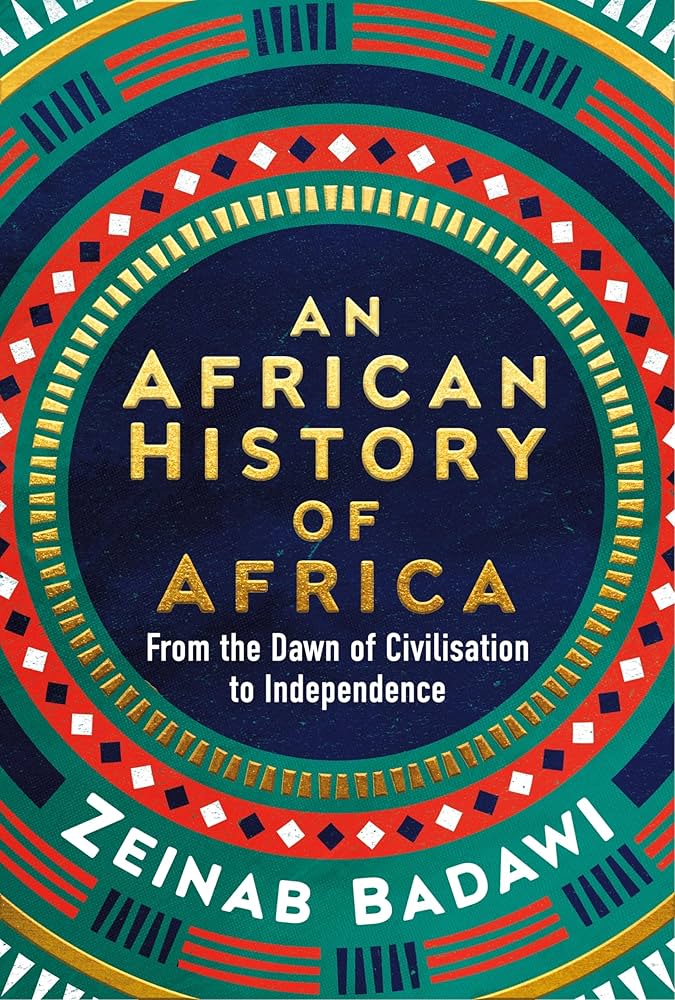
Badawi, Zeinab. An African History of Africa: From the Dawn of Humanity to Independence. New York: Harper Collins, 2024.
I’ve been on the search for a good, modern general history of the African continent for a long time. Much of my historical reading does admittedly trend towards the classic “white man” subjects (United States/European, political/military), and even though my specialization in modern imperialism does bring me to many different regions around the globe, it is often in selective context and organized through a European lens, even if indigenous voices are also highlighted. A history of Africa on its own terms, then, would not only hopefully fill in some of my blindspots but also prove a refreshing change of pace. I thought I had one years ago, and indeed had even left the bookstore with it in hand before discovering it had in fact been published three decades ago. This past fall, however, I thought I finally found the jackpot. A change of pace it might have been, but as it turned out, one I found more confusing than refreshing.
From its cover, Zeinab Badawi’s An African History of Africa seemed to check all of my boxes. It had been published that very year, 2024, and its subtitle promised a wide scope—perhaps the widest scope one could possibly cover in human history, from our initial evolution as a species to the decolonization movements of the 20th century. Along with herself being of African descent (Sudanese, to be precise), Badawi’s foretitle also explicitly indicates an intention to highlight African voices. She certainly delivers on both scope and indigenous perspective in spades, and it is clear that the research for this book has covered decades. There’s always a risk that such a weight of history can end up dense and inapproachable, but if anything the opposite is the case here. Badawi’s prose is highly engaging and readable to the point of being informal, more a casual conversation with her readers than anything. Her decision to avoid a comprehensive narrative of the continent in favor of discreet geographical vignettes gave her the space to dive into topics she finds fascinating while loosely tying them all together chronologically into a passable general history. I particularly appreciated the images of Africa that opened each chapter and explicitly highlighted the region to be discussed.
The methods through which that history is constructed, however, leave something to be desired. When I say that An African History of Africa highlights African voices, I mean that quite literally. Rather than engaging in scholarly dialogue with published sources, Badawi relates myriad actual conversations she has had with eminent scholars and museum personnel throughout the continent, often framing these encounters as two friends having a chat or a tour guide informing her of some interesting tidbit, just like they would a member of the general public. I’ve never encountered such an approach before, and its effect is to make Badawi’s work feel less like a history book and more like a documentary filled with talking heads that do the job of parsing their fields down into easily-digestible bites for uninitiated viewers. As someone who has not been uninitiated to the field of history for quite some time, however, I actually found this casual approach off-putting, robbing An African History of Africa of any real authoritative voice. This is compounded by the fact that these conversations with African scholars are the only interrogation of anything approaching historiography in the book. This means that reams and reams of highly relevant, meaningful, current scholarship on African history is entirely absent because it comes from European authors and academe, leading to some topics being covered quite shallowly (the entirety of pre-historic African life is confined to a single encounter with a modern tribe of hunter-gatherers, and also commits the sin of explicitly assuming that their life as lived in the 21st century is not only identical to their life millennia ago, but that it is also emblematic of all other prehistoric life regardless of region) and a general presentation of indigenous accounts without much critical interrogation. Shining a spotlight on African voices, even prioritizing them, is one thing, but using them alone is bad history—as it would be doing so with any other social group.
This lack of rigorous methodology is especially unfortunate for Badawi’s overall impact. From the introduction, she is clear that she is not trying to write “contested history,” setting different narratives of the same history against each other, but an effort to tell African history in its own right, using only African voices, is at some level precisely that, as her preceding sentences about dispelling the myopia of European-style education and its ignorance of African history makes clear. Indeed, Badawi contests numerous ‘conventional’ interpretations of history both implicitly and explicitly throughout the text, yet without the kind of impeccable, unassailable source work that could actually convince a skeptical reader (the book averages one endnote every four pages, and some entire chapters have only a single citation).What is more, Badawi’s admirable intentions to celebrate the value and relevance of African history all too often manifest in empty superlatives as she introduces stories and figures in terms more fitting for a grade school discussion of superheroes—only for those same stories to not be particularly unique or more insightful than many others in world history.
By the time I had finished, I couldn’t help but wonder who, exactly, An African History of Africa was for. While a number of details were new, none of Badawi’s topics were unknown to me or to any other semi-serious student of world history. Her engaging, casual prose and general approach seemed more fit for members of the general public who haven’t read much if any history before at all, yet I struggle to think of individuals who fit that description but are simultaneously likely to now pick up a work of history that runs to 467 pages. While I wouldn’t go so far as to say that I regret reading An African History of Africa, I also cannot in good conscience recommend it to anyone. Suffice to say, then, that my hunt for a definitive modern history of Africa continues.