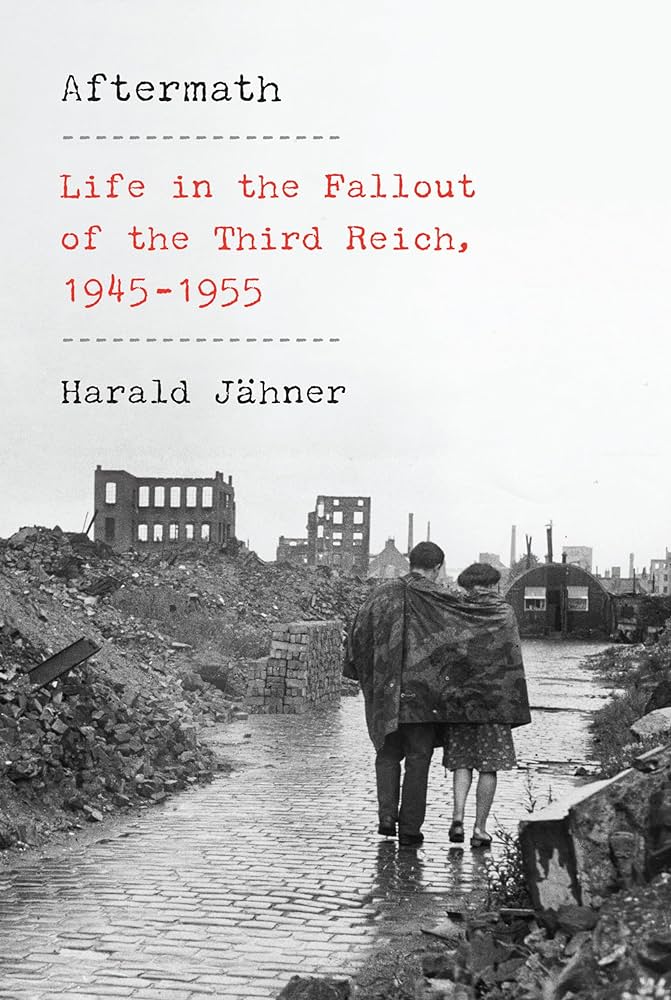
Jähner, Harald. Aftermath: Life in the Fallout of the Third Reich, 1945-1955. New York: Vintage Books, 2021.
Watching the intriguing film Lore with Heather a few years back, I’ve taken more than passing interest in the immediate aftermath of the Second World War in Germany. This has stemmed less from my own German heritage (immigrants to America well before the twentieth century, all) and more to do with the efforts to recover from such unprecedented destruction in the midst of the growing rift between previously allied occupying forces. 2023’s The Defeated was an interesting fictional take on the era highlighting the widespread crime and corruption amongst occupiers and occupied alike, and soon after watching I discovered a more academic take on the period by German journalist Harald Jähner. Eager to explore just how accurate my experiences with fictionalized takes on the era had been thus far, I dove right in.
The appropriately titled Aftermath examines its subject matter thematically, from more materialist subjects like the literal reconstruction of Germany’s bombed-out physical landscape, massive relocation of peoples, pervasive black market operations, and eventual “Economic Miracle” to cultural phenomena like the rediscovery of the arts, reassertion (or not) of gender roles, post-war relationship dynamics, and deNazification. While Germans faced the rebuilding of their society almost from scratch under the eyes of their not-always-benevolent occupiers, they also looked ahead to a new world out from under the thumb of a brutal fascist regime, and Jähner’s narrative is surprisingly not as depressing as one might first expect; there is a significant amount of discovery, joy, and even beauty amongst the ruins to be found in this pivotal decade in central European history.
That is not to say that Aftermath ignores or brushes past the more complicated elements of German reconstruction and reconciliation, however–far from it. Jähner documents the prolonged struggle to repatriate and bring justice for the millions of victims of the Nazi regime, whether Jews, other Eastern European ethnicities, or even displaced Germans, and much attention is paid to the lack of justice on display as Germany allowed former Nazis back into society without much introspection. Indeed, a running theme of Aftermath, whether discussing the Holocaust, other war crimes, or just the effects of Allied bombing or widespread participation in the black market is a very human, highly infuriating tendency to search for justification and avoid a feeling of guilt or blame on the part of the German people. Criminal actions to gain food were rationalized as socially acceptable because “everyone was doing it,” and reactions to accounts of victims’ suffering or even just meeting a Jewish person were often some variation of “Well, the German people suffered terribly during the war, too, you know.”
While at times Jähner is a bit too understanding towards these impulses for my taste, he largely acknowledges how infuriating all this is for a modern audience, and how the cause of justice seems in hindsight so egregiously underserved (members of the SS never even lost their pensions). Perhaps the most fascinating aspect of Aftermath is its frank assessment of the practical realities of the time set against these moral imperatives. Jähner is unequivocal that the German people were complicit in the Nazi regime and deserved to bear much more responsibility and punishment than they ultimately did–and yet, if that had been the case at the time, it is doubtful that a functioning German state could have been reconstructed for decades, let alone ones capable of functioning as worthy allies in their respective blocs’ burgeoning Cold War struggle for supremacy and ideological legitimacy. While I think it’s clear that more justice could certainly have been found without overly compromising the reconstruction that took place, I applaud this kind of practical analysis of fraught topics of historical memory and cannot recommend Jähner’s work highly enough to those interested in learning about just what it looked like to bring Germany back into the fold of the civilized world.