by Bryan & Heather
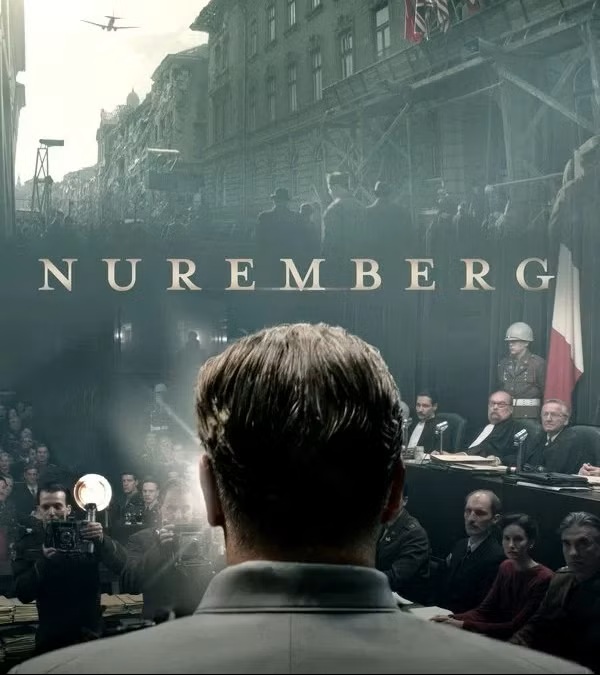
Discussion of war crimes is all the rage these days, particularly as the world monitors and processes ongoing events in Gaza and the rhetoric of the Trump administration towards Iran. International law and war crimes tribunals have also been populating Bryan’s reading over the last couple years, from the aftermath of the Second World War in both Germany and Japan to the history of genocide in the latter half of the 20th century. Combined with Heather’s own interest in German history and the study of atrocity, it was essentially inevitable that we would get around to watching James Vanderbilt’s 2025 film Nuremberg when it landed on streaming. With a star-studded cast led by Russel Crowe, Rami Malek, Michael Shannon, and Hugh Grant, this prestige period drama seemed to have been nearly prophetic in its timing, and we hoped it might assist in making these issues more accessible and palatable to something like a general audience.
One could hardly ask for a more sweeping, or evocative, title for a movie than Nuremberg. Right from the beginning, Vanderbilt seems to deliver on this promise, packing in as much historical context as he possibly can to enable audiences that might not know all the granular details of Second World War history to follow along and for the narrative to work. At breakneck speed, we’re conducted through the surrender of Reichsmarshall Herman Göring (Crowe), Adolf Hitler’s second in command and the highest ranking German officer in history up to that point, not to mention captured alive by the Allies (complete with floating on-screen text in the style that Heather can rarely keep from rolling her eye at), the efforts of Supreme Court Justice Robert Jackson (Shannon) to establish an international war crimes tribunal for surviving Nazi leadership so as to set an example of international law and ‘win the peace,’ and the assignment of US Army psychiatrist Lt. Col. Douglass Kelley to begin evaluating the twenty-two high ranking German prisoners of the Allies of which Göring is the head. Even more exposition is to follow, as Nuremberg seizes the opportunities of both briefings and the trials themselves to insert ‘40s-style newsreels—mostly using actual period footage, but with a modern-recorded narration—that further explain topics, events, and figures to viewers. The highlight, if it can be called that, comes with the display of the original documentary film on the Nazi death camps just as it was really shown in the courtroom at Nuremberg.
Yet for all this information, it also became apparent early on that this film was not going to meet many of Bryan’s hopes for a larger, more consequential treatment of the nature of international law and the complexities of just what happened at the Nuremberg Palace of Justice from November 1945 to October 1946. Many contentious or unsettling issues of the time, such as the novel assertion by the United States that “waging aggressive war” constituted a violation of existing international law that the Allies could prosecute impartially (in short, it wasn’t, but that doesn’t necessarily mean they were ‘wrong’ to do so), the complication that the Allies themselves had certainly engaged in war crimes through area bombing of cities and use of the atomic bomb, the United States’ decidedly halfhearted support for the tribunal’s final verdicts (contrary to popular belief, the United States did not at the time support the precedent that ‘just following orders’ is not a sufficient legal defense, and never officially has since), or how the political and strategic concerns of reconstructing Europe amid a slowly-hardening Cold War interfered with the principal of complete de-Nazification of German society, are ignored or, at very best, extremely rapidly brushed over. Instead, the overwhelming core of the film is the story of Kelley and Göring, doctor and patient that develop an increasingly close comradeship, even friendship, as their relationship goes on. Indeed, as we later learned, Nuremberg is in fact based on a book focused specifically on the interactions of these two individuals, Jack El-Hai’s The Nazi and the Psychiatrist. Kelley at first seeks to artificially slide into Göring’s good graces in pursuit of writing a book that explores what was so different about Germans that could have led an entire nation to have committed such “evil” acts. Just as Kelley comes to genuinely like not just the Reichsmarshall but his wife and young daughter, however, he is shaken to the core by footage of the Holocaust and Göring’s immediate attempts to morally equivocate and equate those atrocities with the hard-war policies of the Allies (all the more reason that the glaring absence of any discussion of area bombing amongst the American and British prosecutors leaves the film much the poorer). All this, plus his ultimate sacking on account of such unprofessional behavior and a train-platform heart-to-heart with his interpreter and—as it turns out, Jewish—friend, leads to Kelley’s realization that there is nothing inherently different about Germans, and that all humanity possesses this capacity for evil. After deciding to help the flailing Justice Jackson’s prosecution with his psychiatric insights on Göring and ultimately securing a conviction and death sentence through the Reichsmarshall’s unwillingness to admit he was wrong for following Hitler (if indeed he thought he was), Kelley returns home and completes his book based on his revelation. The final scenes reveal that while the Nuremberg Trials would succeed in establishing Justice Jackson’s vision of international law as the foundation of a rules-based world order (a framework that is never seriously engaged with in any detail during the film), Kelley’s book would sell few copies and Kelley himself would take his own life scarcely a decade later, distraught at the fact that no one took his insights and warnings seriously.
On the one hand, then, Nuremberg does deliver a fascinating, gripping interpersonal drama which earnestly attempts to carry forward Kelley’s work and impress upon modern audiences not only its validity but its continuing, searingly urgent relevance today. At this it does, mostly succeed, even if it may feel somewhat of a banal point to those who have read widely in the history of the 20th century. Yet on the other hand, the film’s extremely inconsistent presentation of historical information and treatment of its overarching framework left Bryan disappointed, feeling like it had only gone through the motions of presenting an accurate period tableau while in many ways really just broadcasting a lot of white noise. If one goes in with all this knowledge to moderate their expectations appropriately, Nuremberg is a solid watch. If you’re already the kind of person who is interested, however, don’t expect much of a revelatory statement that will leave a mark on our historical memory or larger society.