by Bryan & Heather
Historical fiction operates on a sliding scale between history and, well, fiction. Some stories craft an entirely original narrative set within a generally historical period, sometimes even interacting with or inserting its characters into real events. On the other end of the spectrum are the “fictionalized history” stories that seek to adapt real people and real events to the screen through cleaning up the narrative and making creative choices to simplify and enhance it according to principles of entertainment and storytelling. And then, there’s Greg Berlanti’s 2024 film Fly Me to the Moon.
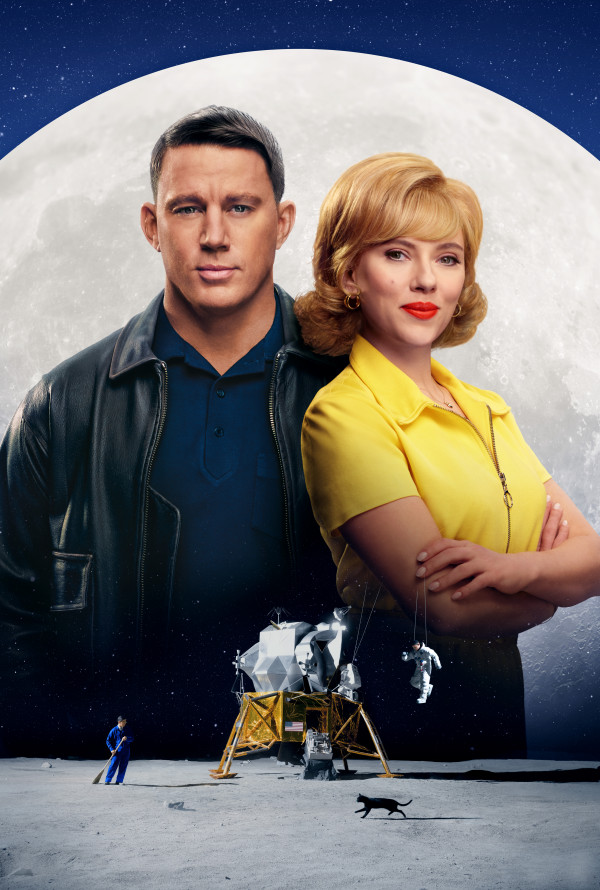
In 1968, on the eve of the Apollo 11 mission that would land the first men on the moon, NASA is struggling. President Kennedy had delivered his famous speech at Rice University committing the nation to just such a mission “before the end of the decade” six years prior, and time is running out. In the interim, the American public has been subjected to repeated mission failures and losses to the Russians in the race for firsts, not to mention the escalation and stagnation of the war in Vietnam. Some wonder if perhaps NASA isn’t a sunk cost fallacy, and unsurprisingly an agency made up of scientists and military personnel is not exactly skilled at having to persuade the public of their own utility. The president now is no Democrat, however, but the arch Cold Warrior Richard Nixon. A shadowy White House operative named Moe Berkus (Woody Harrelson) thus approaches New York advertising executive Kelly Jones (Scarlett Johansson) with an offer: work as a public relations official to rehabilitate NASA and save the moon landing, and her past as a confidence woman and scam artist will be erased. Jones ends up running circles around launch director Cole Davis (Channing Tatum), but strikes up a real relationship there, too, until everything she’s built is jeopardized by Berkus’s new directive: it’s too risky to depend on the landing going well, so Jones must fake the moonwalk in a nearby studio and broadcast it to the nation instead of the real lunar feed.
The initial premise of Fly Me to the Moon is intriguing, even admirably historical in its thinking. The space fatigue of the American people in the late ‘60s and accompanying PR ills for NASA were indeed real, and can easily be overlooked in hindsight, knowing now what a success the moon landing would turn out to be. We always love seeing stories that emphasize how contingent history is as it is lived, not to mention highlighting often-invisible groups or individuals that were crucial to the success of high-profile leaders, soldiers, and scientists. Playing into Nixon’s reputation as a cynical, ends-justify-the-means politician was brilliant, too, and connecting a faked moon landing to his fixers is inspired storytelling. Just as gratifying, the film’s conclusion of the fake moon landing actually not being broadcast and the truth winning out not only thumbs its nose at the many modern conspiracy theorists who still believe we never landed on the moon but serves as a nice little statement of hope in our misinformation-riddled times.
Scratch the narrative surface of the film, however, and it’s apparent that its historicity is only a vaguely inspired gloss. Not a single character aside from Nixon, Armstrong, Aldrin, and Collins is real or even based on a historic figure more than in the most general way. Fly Me to the Moon then splits the difference between historical fiction and fictionalized history, inserting an entirely original romantic comedy into reality, displacing most of the actual people who participated and made those events reality. It certainly makes for a charming little movie, and it is only entertainment, after all, but we can’t help but look a bit askance at such narrative techniques, especially in a movie focused on the triumph of truth over lies and misdirection, no matter how well intended.