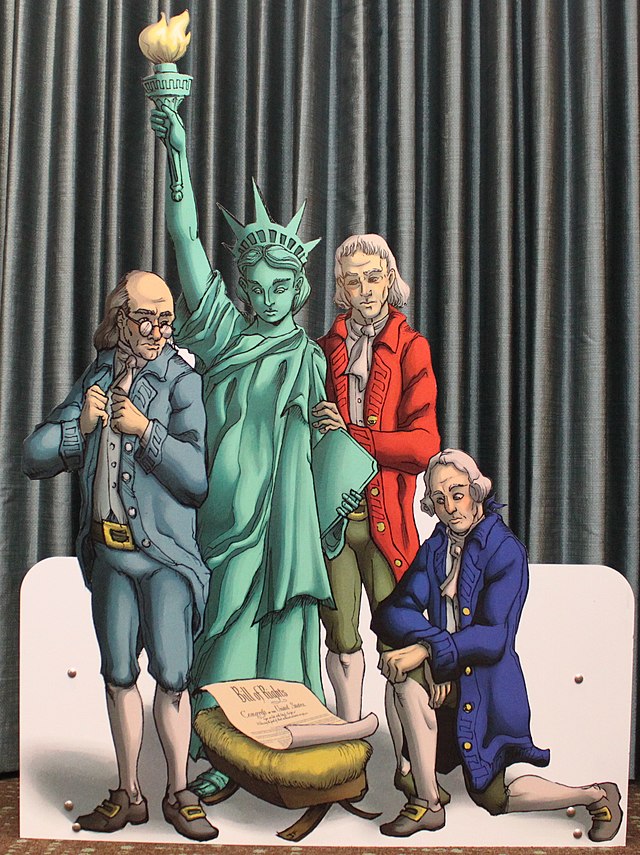
Over the past few months, I’ve written a number of posts discussing elements of United States Constitutional law, especially as interpreted by the Supreme Court in ways both unsupportable and that complicate our own understanding of how rights have evolved throughout our history. Much of my focus on this topic has been inspired by the recent behavior of the current extremely partisan, irresponsible Court, but my original interest actually extends deeper, to my time coaching one of my very first tutoring students in his AP United States Government class. I had never taken the course myself in high school, and as we plowed through reams of flashcards devoted to Supreme Court decisions, I was fascinated by the nuances of how our Constitutional order has developed. One particular concept stood out at the time, one that struck me as bizarre and the product of gross oversight on the part of the Founders: the doctrine of incorporation.
For those unfamiliar with it, the doctrine of incorporation is the legal interpretive process through which the protections of the Constitution, most notably the Bill of Rights, have been extended to apply not just to the Federal government but to the state and local governments as well. This is not unintentional, or at least, the wording that resulted in this outcome is explicitly clear. The First Amendment declares that “Congress shall make no law…”, and in conjunction with the Tenth Amendment, which reserves all powers not given the Federal government or prohibited to the States to state governments, that means that state governments theoretically have free rein to restrict freedom of religion, speech, assembly, and the press—at least as the Constitution was originally written. Thankfully, or perhaps luckily, the protection of these rights was considered so foundational to democratic government that all states adopted similar protections into their own constitutions, but that did leave disputes up to state courts, not Federal ones, which could result in an inconsistent patchwork of protected rights at odds with the spirit of that famous amendment so fundamental to American identity then and now. The First Amendment would only be incorporated and considered to apply to the states as well beginning in the 1920s.
To compound this misstep, American governance also considered the rest of the Bill of Rights to apply only to the Federal government, despite the difference in each amendment’s wording. Only the First Amendment explicitly restricts Congress; all others refer to citizens’ rights being protected in totality. Yet for some reason, either through projecting that initial Congressional language across the entire set or even more general reasoning that something contained within the Federal Constitution can only apply to the Federal government, such social and legal rights as the right to bear arms, protection from unreasonable search and seizure, trial by jury, even protection from quartering soldiers were considered only the purview of Federal law. Embarrassingly, these amendments were only incorporated under the Warren Court in the 1960s, often in relation to the Civil Rights Movement and efforts to ensure equal justice for minorities in southern states.
So what changed? How did we go from a system of rights protected under a rickety, near-imaginary system of norms and common law to a more explicit and universal framework? The answer lies in what many historians consider to be our country’s second founding following the Civil War, specifically in the text of the Fourteenth Amendment. As it established birthright citizenship and attempted to prevent formerly-rebellious states from persecuting freedmen, it declared that “No State shall make or enforce any law which shall abridge the privileges or immunities of citizens of the United States; nor shall any State deprive any person of life, liberty, or property, without due process of law; nor deny to any person within its jurisdiction the equal protection of the laws.” Clearly a law composed in the wake of struggle in which the idea that states could act independently of the Federal government, or were in some way even superior to it, was a major issue, and the implications of this sentence would have far-reaching consequences. Depending on one’s interpretation of what constitutes privileges and immunities, or what’s involved in due process of the law, the Fourteenth Amendment could be read to mean that the Bill of Rights now must be observed by the individual states, and so it has generally occurred. There are problems with this approach as well, though. Incorporating the legal right amendments is fairly simple and uncontroversial if “due process of law” is logically taken to describe a process that includes those protections—though again, these were some of the latest amendments to be so incorporated. The First Amendment is trickier. Some say that its protections are included in the privileges and immunities of every citizen; in spirit, sure, but as seen above, the Constitution as originally written only says that’s a privilege in regard to Federal law. Others define due process as necessarily incorporating such common law liberties as those protected under the First Amendment. In my opinion, this is shaky ground, unsupported by explicit law or text and essentially just reiterating the fortunate coincidence of the early state constitutional protections. Such an approach has only partially worked throughout the past two and a half centuries, leaving minorities only protected at the majority’s whim. I have even less faith it would work moving forward, especially over the next four years with Trump’s return to the White House. “Due process” can easily be twisted to deprive those rights as well, and conflating legality with morality is always a dangerous step towards authoritarianism.
So what’s the point of all this? For me, studying the history of incorporation demonstrates a number of key principles to keep in mind when considering our Constitution, legal system, and how we approach modern governance. Our founding document is very good, but it is by no means perfect. It contains noticeable flaws that do not align with other principles it seems to hold dear, and yet at the same time its text can be interpreted in a variety of ways that gives us a wide latitude for action that aligns more closely with our modern concepts of liberty. Notably, though, it demonstrates the textual limits of interpretation at the same time: justices must locate their arguments in the wording of the document itself and cannot simply argue that the First Amendment makes no sense if it does not extend to the states. We also cannot take those modern concepts of liberty for granted; not only have they been actively constructed over centuries, but they may not be as legally iron clad as we think they are. The past decade has been an exercise in showing just how much of the American Constitutional system has been tied together not by laws but by norms and decency. We assume the protection of our rights is any different at our own peril.