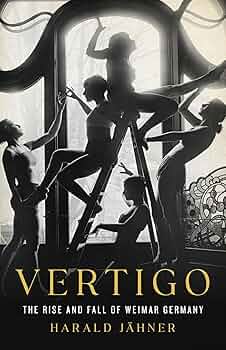
Jähner, Harald. Vertigo: The Rise and Fall of Weimar Germany. New York: Basic Books, 2024.
Last year, I had the pleasure of reading Härald Jähner’s short work Aftermath on the immediate aftermath of the Second World War in Germany. Fitting, then, that his next book should be on German society immediately before the Third Reich. While I wouldn’t say I have a special interest in the Weimar Republic, my studies of the First World War have had more than incidental overlap, and given the less-than-democratic times we’re living through and my trust in Jähner, I decided to give it a try. Little did I know just how relevant that choice would prove.
While Vertigo is billed as a general history of Germany from the birth of Weimar in 1918 to the accession of Adolf Hitler to the premiership in 1933, this is not quite the case. Political and economic history form a framework for his narrative and naturally becomes more prominent in the final chapters as democracy crumbles and the Nazis gain ground, but the meat of the work is really a thematic exploration of all the vibrant facets of Germany in the interwar period that Weimar is so famous for. Across fine arts, architecture, interior design, cinema, dancing, automobiles and traffic, sexuality, gender, urban planning, occupations, leisure time, standards of beauty, and more, Jähner explores the cultural and societal elements of Weimar that made it so unique—and emphasizes the tragedy of its fall.
For all its engaging anecdotes, however, Vertigo never quite reached the same heights as Aftermath for me due to some odd decisions in both content and organization. Jähner begins his narrative with the immediate aftermath of the Great War, asserting that it was only with the revolutions and economic deprivation that accompanied the Treaty of Versailles and demobilization that the war really came home to Germany. Understanding the German mindset in the interwar period and the Second World War has always been based on the absence of enemy invasion during the First World War, but to say that Germans were strangers to war is odd considering the extent to which society was mobilized for the conflict, not to mention how poor logistical planning and the British blockade led to harsh rationing and even starvation by the end of the war. Indeed, Jähner inexplicably ignores the British blockade altogether when discussing the post-war German economy.
The end of the book left me even more perplexed. As I read, I had marked parallel after parallel with current events, to the point where it became rather unsettling. The cracks in a seemingly-tolerant, prosperous modern society being revealed by an economic crisis and exploited by disaffected, nihilist reactionaries that make use of new communications technology to bring down democracy in favor of a fascist dictatorship is just as accurate a description of the 2020s as it is of the 1930s. And yet to my shock, Jähner says not a word about the pressing relevance of his subject. Instead, he fills his epilogue with vignettes explaining the subsequent lives of the many individuals whose writings he used as primary sources for his narrative. This is the kind of epilogue usually reserved for historical fiction novels, and I’ve never seen it in a general history monograph before. It wasn’t bad in and of itself, but when it comes at the cost of any kind of reflection on the parallels and lessons to be drawn from an author’s book, I can’t help but be disappointed.
In the final accounting, I can’t say I regret reading Vertigo, exactly. Jähner’s prose and vivid descriptions of so many cultural movements that in many ways founded the modern world as we know it are worth reading for their own sake. It’s just a shame they couldn’t have been so much more.