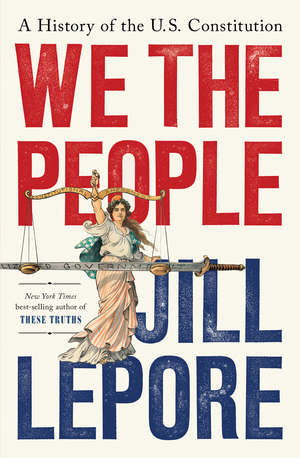
Concerning History Book Club returns! Here, we recreate the experience of the engaging book discussions we’ve had throughout the years in classes and with each other. In this installment, Bryan and Francis dive into august historian Jill Lepore’s history of the United States Constitution, what it does well, what it doesn’t, and what they wish it had delivered.
FB: First, I want to start with the strengths of We the People. Lepore does an excellent job in the first third of the book discussing the ethos of using amendments to revise written constitutions as a key and widely accepted part of America’s emerging democratic institutions. Her analysis of the amending processes that led to revised or wholly new constitutions, with checks and balances, bills of rights, and democratic or egalitarian precepts, convincingly demonstrates that Americans in the Early Republic did not revere their constitutions as divinely inspired, unalterable, or sacrosanct documents. Instead, Framers, be they of state constitutions or the U.S. Constitution, engaged with these documents as real, political, and temporal instruments designed to create a republican form of government. While this may not have been the point of Lepore’s work, which transformed into a social history of the Constitution, the first third of her book quite undermined most, if not all, arguments in favor of originalism or any other constitutional interpretation that reveres the document itself, the Framers, or constitutional republicanism in the U.S. as somehow superhuman or the product of extraordinary geniuses. Giving credit where it is due, the Framers of state constitutions and the federal Constitution were intelligent, perceptive, and politically adroit people who studied history and political science well enough to create functional governments. At the same time, they also thought that these constitutions were necessary, but not permanent, instruments for governance.
BC: I quite agree. Lepore’s treatment of the animus of the Constitutional Convention, the process of drafting and ratification, and the concurrent movement for both state constitutions and their continuous amendment and re-writing, is nothing short of masterful. But as America enters its adolescence and the scope of a Constitutional history necessarily broadens, I couldn’t help but feel like Lepore’s approach did not appropriately rise to the occasion. It feels like we’ve commented endlessly on the inaccuracy of book titles in the past, and we do know that this is often the fault of editors rather than authors, but both the subtitle and introduction of We the People are fairly clear that this work is conceived as a general history of the Constitution. Aside from avoiding overly technical details of legal theory and jurisprudence, Lepore does not lay out any internal reasoning for restricting her material or avoiding certain aspects in favor of others—or so it appeared. What she does argue is that the history of our founding document shows how central the concept of amendment has been to American society, and how the last fifty years has seen the death of serious attempts at doing so. Moving into the 19th century, it quickly becomes apparent that this is more than simply an interpretive lens; Lepore is primarily writing not a history of the Constitution, but a history of amendments and attempted amendments to the Constitution. On its own, this may not have been as jarring, but the problem is that by accepting the argument that interpreting the document is tantamount to amending it (which is stretching logic, to be kind), she actually throws her text back open to a general history in theory while simultaneously ignoring most of those implications and continuing to focus on amendments-plus-some-interpretation. Entire categories of crucial Constitutional history are completely absent here as a result, including discussions of habeas corpus during the American Civil War, what kinds of laws Congress is allowed to pass, what kinds of taxation are allowed under the Constitution (even though, oddly, efforts to include an income tax via amendment are included), and whether Federal military conscription is Constitutional, to name but a few.
FB: Yeah, I definitely felt at one point that there needed to be a discussion of the doctrine of incorporation or that the text just rushed through the Gilded Age when, all of a sudden, judges interpreted liberty and equality to mean “freedom of contract.” I wanted her to sit with some of these giant changes a bit more; maybe I’m adding too many wishes into the text. However, some of those discussions felt necessary to fully grasp the history surrounding proposed or adopted amendments. Specifically, this is the book to point out where people, throughout American history, have made bad faith arguments about the meaning of amendments and Lepore does not do so. In particular, I was rather annoyed that in all the discussions of the Fourteenth Amendment’s Equal Protection clause, and the two Brown v. Board cases, Lepore never disassembled anti-Brown arguments that had stipulated the Equal Protection Clause was never meant to apply to schools. She even mentions, as a major historical character in her work, the legal scholar Jacobus tenBroeck, who provided essential historiographical work on the origins of the Fourteenth Amendment but does not dive into his scholarship that definitively linked the Equal Protection Clause and birthright citizenship to the efforts of lawyers, ministers, and abolitionists across the North to guarantee an equal protection of their states’ civil rights law to all people, regardless of race. To provide one historical example, Massachusetts’ legislature passed a law in 1855 that banned racial segregation in schools in response to a lawsuit from a Black family in Boston whose daughter was forced to travel a far distance to attend her segregated common school. While this initial lawsuit, brought by the white attorney (and future Senator) Charles Sumner and the Black attorney Robert Morris (among others), did not succeed in court, the state legislature changed the law to respect equal rights in education. In fact, the Supreme Court in Plessy v. Ferguson cited the initial decision from this case that upheld segregation, and conveniently ignored the state law that outlawed it, when justifying their own decision in 1896. Similarly, before the Civil War, lawyers and activists invested in abolitionism and civil rights reform all pursued legal or legislative reforms to ensure the equal protection of the laws. The bottom line is that any arguments against Brown on the basis that the authors of the Fourteenth Amendment did not intend equal protection to extend to schools misreads what those lawmakers in the Thirty-ninth Congress in 1866 thought, and their own prior political experience, about equal rights and the law. This book was the place to make such an anti-Brown argument clear and Lepore missed it.
BC: Indeed, and I think the biggest area where this lack of real-time fact checking and analysis is noticeable surrounds the many iterations of the interpretive school of “originalism” that Lepore covers. Perhaps this is because she believes her text can speak for itself and implicitly show the emptiness of these individuals’ argument, or maybe it’s because, as she writes in her introduction, she did not intend We the People to be an explicit attack on orginalism—but it’s hard to read it any other way when Lepore so skillfully narrates a history of amendment and change and organic governance, only for another white, privileged man to rear his head and proclaim that no, actually, his entirely fabricated, ahistorical way of interpreting the Constitution is the only correct one. This goes for both the general approach and specific details; it was painful to read Lepore’s coverage of Antonin Scalia and his jurisprudence concerning the 2nd Amendment without a word of that arch-originalist’s denial that the Framers’ explicit textual reference to a “well-regulated militia” meant anything at all to that amendment’s meaning. It is also odd how each of these originalist figures seem to exist as an island in the narrative. While she does acknowledge some level of continuity between them, Lepore seems reluctant in the extreme to actually place them all into the same intellectual tradition, reserving the actual label of “originalist” only for those of the past three decades despite arguments as far back as Roger B. Taney’s atrocious decision in Dred Scott v. Sanford using identical language. We end up landing in a weird place where I would recommend this to an intelligent reader to demonstrate why a focus on the original intent of the Founders is intellectually vapid, but at the same time would not be confident that a lay person would be able to draw those same conclusions for themselves.
FB: That’s a good point; we both have a lot of background knowledge on this topic and were able to string together Lepore’s critique of originalism. But if this was my first time reading about any of this, I would probably have a hard time following that implicit argument when there were so many other details, historical characters, and questions that Lepore raised and tackled in her narrative. In fact, that was one of my other problems with the narrative itself. Lepore incorporated many neglected stories of constitutional amendments or revisions in her text that I did not think were essential to her explicit and implicit theses (first, that the U.S. has had a long political tradition of amending constitutions or the U.S. Constitution as part of its democratic, constitutional republicanism and, second, that originalism is a bogus method of interpreting the constitution). For example, her chapter on the attempts of native Hawaiians to write and adopt their own royalist constitutions, and reject the written constitutions of American corporations that sought to supersede native sovereignty in Hawaii, was a fascinating case-study in corporate imperialism. Yet, all of these events essentially took place before Hawaii was formally a U.S. colony. That to me suggests that Hawaiian constitutionalism belongs better in an analysis of U.S. imperialism and has less relevance to the development of amendments or the history of the Constitution for the United States itself since such political battles in Hawaii took place before Hawaii was even under the control of the U.S. government.
BC: While it may seem like we have a lot of critiques, that’s largely because what we did read in Lepore’s work was of such high quality. As feels so often the case these days, all the history that was present in We the People was impeccably researched and compellingly told. It’s hard to see Madison and the Federalist papers the same afterwards, and while Lepore’s numerous character moment inserts did feel a little contrived or overwrought at times, others were absolutely fascinating, including and especially her spotlight on the tragically little-known, indomitable 1970s Senator Birch Bayh. We just wish Lepore had either included more, or presented us with a much clearer defined and organized premise for what could have been a masterwork.