In the fifth installment of his series unpacking Supreme Court Cases that reveal unsavory truths about our country and how the legal interpretation of its founding principles have evolved throughout the centuries, Bryan examines the twin cases Nixon v. Fitzgerald and Harlow v. Fitzgerald and how the complicated balance of protection and liability for civil servants’ actions have evolved into a corruption of the principle that no person is above the law.
On July 1, 2024, the Supreme Court decided in Trump v. United States that the President of the United States is considered to have absolute immunity from criminal prosecution for any action undertaken under the official responsibilities of that office. Now in 2025, almost a year later to the day, that same court decided that no lower Federal court has the power to challenge a president’s actions. These rulings are increasingly perilous for American democracy, not to mention in defiance of basic principles of jurisprudence and logic. Yet this theory of an all-powerful presidency is not a recent one. The beginnings of such immunity rulings date back over half a century and stem, at least in part, from efforts to give public servants the necessary leeway to carry out their often-subjective responsibilities to the best of their ability. A laudable sentiment, even one without which our democracy couldn’t function—but in this case, one decided on the grounds of what should have been an odious, obvious exception.
In 1968, Arthur Ernest Fitzgerald was a contractor for the United States Air Force. In the course of fulfilling his responsibilities as a deputy for management systems in the Office of the Secretary of the Air Force, Fitzgerald made a staggering discovery: development of the C5-A Lockheed Galaxy military transport aircraft, originally budgeted for $1.9 billion, was projected to have over $2 billion in cost overruns before the project’s conclusion (equivalent to $18.5 billion in 2025, and bringing the final price tag to more than double the original budget). Against the advice of other Air Force officials, Fitzgerald testified before Congress’s Joint Economic Committee and soon after was fired from his job. Four years later, the release of the Watergate tapes revealed that President Nixon himself had ordered Fitzgerald’s termination, reportedly telling aides to “get rid of that son of a bitch.” While retaliation like this would not become illegal until the passage of the Whistleblower Protection Act of 1989, Fitzgerald then sued both Nixon and his aides in civil court for damages stemming from wrongful termination. Their claims of absolute immunity to the suit generated a series of cases that, understandably, could only be resolved by the Supreme Court.
The two major case decisions that resulted in 1982, Nixon v. Fitzgerald and Harlow v. Fitzgerald, were (supposedly) predicated on the justices’ fear for the health of American democracy. Due to the inherently subjective, judgement-based nature of the being a public servant, especially in the office of the presidency, large numbers of citizens will inevitably disagree with the actions of any given Chief Executive. For our legal system to support virtual open season on these public servants after they leave office could result in endless, financially crippling series of lawsuits that would render these offices impossible to fill. In a split 5-4 decision, then, the Court decreed that Nixon’s claims to absolute immunity from civil litigation for actions taken under the auspices of his official office should be upheld—though they were careful to note that this immunity did not extend to criminal charges. Lest one think that the four dissenting judges did not agree to any kind of immunity, Harlow v. Fitzgerald was far less contentious. 8 of the 9 justices agreed that presidential aides were entitled to qualified immunity for their official acts, only open to litigation if it was determined by a pre-trial judge that the official “knew or should have known” that their actions violated another’s Constitutional rights. The one dissent was one of consistency, as Justice Warren Burger argued that immunity should be decided based on responsibility, not hierarchy, and if the President received absolute immunity then his aides, which are indispensable to the execution of the office, should receive it as well.
It is hard to argue with the Court’s underlying principle of protecting deserving public servants only trying to do their jobs to the best of their ability (and that’s why I decided to discuss this case here, rather than in my Remedial Case Studies series)—but is this blanket presidential immunity really the way to do it? Nixon v. Fitzgerald was not predicated on a disagreement over policy or the outcome of a decision that could not have been foreseen. One of the most unethical presidents in our history used insulting language to demand the termination of a government employee in retaliation for speaking out about a staggering level of government waste, if not outright corruption. . .and because that decision fell within the administrative purview of staffing the many departments of the Executive Branch of government, the Supreme Court decided that Nixon should be immune from even needing to defend himself. It’s difficult to think of a less deserving situation for this principle to be decided upon. Any job’s responsibilities, from a retail cashier to a commanding general, can be executed well, with mistakes, or in a deliberately malicious manner. To argue that no effort should ever be taken to determine if the latter is the case when dealing with the most powerful position in our country is its own kind of negligence.
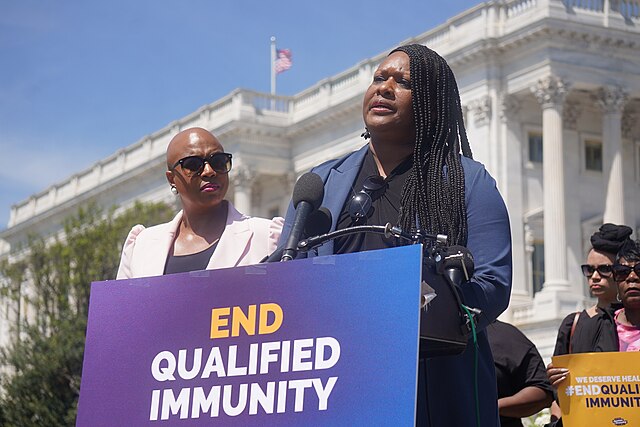
It seems to me that the idea of qualified immunity, or something like it, would be a better standard in situations like these. To minimize drains on time and money, a pretrial judge or some other legal authority (even a separate branch of the Judiciary specifically created for these cases) assesses whether there could be serious wrongdoing or liability to pursue further in a court of law. Yet even here, there is danger. All too often, the “knew or should have known” standard has been measured by whether any previous cases exist where an individual has been found liable for the same action, essentially leading to the first instance of wrongdoing gaining a pass even if the claim not to have known something was a violation is transparently flimsy. Indeed, while originally decided in relation to officials in the Federal Executive Branch, it has found expanded use in shielding law enforcement officers from the consequence of their own abuse of power.
The old proverb that the road to hell is paved with good intentions has rarely seemed as relevant as it is, then, with these twin judicial decisions. Not only do they fall into the all-too-frequent pattern of jurisprudence using innocuous, even apparently beneficial reasoning to protect clear wrongdoing, but they have supplied a foundation for later bad faith actors to achieve the further precedent of absolute immunity from criminal prosecution for presidents’ official acts, as well. The twenty-first century has proven to be an era of overturning what had previously been established legal precedent, however; if our democracy survives the next three years, I can hope that decisions that actually deserve to be overturned or at least modified, like this one, will have their day as well.