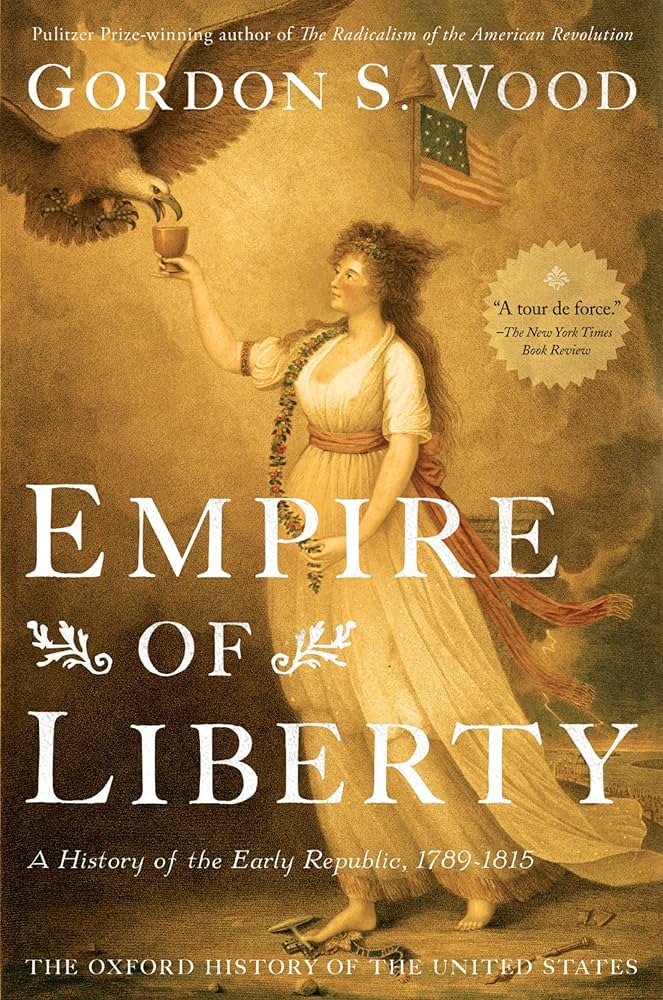
Wood, Gordon S. Empire of Liberty: A History of the Early Republic, 1789-1815. Oxford: Oxford University Press, 2009.
My own professional specializations lie for the most part firmly in the later half of the 19th century, yet the early decades of that same century have ironically received some of the lowest attention from me, especially in my undergraduate years. I’ve recently begun closing that gap, however, and after I finished James McPherson’s rightfully famous Battle Cry of Freedom, I couldn’t help but notice an earlier installment in the Oxford History of the United State covering the Early Republic. Enter Gordon Wood’s Empire of Liberty.
While there are other volumes of the series covering the history of the North American continent before Wood’s contribution (three, to be exact, and only one has yet been published), Empire of Liberty is in a way a history of beginnings. The actual drafting and ratification of the Constitution falls within the purview of the previous The Glorious Cause, but it is left to Wood to explain how those debates manifested in practice and how the Founders then had to figure out what exactly the new government was supposed to look like. These events are so far removed from our own day that they are rarely questioned or analyzed from the standpoint of uncertainty, and Wood eloquently reintroduces the haphazard, improvised nature of so many decisions that would ultimately become hallowed institutions of American government.
If there is a single, major storyline of Empire of Liberty, it must be the formation of the young nation’s first political parties (or factions, as contemporaries would have described them) and the evolution of their bitter rivalry over not only governance and foreign policy but the proper ordering of society. For Wood, this ideological conflict began before even the scope of his book; in certain key ways, he argues that the Constitution was a conservative government designed just as much to reign in the excesses of out-of-control democracy evident in the newly-independent states just after the Revolution as it was to give the central government more effective governing power. This continued into the crystallization of the Federalist party around Washington and his loyalists and Democratic-Republicans around Jefferson, Madison, and their adherents. There is a complex story here, and one that should leave any modern reader with a distinct distaste for both groups. The Federalists, and especially their financial prodigy Hamilton, consistently propose intelligent, modern policies of governance that take into account the reality of economics and international relations of the time—all while clinging to distinctly un-American and un-Revolutionary ideas of social hierarchy that verges on nobility and rejection of democracy. The Jeffersonian Democrats, meanwhile, espouse a view of American democracy, liberty, and freedom that sounds surprisingly progressive even by modern standards, all while violating them in practice through the institution of slavery and clinging to absurd, utopian, and flat incompetent ideas of how they wish government in line with democratic principles to operate. By the end, I was done with all of them and amazed at the miracle of our nation’s survival.
Wood’s narrative is not solely political and economic, however, covering the entirety of social, cultural, and religious history of the era interwoven with the larger narrative. These subjects can be more of a mixed bag, unfortunately, as they are organized as discreet chapters in their own right. This certainly gives the space to delve into them in detail, but some, especially slavery, beg to be incorporated multiple times over the wider arc of the period rather than just explored once. There are also some conspicuous absences; the term “republican motherhood,” for example, never appears in Wood’s text despite being a foundational term in textbooks for the era from middle school through undergrad. I don’t have any problem with avoiding such well known terms per se, if they’re outdated or the historian personally disagrees with how they’ve been applied, but at least some discussion of those points would be appreciated rather than ignoring them entirely.
Despite these minor flaws, however, Empire of Liberty remains a solid general history of our country’s founding decades, delivering its subject matter in highly readable (though not quite as eloquent as McPherson) prose and approachable scholarship. With two successes so far, I’m even considering making a more concerted effort to work my way through the entire Oxford series in coming years—hopefully they can finish publishing all their decades-delayed planned installments in the meantime.
One reply on “Getting it Off the Ground: Gordon Wood’s Empire of Liberty”
Thanks for the review and outline of the book.