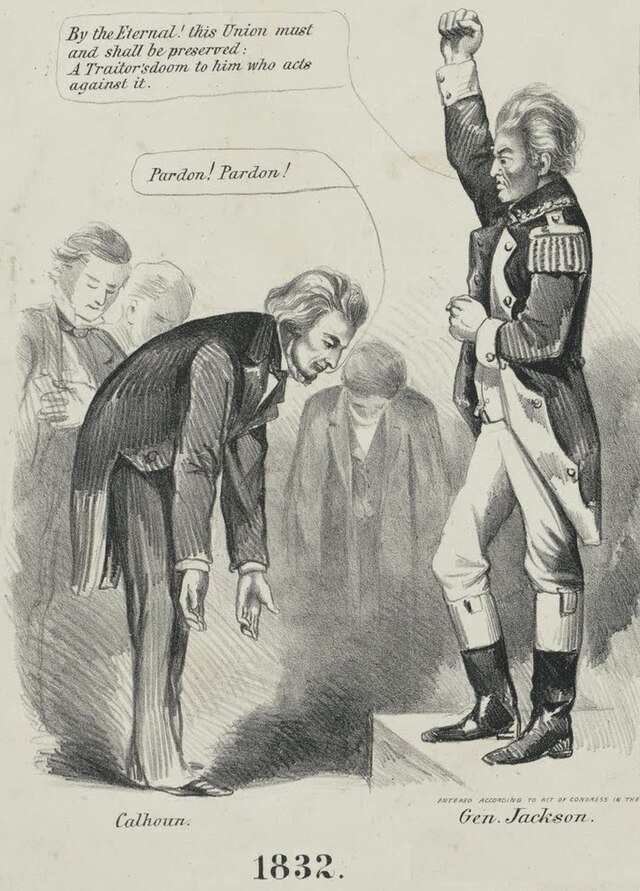
The Nullification Crisis casts a long shadow. While it’s not traditionally categorized as one of the major events that primed the powder keg of secession and civil war in the 1850s, it is inextricably tied to them all the same. South Carolina’s aborted effort to “nullify,” or declare unconstitutional and thus void, a new Federal tariff in 1832 has naturally led to a whole host of connections being drawn to the events that would also begin with South Carolina three decades later. Some of those connections have always been red herrings, if not bad faith; no, the Civil War was not fought over tariffs (and indeed, the South’s resistance to tariffs was directly tied to their commitment to slavery and the cash crop agriculture it supported—such an economy relies on cheap imports in place of domestic goods and manufactures). Others, though, are more solid, and lead down intriguing avenues if pursued. The theory propounded by such politicians as John C. Calhoun, that states had the power to ignore select Federal laws at will, sounds eerily similar to the theories of state sovereignty that animated secession in 1860. Those inclined to view the United States Constitution as a compact between equal, sovereign states believed (and still believe) that those states could then unilaterally withdraw from that compact at any time. As I explored in my first installment of this series, such a view is fundamentally flawed due to none of the original thirteen states actually being sovereign at the time of the Constitution’s adoption, not to mention the fact that their previous union under the Articles of Confederation was explicitly indivisible. While in 1832 South Carolina was not claiming it had the right to secede, it was claiming that it had the sovereignty and power under the Constitution to contend a specific law. Indeed, this emphasis on a contemporary understanding of the federal structure of the United States under its Constitution would fuel its own justification for secession that worked in concert with the idea of pre-Union state sovereignty: that the Federal government is little more than an organization of the states, and is not a government that acts directly upon the people of the nation.
To modern audiences, this statement may very well seem the height of absurdity. The Federal government of the 21st century acts directly upon us citizens in a whole host of ways, from taxing our income to regulating industry to supporting education to even, for a time, conscripting us into the military. Yet this massive size of government and its agencies is mostly a creation of the 20th century, and especially the New Deal and subsequent rise of America as a world superpower after our victory in the Second World War. During the 19th century, the Federal government was miniscule, and the Constitution’s provision that any power not expressly given to it was reserved to the states meant that state governments did indeed wield more power and intervene more often in individuals’ lives than the Federal government. That is not to, say, however, that citizens did not have any interaction with it. Such a claim ignores the obvious fact that the House of Representatives was always directly elected by the people of each state, and while their Senators were appointed by state legislature and the President was officially chosen by the Electoral College, the decisions of these bodies were in large part directly influenced by citizens’ votes as well. Aside from all this, and directly relevant to the specific claims aired during the Nullification Crisis, was that the Federal government holds the sole power of regulating both foreign and interstate commerce, which of course would directly affect the business of any private citizen engaging in either. The claims of Calhoun and his ilk that South Carolina could choose to abrogate specifically this new tariff, then, were absolutely, laughably, false.
But if we set aside tariffs for a second, what of the general principle of nullification? If the Federal government were to pass a law that governed a realm it did not have explicit authority over, could a state nullify it? While the Constitution is silent about this particular eventuality, it does make clear that if a Federal law conflicts with a state law, it is the Federal law that takes precedence, as the Federal government is the “supreme law of the land.” The Constitution also provides an implicit method for resolving these kinds of disputes through the creation of the Supreme Court; it stands to reason that a suit in the Federal court system would be the manner of addressing the issue rather than a unilateral declaration of noncompliance. To summarily declare oneself immune to a law, whether a single statute or the entire Constitution, is the very essence of rebellion; in the words of Abraham Lincoln himself during his First Inaugural Address, “No government proper ever had a provision in its organic law for its own termination.” Rebellions are thus inherently never legal—though that does not necessarily mean that they are never just. In order to determine that, one must examine the causes and inciting incidents of any particular insurrection, and that is where our path must lead us in my third and final installment.
Stay tuned…