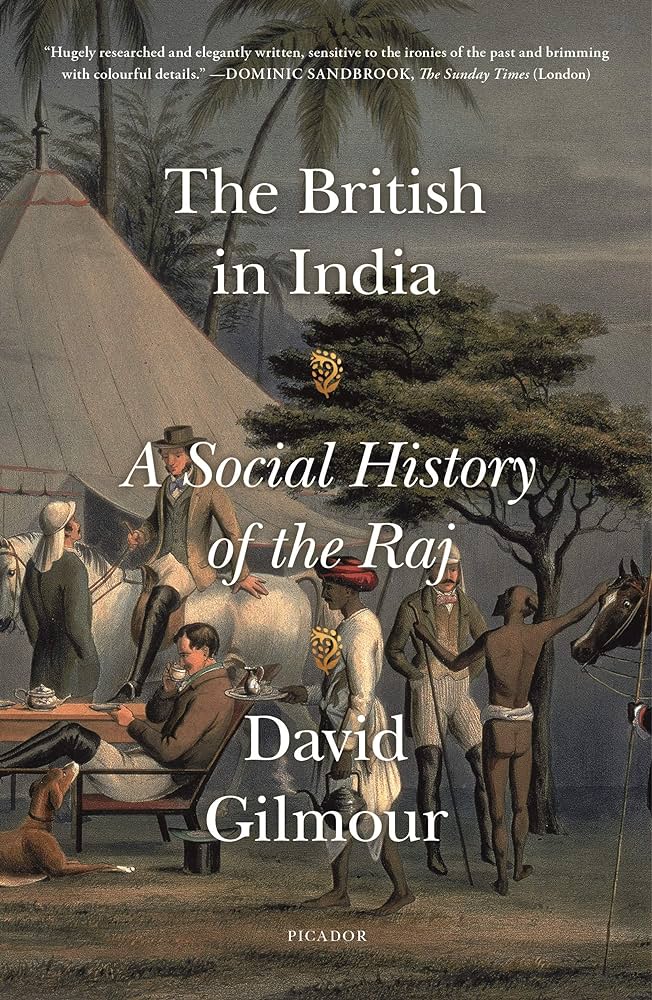
Gilmour, David. The British in India: A Social History of the Raj. New York: Picador, 2018.
For almost two centuries, the British ruled the largest empire the world has ever seen–in terms of both geography and population–and no possession was more central to that imperium than India. Yet the number of Europeans ever on the subcontinent at any one time was incredibly, even laughably, small. What did life look like for these white islands in a sea of colonized peoples? Why were they in India, what roles did they fulfill, how did they prepare for their new lives, how did they enjoy themselves so far from home, and how did they process their experiences? All these questions and more are the subject of David Gilmour’s comprehensive social history of British rule in South Asia, The British in India.
While its title sounds like a comprehensive geopolitical history of the rule of the East India Company and its successor Raj, The British in India is meant to be taken quite a bit more literally. From company directors and viceroys to merchants to common soldiers and the wives and children that accompanied all of them, Gilmour painstakingly reconstructs the lived experience of imperialism on the ground for all the varied facets of this ruling minority. As one who has primarily studied the big picture of the British Empire, both political and economic, for the last decade, this painting of all the slices of life that Europeans led in India was fascinating, and lent much-needed color and context to nearly every level of how I conceive of the Raj. Gilmour’s prose is wonderfully descriptive, as well, and, along with his liberal use of primary sources, brings home such visceral experiences as the oppressive, sticky heat of South Asian summers or the melancholy life of officials who lived apart from their wives and children for decades.
The British in India is not without its flaws, however, though they can be found more in the absence of certain perspectives and the accompanying implications for how Gilmour’s history comes across over all. First and foremost, as a social history, The British in India almost requires a prior familiarity with the geopolitical history of the British Empire to fully understand all that’s going on. Major events like the Battle of Plassey, the Indian Rebellion, the World Wars, and Independence/Partition loom large over Gilmour’s subjects, yet are never explained in detail to the reader. This is perhaps unavoidable, but does necessarily turn Gilmour’s work into more of a companion history that fills in the details glossed over in those other works. More serious, however, is the subtle whitewashing The British in India applies to colonization on the subcontinent. The manner in which Gilmour explores his subjects’ lives only brings South Asian peoples into the narrative when they directly intersect with Europeans’–usually as lovers, servants, or governed masses illustrating the duties of various posts. Moreover, while the motivations and mindsets of Europeans are explored in detail, they are not examined with a critical eye as to whether they truly were as goodhearted in practice as they sound or how often the duties and responsibilities of a certain position were in fact observed. The resulting effect is one that tends to cast British rule in a much more benevolent light than is accurate.
Both of these weaknesses, however, can be adequately addressed by further reading on the British Empire, and if that is readily on hand, then The British in India is an excellent addition to any library that complements the gaps of many other works. I am always a fan of any well-written history that helps me better understand the day-to-day ambience of any period or place, and Gilmour’s work is a shining example of such a volume.