In the seventh installment of his series unpacking Supreme Court Cases that reveal complex or unsavory truths about our country and how the legal interpretation of its founding principles have evolved throughout the centuries and the first in a duology focusing on the draft, Bryan explores the Selective Service Cases of 1918 and why certain seemingly-logical arguments that military conscription is unconstitutional have never been given much weight in our courts.
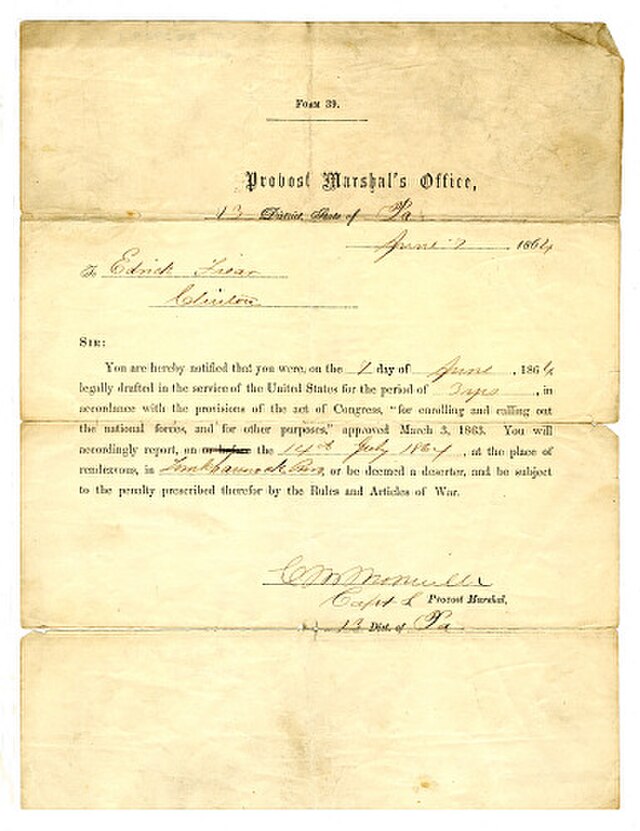
One of the most controversial legal measures in American history has been the draft. From its first introduction during the American Civil War to its return during the World Wars and its permanent fixture during the Cold War and subsequent decades, conscription (also known as the euphemistic “Selective Service”) has not always been present or taken the same form, but its enactment has always brought with it fierce resistance from some corners of society. Until now, however, that resistance has never been successful in challenging the legal basis of the draft itself, even though such cases have reached the Supreme Court multiple times. The most famous of these, the 1918 Arver v. United States, has become known as the Selective Draft Law Cases, and resulted in the justices not only upholding the constitutionality of the draft but rejecting certain arguments against it out of hand. How can that be? And is there really no grounds to argue that selective service is a breach of Constitutionally guaranteed rights?
In a country founded on ideals of freedom and personal liberty like the United States, it’s no surprise that measures to conscript citizens into the armed forces have raised alarm bells from their inception. Ironically, though, its first legal challenges were of a procedural nature. The first draft in United States history, instituted in 1863 during the American Civil War as the flow of volunteers for the Union army began to dry up, essentially took the pre-existing, Constitutionally-acknowledged system of state militias and federalized them, cutting out the middle man and calling citizens directly into Federal service. Before this, it had been understood that Congress’s power to raise and maintain Federal armed forces could only be done on a volunteer basis—though state militias could be called up as their own entities and placed under the command of Federal officers, as occurred during the War of 1812. Republican efforts in 1863, then, launched a wave of backlash from those who believed the Constitution demanded the existence of state militias, which would cease to exist if the Federal government drained them of their manpower in this way. Roger B. Taney even wrote a draft opinion to that effect in preparation for any case that might make it to the Court. Some individual efforts did occur, as well, often through the novel tactic of issuing writs of habeas corpus in state courts to compel authorities to give up “imprisoned” young men that had been called into service. Those courts were largely unsympathetic, however. This first phase of conscription, then, survived mostly intact until the end of the war in 1865, when it was no longer necessary and thus allowed to lapse.
Fifty years later, circumstances would require the draft once again, this time under very different circumstances. Those intervening decades had seen the death of the old militia system and the rise of the modern National Guard, organizations formally intended to serve as an auxiliary feeding system for the Federal army, rendering arguments about the sanctity of state militias irrelevant. The scope of conflict had also changed; the armies fighting the Great War numbered not in the tens or hundreds of thousands but in the millions, and as America entered the conflict in 1917, it would need to resort to conscription again to fill the ranks on a suitable scale. Now, though, opponents of the draft had a potent new weapon in their arsenal, or so they thought: the 13th Amendment to the Constitution, which declared that “neither slavery nor involuntary servitude. . .shall exist within the United States.” Surely being drafted into the military against one’s will qualified as involuntary servitude? Such was the argument Charles Schenck and his fellow socialists made in the flyers that resulted in his own famous Supreme Court Case, and such was one of the arguments made in Arver v. United States. And yet, the Court ruled unanimously in support of the Selective Service Law of 1917. Not only that, but in Chief Justice Edward White’s opinion he stated that these arguments were “so devoid of foundation that it leaves not even a shadow of a ground upon which to base the conclusion.”
This is categorically untrue (though to be fair, I wouldn’t expect a former Confederate soldier like White to be on the correct side of discussions about rights); conscription into the military absolutely qualifies as involuntary servitude, perhaps even more than many realize. The involuntary element is, of course, self-explanatory. The key here is “servitude,” which is different than service. Servitude’s formal definition, per Meriam-Webster, is “a condition in which one lacks liberty especially to determine one’s course of action or way of life.” As Stephen Neff illuminates in his legal history of the Civil War Justice in Blue and Gray, individuals in the military are subject to a fundamentally different set of laws than civilians. While serving, soldiers do not have freedom of speech or expression; they are not protected from unreasonable search and seizure or entitled to trials by a jury of their peers; punishments can be disproportionately harsh; and if they attempt to leave the service without permission, they are not only severely punished but, at the time of White’s decision, could be executed. To state that the Constitution of the United States protects the right of the government to, in effect, unilaterally decide that certain citizens are no longer subject to the protections of the 1st, 4th, 5th, 6th, 8th, 13th, and 14th Amendments (at the very least) seems to be a fundamental misunderstanding of the purpose of that document and the very principles upon which our nation was founded.
And yet, there are certain principles that go deeper than the text of our Constitution. One of those, from time nearly immemorial, is the mandatory duty of citizens to defend the state in times of war. This was especially important in colonial and early republican America, as the militia was, in the words of the 2nd Amendment, “necessary to the security of a free State” by defending it from Native Americans, slave uprisings, or the forces of opposing European governments. Membership in the local militia was mandatory, and thus one could argue that the principle of involuntary servitude in defense of the state, when the state calls, is baked into the underlying ethos of our Constitution—as White in fact did, calling it the “supreme and noble duty” of a citizen to “contribut[e] to the defense of the rights and honor of the nation.”
Here, we’ve finally arrived at our answer. If I were to be so bold as to suggest revision to White’s century-old decision, I would suggest that he give full credit to how, under any other circumstances, the nature of military conscription would indeed violate the Constitution, yet the needs of the nation to defend itself are fundamental to any nation regardless of the wording of their founding documents, and so the draft as Congress implements it cannot be anything other than legal.
I must admit, there is an element to this answer that I agree with. I have always propounded the necessity of government to first and foremost practically work in the time in which it finds itself, and if too dear a commitment to individual liberties would result in a nation not being able to raise sufficient force to defend itself, there is a serious problem with how that government has been constituted. That said, I also do not think it’s as unassailable as White evidently did. The circumstances of our revolution and, later, the drafting of our Constitution were based on the idea that no government action should be inherently above reproach just because it is the government that performs it, and there is enough potential abuse with conscription that it shouldn’t be, either. There is a deeper, more explicit conversation to be had here about the nature of military service, the value of personal conscience (that extends beyond protections for pacifist Conscientious Objectors), how our rights can and should be limited when it serves the common good—but also specifically defining when that need becomes important enough to do so.
We also need to have a discussion about those obligations and limits falling equally on all citizens, but that is a blog post for another time…