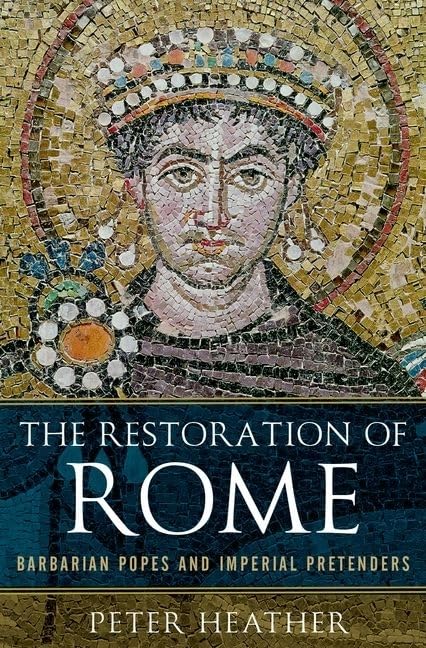
It’s time again for the Concerning History Book Club, where we recreate the experience of the engaging book discussions we’ve had throughout the years in classes and with each other. In this newest installment of our long-running series, Bryan and Francis break down what has quickly become a foundational work for both their understandings of Late Antiquity and the early days of Christian Europe, Peter Heather’s The Restoration of Rome.
BC: I’ve reviewed many of Peter Heather’s works here on Concerning History before, from his account of the “barbarian invasions” of the late Roman world to his reappraisal of the reign of Justinian to his recent history of the first millennium of Christianity. When I read The Restoration of Rome a couple years ago, however, I knew that its subject matter and the questions it raises about Late Antique and early medieval history deserved a much richer discussion than a simple review could provide. Heather frames his history of the years AD 500 to AD 1100 as one of four different attempts to restore the imperium of Rome in Western Europe. The first two—those of Theodoric’s Ostrogoth kingdom in Italy and East Roman Emperor Justinian’s reconquest of North Africa and Italy—might be more accurately categorized as resuscitations or efforts at preservation, while the second two—Charlemagne’s Frankish empire and the rising power of the Papacy—are more akin to reinventions after centuries of Rome’s absence. In all of them, Heather delivers outstanding, even provocative, history.
FB: I couldn’t agree more, Bryan. This is one of those works of history that makes everything you have learned previously make more sense. For instance, explaining how Emperor Justinian developed a new law code or Emperor Leo III initiated the iconoclasm controversy to solidify public perceptions of them as legitimate Roman rulers suddenly provides a contextual impetus for why exactly these rulers took the risks or initiated the reforms they did. Yes, these rulers may have cared about uniform laws and been pious (if not exactly “good”) Christians, but initiating such actions as an act of demonstrating legitimacy places such actions within the larger picture of their ideology and worldview. In essence, I really liked how Heather set up a rubric for how to evaluate a Late Antique Roman Emperor. They needed military victory (especially against the Sasanian Persians), to adhere to a written and rationally-argued law code, to promote the arts, and to act as both the arbiter and great evangelizer of the Christian Faith. Success in these areas demonstrated that God anointed them for their role and failure in these fields could mean a catastrophic loss of legitimacy in the eyes of imperial elites or Roman subjects. The Nika Riots in Constantinople against Justinian suddenly become something much more than an uprising of urban residents upset about bread prices or the loss of a chariot team. Justinian had lost a major war with Persia. His enemies then used the concentrated masses at the Hippodrome as a convenient staging ground for a coup.
BC: And so much of that framework comes from the embrace of a central fact that we who aren’t specialists in Late Antiquity often forget (and honestly, Heather could have even more explicitly discussed): the Roman world after the third century was one that had differed in major ways from the “classical” world of the Republic and early Empire that we all automatically think of when talking about Rome. Its political structure was more authoritarian, of course, as the crisis of the third century was solved in part by the imposition of the Dominate and accompanying Tetrarchy, but that’s far from all. Religion had evolved beyond that traditional Hellenic pantheon, with Eastern deities such as Mithras and Isis playing major roles in Roman worship across the empire and many moving towards a more limited polytheism or even quasi-monotheism under Jupiter or Sol Invictus. Even many of the titles we associate with the medieval world like “count” and “duke” come from imperial offices and roles during this Late Antique era.
Complicating how we approach the Romans themselves then sets up one of Heather’s intellectual coups for me: blowing wide open the question of what even is Roman, exactly. Like so many, I had always accepted the date AD 476 as the fall of the Western Roman Empire and considered the Visigoth and Ostrogoth leaders that ruled from the Eternal City over the following decades as petty barbarian successor kings. The entire history of the empire, though, was always one of cultural assimilation and evolution; the rule of Spaniards Trajan and Hadrian and North African Septimius Severus are just the most famous examples. If Justinian, a man from the Balkans who only spoke Greek, and Belisarius, a Greek general who led Germanic, Gothic, and Hunnic soldiers, are both inarguably considered Roman, why not Theodoric, who used the trappings and language of imperial authority, employed local Italian patricians in his Roman-style administration, held official sanction from Constantinople for a time, and strove to emulate all the conditions of legitimacy Heather laid out for Roman emperors? Years of turning that question over in my head have yielded no convincing answer in the negative, and I now believe Belisarius’ campaigns in Italy in the sixth century may better be described as a Roman civil war against an unruly provincial governor or even rival claimant to the purple a la Constantine the Great.
FB: For me, Heather’s most profound and enlightening material is on the papacy and its implications for Catholic and Christian History. First, Heather makes it abundantly clear that many sects of Christianity weren’t exactly heretical until Roman Emperors definitively proscribed them as unorthodox. That fact illuminates both the role of the Emperor as the de facto leader of the Christian Church (especially pre-Great Schism) and how Christianity existed as heterodox until a combination of earnest theological debate and Roman imperial realpolitik resolved how doctrine ought to be interpreted. Similarly, Heather shows just how contingent the development of the Papacy as both the head of the Church and a new style of Roman emperorship really was. Without lightning striking me down, I think his work clearly demonstrates how successive Bishops of Rome lied, connived, or pragmatically intervened in broader Christian affairs to assert papal dominance. For me, at least, I don’t see a clear continuity between Matthew 16: 17-19 (Peter as Rock of the Church) or John 21 (Jesus telling Peter to ‘feed his sheep’ after the Resurrection) and the primacy of the Bishop of Rome. That doesn’t mean the Pope lacks holiness; it does mean, historically at least, the Papacy slowly accrued power through contingent events that could have gone to any other major bishop in an imperial capital (Milan, Ravenna, Constantinople) or major city (Jerusalem, Antioch, Alexandria). Ironically, both in this context of fabricated legitimacy and that of the contemporary power of Heather’s other case studies, it would actually be this vision of Roman imperium that would be most durable and last until our own time.
BC: I couldn’t agree more. Heather’s approach of acknowledging past scholarship, traditions, and memory before then interrogating them in light of the actual documents we possess, placed inside their proper context and contingency and applying a general sense of practical logic, has impressed me across all of his works and led to revelations great and small. One relatively minor fact in his treatment of Charlemagne that I know resonated with our own educational experience was the process through which court scholars essentially re-invented Latin from whole cloth. The language used in Catholic services for over a millennium, written and copied by monks, and studied by millions—including the two of us—is an artificial construct derived by 8th century churchmen from reverse-engineering what surviving Classical documents they could find in order to “rediscover” a more “authentic,” “pure” version of that essentially Roman language. This is the kind of scholarship that I can’t get enough of, and why Heather is now one of the few historians that I automatically seek out the newest work of as soon as it arrives, regardless of topic.
FB: And so much of that approach relies on his source work, which is outstanding. Both in methodology and in impact, Heather sets up a model for how to interpret primary sources. He readily interrogates who wrote a source, where historians contend it comes from, and how its content relates to broader revelations from archaeological and historical interrogation. Restoration of Rome doesn’t have a copious amount of primary source material in it compared to a monograph on modern historical topics, for instance. But, man, does Heather squeeze them for every ounce of insight they can provide. The way he deconstructed what appears to be a banal diplomatic message from Theodoric to Constantinople as a brazen claim to co-equal legitimacy in the opening of his book is just awesome to read. I actually laughed a few times in the way he delivered his information, too. While some historians may fault Heather for relying on idioms or contemporary analogies to make his point, I found them to be helpful asides and analogies that clarified rather than obfuscated his point. All in all, I couldn’t recommend this book highly enough for anyone interested in Late Antique and early medieval history who has a decent understanding of the timeline but wants to know what was really happening as the late Roman Empire metamorphosed into the Roman Church.