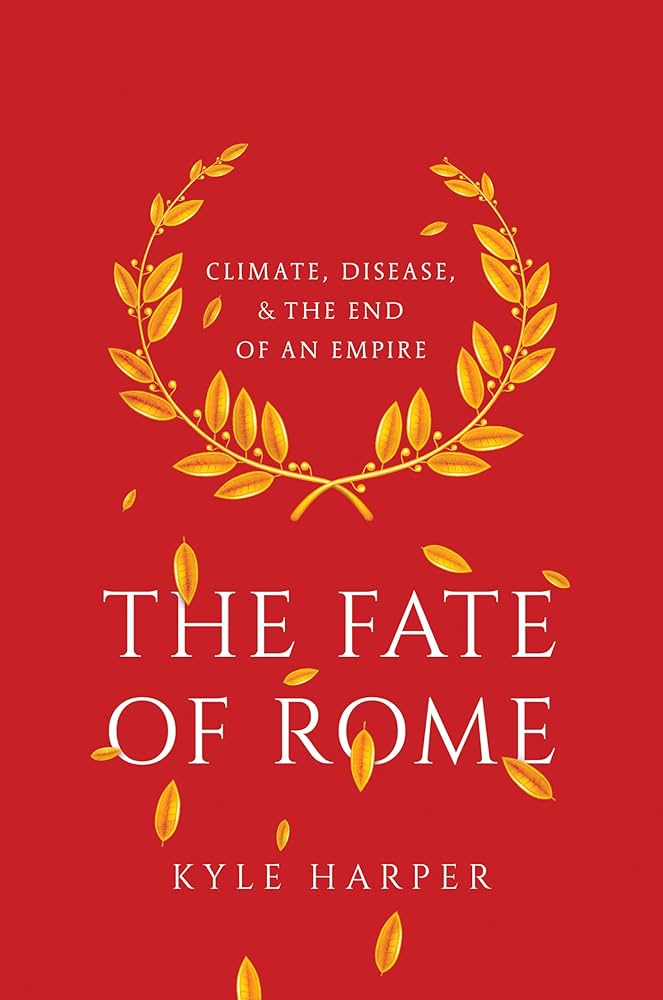
Harper, Kyle. The Fate of Rome: Climate, Disease, & the End of an Empire. Princeton: Princeton University Press, 2017.
Years ago, I read a fascinating article in The Atlantic about the role of epidemic disease in the history of the Roman Empire. My courses on warfare in the ancient world from undergrad had taught me that while Rome might have had a slight edge in tactics and technology, her real advantage over her contemporaries was the organization of its society and consequent ability to tap seemingly-inexhaustible reservoirs of manpower—destroy one, two, even three Roman armies and others would simply be raised to take their place. If the outbreaks of antiquity, particularly the Antonine plague of the late second century AD, were as widespread and debilitating as some sources suggest, then this advantage may have quickly disappeared just as Rome faced renewed opposition from organized peers like the resurgent Sassanid Persian Empire and provides context for the extension of citizenship—and thus tax burden and military service—to all inhabitants of the Empire by Caracalla in the early third century. I’ve since been on the lookout for a monograph that could explore the topic more in depth, but hadn’t had any luck…until now.
The Fate of Rome in fact goes beyond what I had originally been searching for, examining how climate change and particularly the end of the Roman Warm Period affected ancient agrarian economies alongside creating the conditions for new disease ecologies that spread throughout the Roman world in successive waves across three centuries. Harper meticulously demonstrates how the decline in productivity that came along with a cooler, more arid world than the one Rome’s foundation was built on led not only to a less prosperous, less resilient Empire but paved the way for new pathogens like the second-century Antonine Plague (likely smallpox), third-century Plague of Cyprian (some kind of hemorrhagic fever possibly related to Ebola), and sixth-century Plague of Justinian (confirmed to have been bubonic plague through DNA testing of plague burials) that killed millions and fostered the popularization and spread of new faiths like Christianity and Islam that might explain the apocalyptic conditions. Loss of political legitimacy also led to increasingly frequent civil wars and more authoritarian government to make up for it, further accelerating demographic decline. This transformed Rome’s strategic situation, depriving it of the ability to achieve situational supremacy and forcing it to adopt a system wherein breaches of the frontiers could not be prevented, only responded to after the fact. One last round of climate change drove the Huns west from their steppe homeland, pushing other peoples before them and overwhelming the Western Empire and finally culminated in the Little Ice Age that yanked the rug out from under Justinian’s efforts at revanchism in North Africa and Italy a century later. It is hard to imagine a more groundbreaking re-framing of Roman—indeed all of Western—history.
Yet as eye-opening and well-argued as Harper’s narrative was, I couldn’t be totally satisfied with his new approach. As much as previous histories did not include ecological factors in the course of Rome’s rise and fall, The Fall of Rome similarly excludes much of the political history that operated within these larger trends. I’ve often written on how I reject the idea of inevitability in history, and Harper seems to largely ignore human agency and the many individual human choices that either temporarily stemmed the tide or made a bad situation worse. It’s now clear that climate change and diseases provide compelling context and causality to certain events or trends in Roman history, yet I cannot agree that they are the entire answer in and of themselves, with humans powerless to change their fates. Instead, Harper’s work has shown that these factors steadily stripped away the Empire’s reserves of energy, both plant and human, and narrowed the margin of error so that rulers could make no mistakes in preserving their imperium. One brash war or ill-considered settlement, let alone the destruction of an entire field army and death of the Emperor in battle, could easily tip the scales towards irrecoverable decline.
While The Fall of Rome has not quite become my new standard text on Late Antiquity, then, neither is it in any way dispensable. When combined with a perceptive political history like those written by Peter Heather (reviewed here and here on Concerning History), Harper provides an unparalleled understanding of how the ancient world came crashing down. As more and more historical climate data becomes available, I can only hope this trend of ecologically-focused history continues to restore those puzzle pieces we may not even have realized were missing in our perception of the past.